Author: Paul Wallbank

  • Confessions of a corporate axe man

    Confessions of a corporate axe man

    What does the future of work really look like? Management consultant Rob Gaunt has some bad new for those looking forward to a future of leisure.

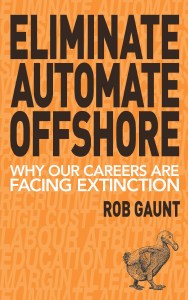
    In his book Eliminate, Automate, Offshore; Gaunt looks at how the modern workplace is changing and the priorities of managements and boards in a competitive, globalised world.

    Gaunt, who describes himself as a ‘corporate axe man’ warns the reader “you may not approve or like what I do, but that doesn’t mean it isn’t going to happen.”

    To start the book, Gaunt gives a potted history of automation in the workforce and how processes can be improved by better management and new technology. He cites his local council garbage collection service which not so long ago would have required eight or nine workers per truck now only needing two.

    This trend is coming to the rest of the workforce, Gaunt warns, adding that many of those jobs that can’t be automated can be outsourced.

    “When I walk into an open plan office, I look and listen to the activity; if the overwhelming noise is of keyboard strokes rather than human voices, it’s a good clue that much of the functions being performed aren’t location dependent.”

    Gaunt goes on to describe how effective outsourcing works with an emphasis on the client having to document their processes before shifting functions or departments to outside contractors as well as the importance of properly scoping and understanding an agreement.

    Towards the end of the book, Gaunt examines what roles are likely to survive in higher cost economies along with the skills today’s children are going to need if they are going to avoid being ‘digital roadkill’ in an automated society.

    Overall the book is a good read to understand the direction of today’s workforce and the factors driving it. It isn’t a pretty tale.

    If anything; Eliminate, Automate, Offshore may be somewhat optimistic about the effects on the skilled trades, professional and managerial sectors as Gaunt probably underestimates how robotics and artificial intelligence are advancing.

    Should you read the book, you may want to give your kids – and their teachers – a good talking too. The axe man is ruthless and he’s coming for many of our jobs.

    Similar posts:

  • How the movies beat disruption

    How the movies beat disruption

    With the movie industry’s Academy Awards taking place last night, albeit not without mishaps, it’s worth reflecting on how Hollywood has defended itself against a range of disruptions over the last century.

    From when the first movie was shown by the Lumiere brothers in Paris just after Christmas 1895, cinema has been both a disruptive force and one that’s been subject to its own challenges.

    The immediate effect of the new technology was an explosion of new businesses, trades and techniques not dissimilar to the first dot com boom of the early days of the web as the traditional theatre industry was displaced by movie theatres.

    As the  technology evolved, the movie industry itself was subject to disruption as sound was developed – ending the careers of many silent film stars – followed by colour both of which allowed new techniques and markets to developed.

    Then came television and, it would have seemed, the end of the movie industry. Although that didn’t happen and it’s instructive how the industry reacted to the challenge.

    In a 2007 paper, academics Barak Orbach and Liran Einav showed the movie industry’s evolution starting just after the introduction of talkies in 1927.

    The shift to sound drove the movie industry to its all time heights prior to the Great Depression, however the economic downturn hit the film business hard – something to consider when people talk about the ‘lipstick effect’ -however steady growth returned through the 1930s and until the end of World War II.

    Following the war, economic change and the arrival of television were tough for the movie business as attendances fell dramatically until stabilising in the late 1960s. Interestingly, the price of movie tickets went up dramatically shortly before the decline tapered off.

    The graph finishes at 2002, at the end of the first internet boom and it’s notable the early days of the web, or the rise of Pay-TV in the 1970s and the Video Cassette Recorder in the 1980s had little effect on the industry’s attendance figures.

    Despite those new technologies, the movie industry managed to attract audiences despite the plethora of entertainment options on offer at home.

    Much of this was due to technological change with advances in computer generated graphics and recording techniques giving film makers far more creative scope while the roll out of multiplex cinema complexes allowed patrons far greater choice in movies.

    Fifteen years later the effects of technology are still telling. In 2002, the average American was buying five movie tickets a year, according to the 2016 Motion Picture Association of America’s annual report this had fallen to 3.8, no doubt partly due to the success of Netflix.

    However the film industry has still remained lucrative, partly through developing alternative streams of income like product licensing and international sales – China is by far the US industry’s biggest market and non-North American sales are growing by 21%. At the consumer level, movie houses increasingly make their money from concession sales and add-ons like premium seating.

    So the answers to the movie industry’s success in staying profitable in the face of disruptive technologies seems to be in adopting new tech, diversifying income streams and globalising their product – although a bit of legislative protection in extending copyright probably helps.

    The lessons though from a century of disruption though are clear, how well the movie industry responds to continuing disruption from the likes of streaming services like Amazon Prime, Netflix and their Chinese equivalents remains to be seen.

    Similar posts:

    • No Related Posts
  • Rethinking startup rules

    Rethinking startup rules

    What are some of the barriers to increasing diversity in the startup community’s monoculture? Yesterday we had an insight into some of the changes needed at the Women in VC forum held in Sydney.

    Samantha Wong, partner at early stage startup accelerator Startmate and Head of operations at Blackbird Ventures, described how Startmate identified some of those barriers among the 51 companies that went through the program and the steps to overcome them.

    What Samantha and her team found illustrate how the Silicon Valley model of founding and funding businesses inadvertently creates obstacles for women, older workers, disadvantaged groups and poorer people.

    Insisting on Solo Founders

    “Previously we had a rule that you couldn’t be a solo-founder. It’s too much work to do it by yourself,” she explained.

    There’s good reason for that belief as building any business on your own is hard, regardless of whether it’s a tech startup or a dog walking franchise.

    It’s understandable that investors are reluctant to get involved with a ‘one person show’, although a lack of capital is going to make life extraordinarily harder for a sole founder or proprietor.

    The myth of the tech co-founder

    “You had to have at least one technical co-founder in the team.” Samantha explained, “the reasons for this rule were historical.”

    This belief goes back to the origins of the Silicon Valley business model where companies like Apple, Hewlett-Packard, Microsoft and even Google were founded by ‘two men in a shed’ where one was the marketing or sales whiz and the other delivered the product.

    Interestingly many of the recent successes like Facebook, Uber and AirBnB haven’t had that dynamic, probably because the technology industries have matured to a point where developer and product managers are established trades or professions are easily available as well as cloud based tools making technology itself more accessible.

    So a ‘tech co-founder’ will almost certainly be useful but isn’t essential to get a business off the ground in today’s tech environment.

    Being in attendance

    “We had a blanket rule of requiring participants to be in Sydney for the full duration of the program,” says Samantha. “The reason for this we know from experience that ninety percent of the program’s value comes from that sharing which happens between founders, the support and the friendly competitive pressure you get from them. It brings the best out of you.”

    Startmate changed its policy so only one of the co-founders needs to be in Sydney. While it doesn’t solve the problem of solo founders with family obligations that don’t want to move, it does make it easier for those with dependents to participate.

    Dropping the blanket rules

    Over the six years Startmate has been running, they’ve seen a change in the nature of startups joining the program. “When the program started in 2011 we gave a small amount of money to a couple of people to build a product and start attracting customers,” Samantha said.

    “By 2016 we were attracting much later companies that already had revenue and the program’s focus became growth and fund raising.”

    “So instead of blanket rules we started to ask ‘what does this company need to grow in the next three to six months?’ Do they enough resources right now? Is the product good enough to sell? If you can get good answers to those then it’s worth considering them joining.”

    The lessons from Startmate in increasing diversity among their intake are instructive and it indicates the limits of the Silicon Valley model that favours young, middle class men over other groups.

    For the tech industry, that focus on one group is a great weakness and means investors are missing a world of opportunities. Ditching existing biases and established wisdom could be a very profitable move from everyone.

    Similar posts:

  • Bringing the IoT to Australia’s far north

    Bringing the IoT to Australia’s far north

    In the tropical north of Australia, one university is looking at using the Internet of Things to expand the reach of its research and open new opportunities for the local economy.

    On Monday James Cook University opened Australia’s first university IoT lab in Australia.

    Based at the Cairns campus in Far North Queensland, the lab is part of the university’s new Internet of Things engineering degree and is supported by Chinese telco vendor Huawei.

    The university, which also has campuses in Townsville and Singapore, boasts expertise in areas such as marine sciences, tropical ecology and tropical medicine, all of which are relevant to the IoT and made more relevant by Cairns being the main service centre for much of Australia’s remote Top End and the Torres Strait.

    Part of a central mission

    “The Internet of Things is based on something that is central to our mission in the Tropics: building greater connectivity between people, place and technology,” said the university’s Vice Chancellor Professor Sandra Harding.

    JCU’s IoT degree, the first of its kind in Australia, combines the study of electronic engineering with internet technologies, wireless communications, sensor device, industrial design and cloud computing.

    Currently the IoT faculty has 57 first year students, which the university hopes to grow to over 200. The head of the IoT faculty, Professor Wei Xiang, explained why the university decided to offer this course.

    Economic drivers

    “Primarily it’s driven by the economy, Australia is transitioning from a mining boom to a knowledge and innovation driven economy. So in the middle of 2015, JCU decided to offer an engineering degree in Cairns.”

    “The IoT places nicely into traditional strengths at JCU in fields like marine science, marine biology and remote medicine, for example we can use the IoT for reef condition monitoring and our Daintree Rainforest project.”

    An electronics Engineer himself, Professor Xiang sees the IoT as the future of industry and leapt at the chance to lead a course when the opportunity arose.

    “In the middle of 2015 I thought, ‘this is what I want to do as this is where the future is.’”

    Smartcity opportunities

    Along with the remote health, marine science and agricultural aspects the City of Cairns itself offers smartcity opportunities. As a moderate sized town of 142,000 relatively isolated from the rest of Australia, Cairns has large tourist traffic coupled with weather extremes – the city gets nearly two meters (80 inches) of rain every summer. Making it a good test bed for new city technologies.

    “Cairns Regional Council is very interested in smartcities, I’ve been working very closely with the city council and its innovation team,” says Professor Xiang. “We are also rolling out our smart campus.”

    Part of the smart campus initiative is the university installing a NarrowBand-IoT base station provided by its program supporter, Chinese telecoms giant Huawei.

    Huawei’s NB-IoT base station

    Along with supporting the IoT lab, Huawei also plans to offer JCU IoT students the opportunity to travel to Huawei’s global headquarters in China and its Australian headquarters in Sydney as part of its Seeds for the Future program.

    “It gives our students and staff an experimental platform that conforms to the latest IoT international standard,” Professor Xiang said. “It means that as we design devices and sensor networks we can test and configure them using that standard.”

    The university’s Vice Chancellor, Sandra Harding shares Professor Xiang’s enthusiasm. “From designing smarter cities, to growing precision agricultural systems, monitoring natural environments in real-time, and creating clever health solutions that work in remote communities,” she says. “We don’t want to be just a part of that future, we want to lead it.”

    Paul travelled to James Cook University’s Cairns campus as a guest of Huawei.

    Similar posts:

    • No Related Posts
  • Meeting the future head on

    Meeting the future head on

    What can businesses do to prepare for an exciting but challenging future?

    As part of the New South Wales Government’s Back to Business Week, I’ll be on the Meet the Future Head-On panel looking at the future of business and work.

    Facilitated by Jo Kelly, Director of People, Place and Partnership, the seminar will look at local and global business changes and what they mean for small to medium companies.

    The keynote speakers are Terry Rawnsley – Principal & Partner of SGS Economics and Planning – who’ll discuss his company’s analysis of the economy in the year 2026, and Karen Borg – the Chief Executive Officer of Jobs for NSW – with an overview of the state’s Jobs for the Future report.

    Joining me on the panel will be Paul Fairhead, the Managing Director of Huddle; Jost Stollmann, the Executive Director of Tyro Payments and Marianne McGee, the owner of Allis Technology.

    Tickets for the 6pm event on March 1 at the Sydney International Convention Centre are free and can be booked through Eventbrite.

    Come along and have your say. Look forward to seeing you there.

    Similar posts: