Author: Paul Wallbank

  • Discussing Cryptolocker and Internet of Things security on ABC Radio

    Discussing Cryptolocker and Internet of Things security on ABC Radio

    If you missed the program, you can listen to the segments through Soundcloud.

    Tuesday morning with Linda Mottram on ABC 702 I’ll be discussing Cryptolocker ransomware, the security of the Internet of Machines and the tech industry’s call for less internet surveillance.

    It’s only a short spot from 10.15am and I’m not sure we’ll have time for callers, but one of the big takeaways I’ll have for listeners is the importance of securing your systems against malware, there’s also some security ideas for business users as well.

    We’ll probably get to mention the ACCC’s warnings on smartphone apps and the current TIFF bug in Windows as well.

    If you’re in the Sydney area, we’ll be live on 702 from 10.15, otherwise you can stream it through the internet.

    Similar posts:

    • No Related Posts
  • Facebook’s advertising struggle

    Facebook’s advertising struggle

    Facebook is further restricting the reach of brands on their social media platform reports industry news site Ad Age.

    It’s not surprising that Facebook is doing this seeing their stock is currently trading at 120 times current earnings and sixty times estimated revenue. The income has to come from somewhere to justify those prices.

    The social media service is quite blunt about it’s objectives in making brands pay more to get their message out on Facebook as Ad Age reports;

    “We expect organic distribution of an individual page’s posts to gradually decline over time as we continually work to make sure people have a meaningful experience on the site.”

    Facebook’s idea of a meaningful experience though might be very different from its users, who are showing their irritation with the service messing around with their news feed. It remains to be seen just how interested those posting on the site are in clicking on sponsored or promoted posts as opposed to finding updates from those they care about.

    For smaller businesses, Facebook’s moves make it harder to use the service as an effective marketing or engagement platform as it means stumping up substantial amounts of money to get your messages in front of your customers and friends.

    It’s going to be interesting to see how this pans out for Facebook and the social media marketing community. It may mean that social advertising is monopolised by big brands while small and local business finds other channels to get their message out.

    One thing is for sure though, the idea that social media would replace the news media is beginning to look shaky as people’s feeds start to be dominated by messages they don’t want.

    The next few years promise to be interesting for everyone in the social media industry, particularly Facebook’s shareholders and advertisers.

    For smaller businesses, it’s clear that Facebook is no longer a cheap marketing platform.

    Similar posts:

    • No Related Posts
  • Commoditising cafe Wi-Fi

    Commoditising cafe Wi-Fi

    Over the past decade the idea of offering Wi-Fi internet connections to customers has become standard in the hospitality industry, today it’s pretty well a commodity.

    Not so long ago it was difficult to find a cafe that offered Wi-Fi and many of those that did either charged for it or were part of a provider’s networks that you had to be a member of.

    Today, Wi-Fi has become pretty standard in cafes and places like airport terminals although interestingly the hotel industry has been slow to adopt it.

    In the hotel industry a perverse rule of thumb seems to apply that the more expensive the property is, the pricier internet access will be as backpackers hostels invariable have free Wi-Fi while six star hotels charge anything up toe $30 a day for a connection.

    While the hotel industry still has to be dragged into the 21st Century on this front, cafes seem to have reached a point where having Wi-Fi is no longer a commercial advantage but not having free internet is now a distinct disadvantage.

    This was the point made by Nicholas Carr in his 2003 essay IT Doesn’t Matter where he suggested that computers, and other ‘infrastructural technologies’, don’t offer a competitive advantage once they are widely adopted.

    For a brief period, as they are being built into the infrastructure of commerce, these “infrastructural technologies,” as I call them, open opportunities for forward-looking companies to gain strong competitive advantages. But as their availability increases and their cost decreases – as they become ubiquitous – they become commodity inputs. From a strategic standpoint, they become invisible; they no longer matter.

    Carr’s proposition also implies that businesses who don’t adopt these technologies once they’ve become widespread risk being irrelevant and marginalised.

    For cafes, this means that customers will be ignoring them unless they do offer Wi-Fi and it will be another cost of doing business for the proprietors of coffee shops.

    Which begs the question of how do cafes differentiate themselves.

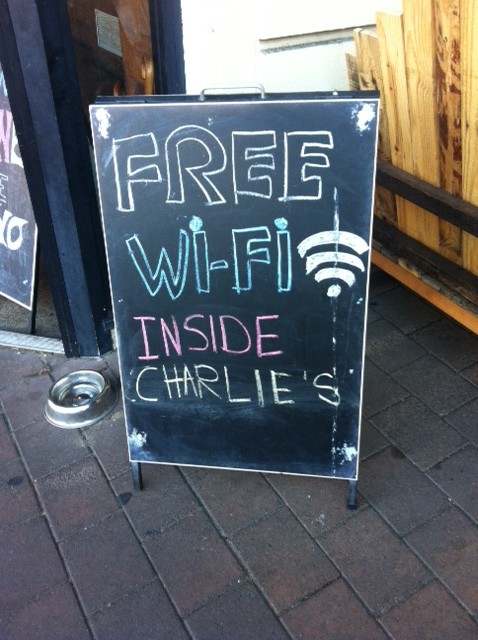
    Perhaps the answer lies in the dog bowl shown in the photo, making a venue pet, or child, friendly may be one way to attract customers.

    One thing’s for sure, just having good coffee and tea might not be enough to cut it in the future.

    Similar posts:

  • Microsoft and the zero day Tiff

    Microsoft and the zero day Tiff

    One of the most dangerous things in computer malware is the Zero Day Exploit where an error in a program is used by the bad guys before it can the hole in software can be fixed.

    A particularly irritating zero day exploit is the TIFF bug in Windows systems where users using Microsoft products can be fooled into opening what appears to be an image file but what turns out to be something more malicious.

    Even more irritating with this bug is that Microsoft aren’t going to fix the problem in Windows XP systems until January’s patch Tuesday which means many people will be susceptible to this problem for nearly two months.

    Zero day exploits are a good reason why every computer user needs to have an up to date virus checker and to take basic precautions before surfing the web or downloading email.

    For Windows users it might be worthwhile taking extra care with email attachments for the next few weeks.

    Similar posts:

    • No Related Posts
  • Potentially unwanted applications – what are we are installing on our smartphones?

    Potentially unwanted applications – what are we are installing on our smartphones?

    One of the notable things about the technology industries is there are always new terms and concepts to discover.

    During a visit to Sophos’ Oxford headquarters last month, the phrase ‘Potentially Unwanted Applications’ – or PUAs – raised its head.

    PUAs come from the problem application developers have in making money out of apps or websites. The culture of free or cheap is so ingrained online that it’s extremely hard to make a living out of writing software.

    As result, developers and their employers are engaging in some cunning tricks to get customers to download their apps and then to monetize them, particularly in the Android world which lacks the tight control Apple exercises over the iOS App Store.

    “What’s interesting about Android,” says Sophos Labs’ Vice President President Simon Reed, “is it’s attracting aggressive commercialisation.”

    The fascinating thing Reed finds about this ‘aggressive commercialisation’ is where the distinction lies between malware and monetisation and when does an app or developer cross that line.

    Reed’s colleagues Vanja Svajcer & Sean McDonald explore where that line lies in a paper titled Classifying PUAs in the Mobile Environment which they submitted to the Virus Bulletin Conference last October.

    In that paper Svajcer and McDonald discuss how these applications have developed, the motivations behind them and the challenge for anti virus companies like Sophos and Kaspersky in categorising and dealing with them.

    The authors also flag that while the bulk of the revenue generated by these apps comes from advertising, there are serious privacy risks for users as developers try to monetize the data many of these packages scrape from the phones they’re installed on.

    Svajcer and McDonald do note though that potentially unwanted applications aren’t really anything new, we could well classify many of the drive by downloads that plagued Windows 98 users at the beginning of the century as being PUAs.

    What we do need to keep in mind though that what is driving the development of PUAs is users’ reluctance to pay for apps and that it’s going to take a big change in customer attitudes for this problem to go away.

    For businesses, this is something managers are going to have to consider as they move their line of business applications onto mobile devices, as Marc Benioff proposed at the recent Dreamforce conference.

    Sophos’ Simon Reed believes potentially unwanted apps won’t be such a problem in the workplace however. “Consumers may have a different tolerance towards PUAs than commercial organisations,” he says.

    The prevalence of PUAs on mobile devices does underscore though just how careful organisations have to be with who and what can access their data. It’s another challenge for CIOs.

    Similar posts:
    • No Related Posts