Author: Paul Wallbank

  • Bringing social networking to life

    Bringing social networking to life

    One of the highlights of the 2013 Australian Microsoft TechEd was a startup panel featuring local startups CoOpRating, Project Tripod and Nubis.

    All three startups are interesting projects and Nubis in particular illustrated how various internet and smartphone technologies which are coming together.

    Nubis is an Augmented Reality platform that projects social media onto the viewer of a smartphone’s camera. By pointing the camera at someone, the idea is a user can bring up details about a person.

    “We’re bringing social networking to life,” says founder Uzi Bar-On.

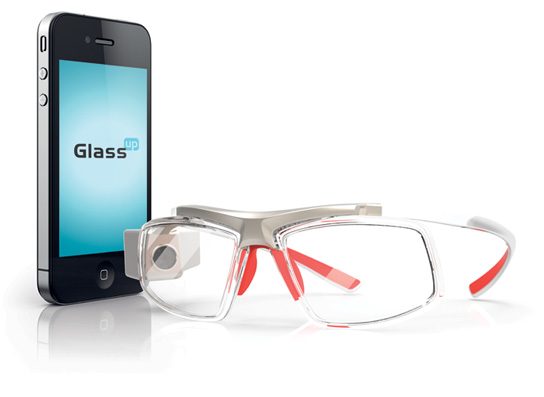
    As part of their Alphega project, Nubis has teamed with Glass Up, an Italian startup attempting to create a Google Glass competitor, the aim is to create a wearable computer that feeds social media information to the wearer.

    While it’s not clear what the benefits will be of that – or whether Glass Up, Nubis or Alphega will be successful – the project is interesting as it brings together Augmented Reality, geolocation, wearable technologies and social media.

    Over the next few years we’ll be seeing more products like Alphega tying together different technologies and using the Internet of Everything to talk to each other.

    It’s these sort of projects that will show us how our businesses and lives are going to change over the next decade as smart people figure out the ways to mash together these technologies.

    Paul travelled to Microsoft TechEd 2013 courtesy of Microsoft Australia

    Similar posts:
  • Kinkabool – the highrise past and future

    Kinkabool – the highrise past and future

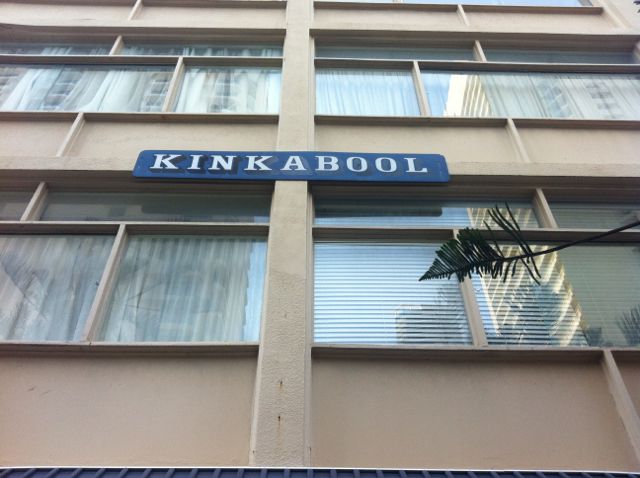
    Today high rise buildings are the norm on Queensland’s Gold Coast, but just over fifty years ago in Surfers Paradise, nine storey Kinkabool was the first of the breed to be built. Its condition today is a warning on how skyscrapers can turn into expensive liabilities for owners.

    ABC Open has an interview with one of the workers on the building and in the accompanying video Bob Nancarrow shows just how Kinkabool dominated the then sleepy seaside resort of Surfers Paradise in 1960.

    kinkabool-overshadowed

    A visit to Kinkabool today reveals a building struggling in the face of poor maintenance and an undercapitalised ownership. Luckily for the owners’ corporation,  the Queensland government pitched in to repair the roof but much of the rest of the complex is showing its age.

    kinkabool-lobby

    The rabbit warren lobby with its orange tiles indicate some of the building was upgraded in the 1970s but apart from a lick of paint, it hasn’t seen much love since.

    kinkabool-lift-lobby

    The lift is are where the building’s age and owners’ lack of investment really shows. An old, slow elevator that hasn’t been upgraded since the first residents moved in clunks its way up the building. Even Hong Kong’s Chunking Mansions – the world’s best example of a dysfunctional high rise – gets its lifts upgraded sometime.

    kinkabool-lift-interior

    Inside the lift, it’s a depressing scene and one wonders if the antiquated equipment would meet today’s building standards. Even if it does meet the regulations, the dispiriting ride on its own would knock a big chunk off the asking prices for buyers or renters.

    kinkabool-lobby-stairwell

    Stepping out of the lift, the view in the stairwell isn’t much better. The lack of maintenance or investment begins to show in old fittings, damaged glass and hints of painted over graffiti.

    kinkabool-stairwell

    While standing on the ninth floor, music from unit 1B drifts through the building – it’s lucky the occupant has a taste in cheesy 1970s music as some thumping headbanger music could to serious damage to the building along with the residents’ sanity.

    One wonders just how noisy the building would be with a party happening or a young, crying baby although it seems families aren’t really interested in these apartments or the central Surfers Paradise location.

    Though a very undistinguished building, it does have one touching little architectural feature in  the different tile patterns on each floor, although probably not enough to redeem it in the eyes of most people.

    kinkabool-tile-featurekinkabool-tile-feature-2

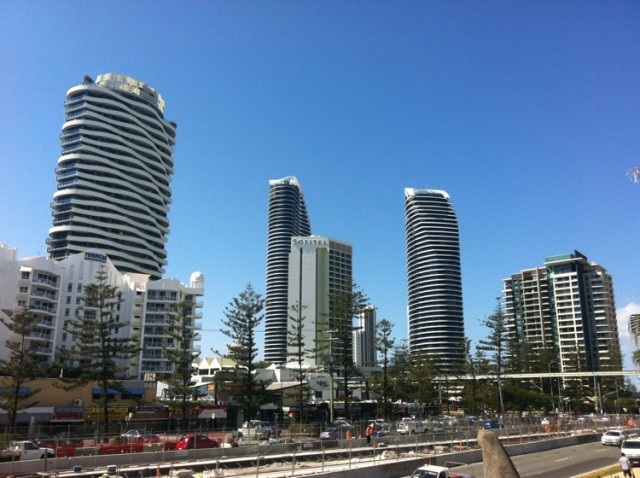
    Probably the saddest thing about Kinkabool is how a building that once dwarfed everything in the region is now overshadowed by its much bigger neighbours.

    kinkabool-neighbours

    Across the road, and blocking out most of Kinkabool’s sunlight, is the 1980s Paradise Centre.

    Time isn’t proving any kinder towards the Paradise Centre with the lack of maintenance beginning to show on the thirty-year old complex as this vent across the street from Kinkabool illustrates.

    kinkabool-neighbours-rusting

    Generally, if the landlord or owners’ corporation is too stingy to afford a coat of paint, then you can be sure there are more nasty surprises

    Both the Paradise Centre’s and Kinkabool’s declines illustrate a much more fundamental problem in an economy driven by property speculation and taxation allowances — there isn’t a lot of money to go around for maintaining older buildings.

    While Kinkabool’s residents can get by with a clapped out lift, inhabitants of larger and more modern complexes like the Paradise Centre will find the costs of running and maintaining their buildings an increasingly difficult burden.

    It could just turn out that Kinkabool, should it escape the wrecker’s ball, may well turn out the more desirable dwelling than its bigger, more modern neighbours.

    For the meantime though, Kinkabool marks the beginning of a far more sophisticated era in Australian and Gold Coast history. Whether that era became too sophisticated for itself remains to be seen.

    kinkabool-goodbye

    Similar posts:

  • Security and the hackable baby monitor

    Security and the hackable baby monitor

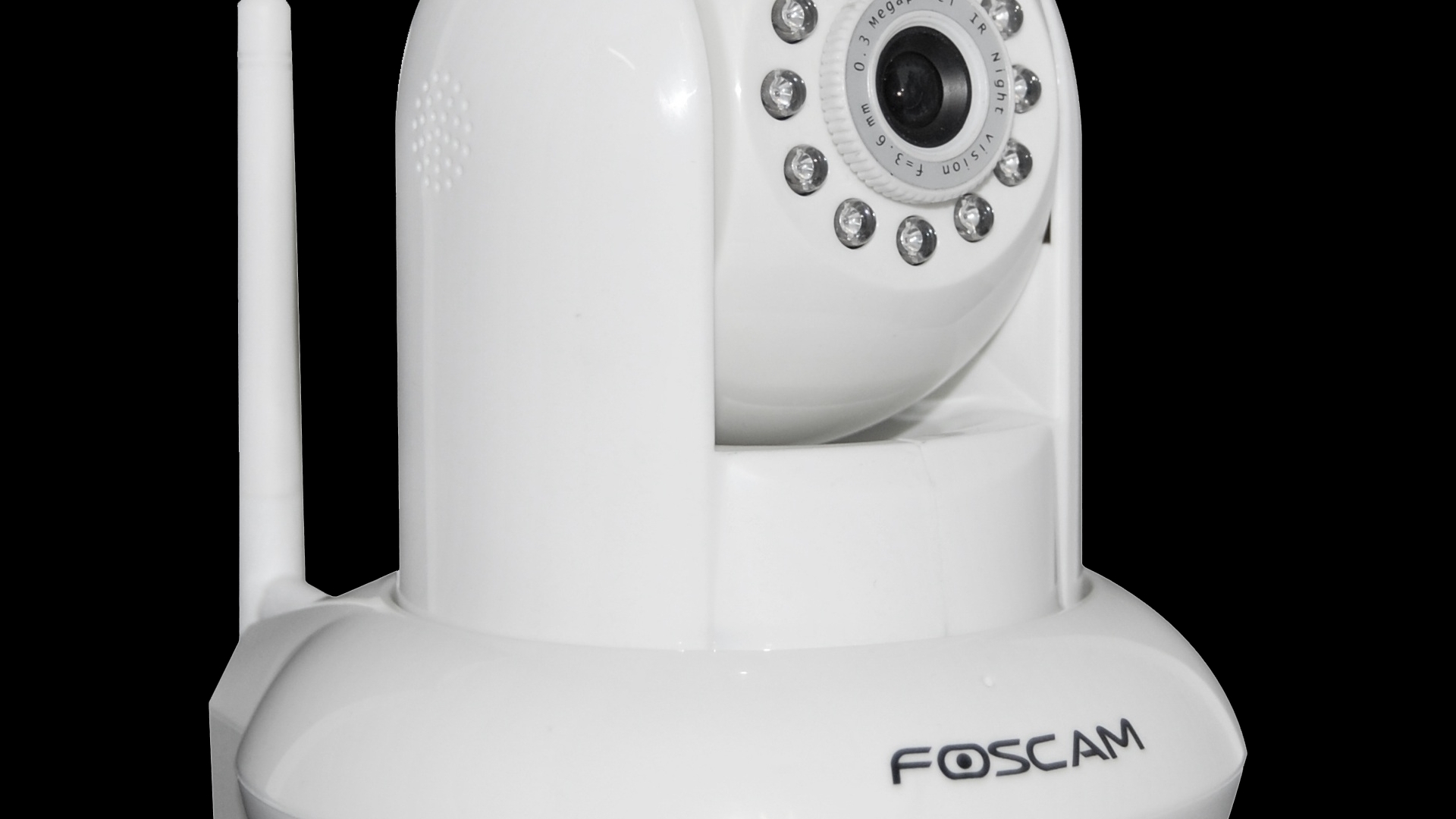
    Imagine a baby monitor that can be hacked, that’s the story that Forbes magazine tells about the Foscam baby monitors that can be owned by anybody using the Shodan search engine to find unsecured video devices.

    Like all similar stories, the Foscam monitors’ weaknesses are born out of good intentions, the idea is parents can keep an eye on their children across the internet.

    The problem, as always, is convenience and ease of use trumped security with Foscam making it easy for parents to by having trivial, if any, security on their devices.

    It’s a lesson that should have been learned a million times, yet manufacturers continue to disregard the risks of poor security on internet connected devices.

    As these internet connected devices become critical to business and public safety, this lack of security won’t be acceptable.

    Slowly, companies like Foscam are being forced to take security seriously — hopefully consumers will accelerate the process by voting with their wallets.

    In the meantime, it might be a good idea to make sure your home or business router has a good firewall before setting up internet connected devices.

    Similar posts:

  • Building the post-agile workplace

    Building the post-agile workplace

    “I personally believe we haven’t seen a major change in how companies work since the industrial revolution,” says Yammer co-founder Adam Pisoni. “We’re, I think, on the brink of a change as large as that.

    Pisoni was speaking at Microsoft’s Australian TechEd conference on the Gold Coast and gave an insight into how Yammer’s development philosophy is being implemented at Microsoft since the smaller company was acquired last year.

    He believes all businesses can benefit from collaborative, cloud based tools like Yammer however software companies like Microsoft are the ones being affected the earliest from their adoption.

    “We sometimes joke that Yammer’s development methodology is post-Agile, post-Scrum” says Pisoni. “Because they were not fast enough and don’t respond to data quickly.”

    Understanding modern workplaces

    This will strike fear into the minds of managers who are only just coming to understand Agile and Scrum methodologies over the traditional ‘waterfall’ method of software development.

    “We focused primarily in the past on efficiency,” states Pisoni. “In many ways things like scrum attempt to make you more agile but still focus on efficiency. Everyone is tasked based and hours and burn down points and all that”

    “The name of the game now is not efficiency, it’s how quickly you can learn and respond to information.”

    “Yammer is less of a product than it is a set of experiments running at all times. We take bold guesses about the future but then we try to disprove our hypotheses to get there.”

    “So we came up with this ‘post-agile’ model of a small, autonomous, cross-functional teams – two to ten people for two to ten weeks who could prove or disprove an hypotheses based on the data.”

    “This lets us quickly move resources around to double down on that or do something else.”

    Flipping hamburgers the smart way

    Pisoni sees this model of management working in areas outside of software development such as retail and cites one of his clients, Red Robin burgers, where the hamburger chain put its frontline staff on Yammer and allowed them contribute to product development.

    The result was getting products faster to market – one burger that would have taken eighteen months to release took four weeks. The feedback loops from the customer and the reduced cost of failure made it easier to for the chain to experiment with new ranges.

    With companies as diverse as hamburger chains, telcos and software developers benefitting from faster development times, it’s a warning that all businesses need to be considering how their employees work together as the competition is getting faster and more flexible.

    It remains to be seen if this change is as great as the industrial revolution, but it’s now that can’t be ignored by managers and entrepreneurs.

    Paul attended Microsoft TechEd Australia as a guest of Microsoft who paid for flights, accommodation and food.

    Similar posts:

  • We came, we saw, we were ripped off.

    We came, we saw, we were ripped off.

    One bad schnitzel on Queensland’s Gold Coast illustrates the biggest economic problem facing Australia.

    As we approach the 2013 Australian election, it’s notable how the debate – if it can be described as that – hasn’t touched on the biggest issue facing the country, the hollowing out of the nation’s economy.

    In the 1980s the Gold Coast was going to be the centre of a Japanese led tourism boom.

    That boom petered through a combination of greed and incompetence on the part of Australian tourism and hotel operators, a process being repeated with Chinese tourists twenty years later.

    Like the rest of the Australian economy, in the 1990s the Gold Coast looked inwards with a focus on property speculation and construction that kept the workforce employed pouring concrete and fitting out kitchens.

    In the meantime, the Gold Coast’s tourist assets were left to rot through under investment. Jupiter’s Casino is a good example of this, a building stranded in the 1980s and in desperate need of a capital injection.

    The Gold Coast was not alone in this, a review of Perth’s Rendezvous Grand Hotel — built by Alan Bond in the 1980s — illustrates exactly the same problem at the other end of the country.

    A lack of investment plagues all of Australia’s hospitality industry, a dinner at the Bavarian Bier Cafe on the Gold Coast’s Broadbeach* was a disaster as poorly trained staff were overwhelmed by a half full establishment and let down by poor business systems.

    That shocking meal — which saw the staff struggle to get out a salad and two beers in over two hours with the greasy, overcooked mains arriving nearly three hours after the diners arrived — is not untypical in Australia.

    Soviet style service is fine when beer and a poorly cooked, mostly breadcrumbs, schnitzel costs fifty kopecks, however at modern Australian prices the service, food and cooking should be world’s best.

    That high prices rarely translate to superior standards in Australian establishments shows how poorly the nation has adapted to being a high cost nation.

    While it’s fashionable to blame the mining industry for the down under manifestation of the Dutch disease, the answer to what has driven Australia’s under investment in tourism, agriculture and manufacturing lies in the cities and suburbs.

    On the same day as the disastrous Bier Cafe meal, the Gold Coast media was reporting that relaxed zoning restrictions would allow unrestricted high rise building heights.

    While the real estate industry welcomed this, the reality for local property speculators hasn’t been pretty with buyers in the twin tower Gold Coast Hilton development being hit with forty percent losses.

    Part of the reason for the poor performance in property speculation is that Gold Coast industry has been hollowed out with local office vacancy rates varying between 27 and 14% percent.

    While much of the rest of Australia’s property markets have been spared similar declines to date, the emphasis on real estate speculation over investment in industry has been similar across the nation.

    That lack of investment in productive industries, whether in tourism or manufacturing is already hurting Australia,  more critically it’s preventing Australian businesses’ from dealing with the transition to being a high cost economy more akin to Switzerland, Japan or Germany than the United States.

    One bad schnitzel on the Gold Coast might not tell us much in itself, but the under investment in systems, training and staff is a bad omen for Australia’s economy.

    Regardless of who wins Australia’s federal election on Saturday, it’s unlikely the group of pampered apparatchiks occupying the Treasury benches will have any idea of helping business or society transition to the realities of the Twenty-first Century.

    *Paul travelled to the Gold Coast and ‘dined’ at the Broadbeach Bavarian Bier Cafe as a guest of Microsoft Australia

    Similar posts: