Author: Paul Wallbank

  • Digital hunter gathering

    Digital hunter gathering

    It has come to this – we’ve had the digital natives, the digital immigrants and now we have the digital hunter-gatherers.

    This is the logical end of the ‘sharing economy’ philosophy which sees retweets, mentions and Facebook likes a hard asset.

    Unfortunately having 100,000 Facebook friends giving the thumbs up to your latest retweet of an article of dubious value doesn’t translate into income – most of the digital curators find themselves living a hunter-gatherer lifestyle.

    Life as a hunter gatherer is not pretty or easy – it’s short and brutal. The only certainty as a hunter gatherer is if you don’t find something to eat today, you will starve tomorrow.

    In some ways, it’s fair to say the modern social media expert is not dissimilar to the prehistoric hunter gatherers in that their days are numbered and starvation is a near certainty.

    One conceit of modern times is that life was so much better in the pre-industrial era; that before the industrial revolution people worked less and primitive man lived a noble life unshackled by possessions.

    That’s all nonsense. Mankind shifted to an agricultural and then an industrial society because life is a lot better than fighting sabre toothed tigers for buffalo or trying to live on berries.

    Myths like this are part of masking the steady decline in middle and working class incomes. George Freedman, the CEO of the Stratfor security consultancy, discussed this in his blog post The Crisis of the Middle Class and American Power.

    The rise of the precariat, workers employed on a casual or project based basis, is part of that erosion of incomes. As Freedman says, the “the decline of traditional corporations and the creation of corporate agility that places individual workers at a massive disadvantage”.

    In this respect, today’s digital hunter gatherers are more like the day labourers of a hundred years ago where workers, like my great-grandfathers, would wait at the gates of the factories or docks hoping to be picked for the day’s work.

    One of the truths of today’s workforce is that it’s a harder place than a generation ago and the expectation of naturally rising incomes is gone for the bulk of the population.

    This means we have to re-imagine our own roles in a changed economy. The assumptions of the post-war economy which have sustained us for over fifty years no longer hold.

    Hunter gathering hopefully won’t be option which we end up with.

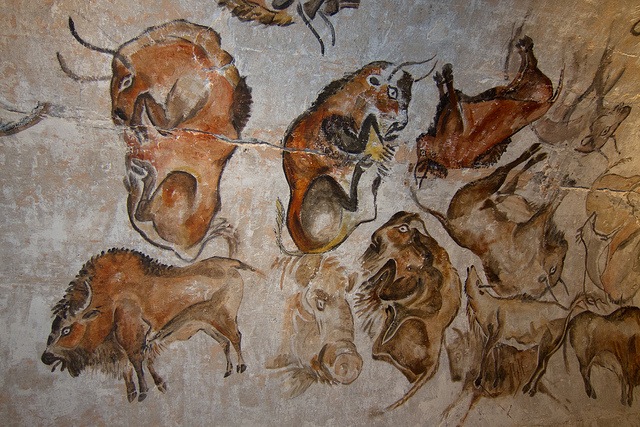
    Reproductions at the Museo del Mamut, Barcelona 2011 from quinet on Flickr

    Similar posts:

  • Samsung’s place in the market

    Samsung’s place in the market

    Samsung’s announcement of a 7 billion dollar quarterly profit yesterday tops off a big 2012 for the Korean electronic manufacturer in which they became the world’s biggest mobile phone manufacturer after overtaking Nokia’s sales.

    Android phones have been the great success for Samsung as other providers, including Google, have been comparatively slow to offer devices which give telcos the opportunity to claw back some margins they’ve been giving away to Apple over the last few year.

    Despite these successes Samsung have a number of challenges ahead in 2013.

    The biggest challenge is channel conflict with Google and Motorola working on launching an X-Phone which they hope will compete against both the iPhone and Samsung products

    Channel conflict was always going to be a problem for handset manufacturers using the Android operating system when Google bought Motorola Mobility and now we’re seeing the effects of this.

    The Koreans aren’t taking Google’s threat lying down having joined with Japanese manufacturers in a joint venture to develop a Linux based operating system for smartphones and Samsung expects to release Tizen equipped phones later in 2013.

    Just on its own, the conflict with Google would be a problem for Samsung but the ongoing fights with Apple over tablet and smartphone patents continues to be a management distraction as well.

    Apple’s relationship with the Korean conglomerate is a classic case of co-dependency as Samsung supply the bulk of the processors used in the iPad and iPhone. While Apple may want to kill the Samsung Galaxy tablet range, they have to be careful about going too far with a key supplier.

    On the Asymco blog wonders if Apple’s announcement to bring some manufacturing back to the US may be part of a strategy to deal with the company’s dependence upon Samsung.

    With threats from ‘frenemies’ like Apple and Google one of best defenses Samsung has is the companies varied range of products along with its willingness to strike out on its own into customers’ markets.

    At the Computer Electronics Show in Las Vegas, Samsung showed off its range of OLED TVs, laptops and other equipment alongside smartphones. That breadth of product frees the company from being locked into one or two markets.

    Of course the best example of such an electronics conglomerate in the past was Japan’s Sony which is now truly lost and wandering in the business wilderness.

    Whether Samsung can avoid Sony’s mistakes will be worth watching over the next few years, for Apple and Google it may determine who is the biggest competitor in the 2020s.

    Similar posts:

  • Pennies for Apps – how Apple and Google dominate online income

    Pennies for Apps – how Apple and Google dominate online income

    “App Store tops 40 billion downloads” trumpets Apple in a media release curiously timed to coincide with the opening of the Consumer Electronics Show.

    While impressive, those figures aren’t great for developers. As writer Ed Bott points out they are getting 17.5 cents per download.

    Making things worse, that return is trending downwards. Tech site Giga Om put the return at 20 cents a year earlier.

    Giga Om also points out App Store returns are skewed towards the big successful game apps, meaning the majority of app developers are scratching for pennies.

    This phenomenon is also happening with online advertising as Google Adsense partners find their income dwindling for pay for click adverts.

    On top of declining revenues, there’s the cut that Google and Apple take. In the App Store, Apple’s take is 30% while Google pocket over 50% of Adsense revenue.

    Working for pennies has become the norm for for creators like musicians, writers and app developers in the digital economy. The long tail is fine, but it barely pays the bills for all but a few outliers. Everyone else needs a day job.

    In some respects this isn’t new – writers, poets, musicians and painters have generally starved in their garrets throughout history – but the Twentieth Century model of intellectual property, record labels and broadcast empires offered at least a decent living to many.

    Right now the 21st Century model seems to be that creators can go back to starving, while the big four online conglomerates make the profits previously shared around by the movie studios, record labels and book publishers.

    Maybe though the rivers of gold which are making Apple and Google’s managers rich may turn out to be just as vulnerable as those of the newspapers they’ve displaced.

    It may well be that the current dominance of the App Store and Adsense are a transition effect as we move to other business models. It’s difficult to see right now, but we can’t rule it out.

    Similar posts:

  • On being evil

    On being evil

    “Don’t be evil” are the opening words of Google’s corporate code.

    When it was framed in the late 1990s there was one company in particular everyone in the tech industry thought of when the word ‘evil’ was being used.

    At the time Microsoft defined evil in the technology industry. The main reason was their crushing of real or potential competitors like Netscape, Java or the troubled IBM joint venture of OS/2.

    Topping everything though was Microsoft’s tactic of fake error messages designed to scare customers away from the competing DR-DOS system in the early 1990s.

    So it’s rather delicious that Microsoft seems to be getting a taste of its own medicine twenty years later as Google Maps returns an error message on Windows Phones.

    This is particularly galling for Microsoft as Windows Phone is essential for the company’s resurgence and, as Apple have learned, maps are a critical feature for smart phone users.

    It’s too early to accuse Google of having become evil as Microsoft did during their period of dominance as Tim Wu discusses in Why Does Everyone Think Google Beat The FTC but the search giant is flexing its muscles on many fronts.

    For Microsoft, they are learning what life’s like when you’re not the toughest, meanest kid on the block.

    Karma can be a real bitch.

    Similar posts:

  • How Australia’s nanny state hurts business and society

    How Australia’s nanny state hurts business and society

    It’s becoming popular to describe Australia as a ‘Nanny State’ as governments respond to moral panics and the need to do something about anything from bicycle helmets to unpasteurized cheese.

    Unquestionably Australia has changed in the last quarter century as governments of all persuasions have found it easier to legislate rather than lead. This has had effects on business and society in general.

    A good example of how the regulations have built up over the last twenty years in Australia is a sign at my local beach.

    the Australian nanny state is shown in signs at balmoral beachThat’s a fine welcome and it compliments the $7 an hour parking fees the local council levies. In itself, those parking fees are a good example of the price pressures driving Australia’s high cost quandary.

    Drinking on Sydney ferries is banned in Australia's nanny state

    Possibly the saddest regulation is the alcohol ban on ferries. Twenty years ago it was normal to see a group of friends unwinding on the way home from work with a cold beer or wine. Today you can’t do that because some bureaucrat decided drunks were a problem and rather than enforce existing laws it was easier to ban drinking entirely.

    The press and moral panic

    Much of this nannyism is being driven by the media who drum up hysterical reports demanding ministers do something. In turn the government’s panicky PR obsessed apparatchiks respond with pointless and unnecessary laws and rules. Often duplicating those that already exist.

    A good example of cynical media hysteria was the story of Malea, a Sydney mum minding her own business while legally cycling with her child in a trailer.

    While out riding a discredited journalist filmed Malea and passed the footage onto a current affairs TV show which portrayed her as a reckless mum and demanded such behaviour be banned.

    Fortunately in that case the politicians ignored the confected outrage, but that’s the exception rather than the rule.

    Doing something

    The media though doesn’t have to force Australian politicians into adopting the nanny reflex. Often governments will create their own outrage in order for attention deprived politicians to get press coverage.

    A good example of this was the incompetent Carr government which decided its contribution to the War On Terror after the 9/11 attacks would be to turn the Sydney Harbour Bridge into something similar to what welcomes Guantanamo Bay detainees.

    The Australian nanny state is shown by the Sydney Harbour BridgeIt’s worthwhile comparing the same view on San Francisco’s Golden Gate Bridge and ask which is the greater terrorist target?

    San Francisco's Golden Gate BridgeWhen Sydney genuinely was a larrikin city, climbing the Harbour Bridge in the dead of night was a rite of passage. Today, if you can get around the security guards, barbed wire, CCTV and motion detectors you risk a $3,300 fine and being branded a terrorist.

    If you try to climb the bridge and get caught, the fine is only half that of stepping on the hallowed turf of the Sydney Cricket Ground.

    At the cricket, if you’re foolish enough to bounce a beach ball, start a Mexican Wave or sing out of tune and you’ll be out before you can say “Shane Warne is a safe driving ambassador.”

    The Age newspaper gave a good example of Australian sports administrators’ Stalinist mindset in this fawning article which gloats over the efforts MCG staff go to in harassing their customers.

    On level three of the Members’ wing is a secure room with the best seats in the house, although the occupants only manage an occasional glance at the game on hand. It is the MCG command post, where ground security, police and Securecorp officers constantly watch a bank of computer monitors and camera screens.

    Dohnt says the camera operators will check the froth on a punter’s cup of Coke to see if it has been topped up with smuggled grog.

    Forcing cricket fans to buy overpriced drinks or visitors to spend over $200 to climb the Harbour Bridge brings us to the core motivation behind many of Australia’s nanny state regulations – protectionism.

    Hidden protectionism

    Many Australian Nanny state rules are to protect businessThis sign, which is attached to the back of the one at the beginning of this story, bans vendors who sell from boats. It’s questionable whether the council actually has the power or resources to enforce this ban but if it helps the local shopkeepers then so be it.

    One of the hubristic traits of Australian exceptionalism is that the nation is a ‘free trade’ economy hard put upon by sneaky Japanese, American and European protectionism. The reality is Australia is just as good as Japan or the EU in introducing sneaky regulations to protect the well-connected locals.

    A very good example of this is bananas where the Australian domestically produced product is substantially dearer than imported bananas sold in the US, UK or Europe.

    In early 2011, Cyclone Yasi devastated Australia’s banana crop and prices soared. Not one imported banana was allowed in to ease the shortage. Remember that the next time you hear a politician or journalist boasting about Australia’s free trade credentials.

    business is hurt by nanny state rules

    Banana prices are another example of the costs passed onto Australian households and industry through nanny state regulations. Compliance costs are real and add to the cost of production and employment. They are another reason why Australia has become a high cost economy.

    More importantly, those regulations tend to favour incumbents making it harder for entrepreneurs and new entrants into markets making the economy even less flexible.

    The burden of regulation is also unfairly dropped upon the smaller business who don’t have the resources to comply with or challenge unfair rules. The Howard government was very good at this with slapping small business with the responsibilities of raising the GST and complying with draconian laws like Workchoices.

    At this stage it’s worth noting that the Australian nanny state isn’t a Labor party creation, it’s come from both sides of politics and often because poorly drafted laws require mountains of regulations to overcome the legislative flaws.

    Workchoices was probably the best example of badly thought out laws where the Howard government panicked into slapping a whole level of punitive rules for businesses who failed to keep log books of staff hours worked – the legislation was so bad that had it not been repealed by Rudd, the sight of bundy clocks would have become common in Australian offices.

    Nanny and risk

    One of the unfortunate effects of the nanny state is that it saps the entrepreneurial spirit – why take risks when nanny is there to support you?

    There is an unintended effect of this though – because we think nanny will always protect us we lose the ability to evaluate risk.

    Where this is most obvious is in financial matters. Too often people are fooled into investing in dodgy schemes because they think that regulators will protect them. They find out this isn’t the case when the money is long gone.

    That failure to understand risk though becomes pervasive through the community as the nanny state mentality becomes established. We could argue that inability to identify risk was the core reason for the global financial crisis.

    The future nanny state

    While the nanny state has been rampant around the world for the last fifty years, its days are numbered as cash strapped governments find they can no longer bear the cost of maintaining armies of bureaucrats to enforce silly rules.

    As society deleverages from the excesses of the credit boom, governments are going to find revenues falling short and while it won’t be the first casualty of the new austerity, the nanny state will almost certainly be a victim.

    Similar posts: