Author: Paul Wallbank

  • Instagram’s blues and the question of trust

    Instagram’s blues and the question of trust

    “I’m opting out” is one of the milder reactions to Instagram’s changes to their terms and conditions.

    Since the photo app was bought by Facebook for a billion dollars – and marking the high water point for Silicon Valley’s greater fool model of investment – observers have been waiting to see how Mark Zuckerberg’s team would integrate the service and get a return on their substantial investment.

    Now we know. Under the new terms, Instagram will inject sponsored posts and advertising into users’ information feeds.

    There’s nothing really unusual in this, almost every ‘free’ online service has something like this in order to make money. The Atlantic’s Alex Madigral makes the point that companies will continue to sell and use our information for as long as we won’t pay for software.

    What’s really interesting about this is the angry reaction to the changes, showing how people are losing trust in Facebook and, more worryingly for all social media services, how people are beginning to value their private information.

    Once people understand the value of their personal data, and the time they spend creating content for these services, the economics of social media services starts to change which in turns hurts the business models of Facebook and others social media sites.

    We’re still in the early days of social media and the business models that underpin them are evolving quickly. Instagram’s current problems are another lesson for users, advertisers and entrepreneurs.

    Similar posts:

  • Poor journalism and social media

    Poor journalism and social media

    Brother’s plea shows up online failings crows the Sydney Morning Herald over social media’s role in misidentifying the perpetrator of the Sandy Hook school shooting.

    The problem for the SMH is that social media wasn’t responsible for the story. As the Washington Post reported, CNN and various other outlets misidentified the shooter as his brother who had to take to social media to correct the record.

    For the mainstream media, the Sandy Hook shooting was not their finest hour; not only did they misidentify Ryan Lanza as the shooter, but they mistakenly reported his mother had worked at the school. When the Daily Mail does a better analysis of the story than many outlets, you know something is wrong.

    Something is certainly wrong at Fairfax as the cutting of resources results in the Sydney Morning Herald being three days behind the story and factually wrong on key aspects – not to mention adding a smug headline that is embarrassingly incorrect.

    While the writer of the SMH article should be held to account for sloppy work and poor research, the real responsibility for this embarrassment lies with the paper’s editors and management who should be ensuring what appears under the masthead is accurate and reliable.

    Both The Age and Sydney Morning Herald are essential to the fabric of their respective cities, this story is a good example of the important role the SMH has in shining light on the arcane dealings of the city’s business community. Fairfax can, and should, do far better than a poor, badly researched story on social media.

    Ironically, the mis-identification story quotes media academic Julie Posetti as saying “anyone with an internet connection could now contribute to and comment on the breaking news cycle without going through the filters of the traditional media.”

    At Fairfax, those filters are broken with the breathing space from selling its New Zealand digital operation, the company’s management has an opportunity to fix their credibility problem and focus on its core business.

    Similar posts:

  • Connecting the household to the internet of everything

    Connecting the household to the internet of everything

    The development of intelligent household appliances like lights is changing our lives in subtle ways, Australian startup Moore’s Cloud is a good example of how cheap computing, accessible internet and open applications are coming together.

    One of the frontiers of technology right now is the internet of things, where machines connect directly to each other, cutting out the requirement for people to monitor them.

    Good examples of these devices is the internet connected fridge – which was the poster child for pointless connectivity during tech wreck in the early 2000s but is now standard equipment in hotels, restaurants and hospitals where monitoring stock levels has become wholly automated.

    Cheap hardware has driven this trend, as processor prices have tumbled it’s become cost effective to incorporate intelligent systems into almost every household device. Everything from the kettle to the washing machine now has some sort of CPU in it.

    Moore’s Cloud is a good example of how the internet of machines is coming together. A simple cube shaped device has the electronic smarts to connect with other lights and be controlled by software apps.

    Being able to create is important as the software interfaces – the APIs – are open which people to write programs that take advantage of the light’s features. A video from the Moore’s Cloud builders showcases twelve of the apps which have been developed so far which include weather forecasting, night lights and changing moods.

    Having an ‘ecosystem’ of apps is now driving innovation in consumer electronics. The iPhone started the app revolution and now everything from stereo systems to lights are being controlled by them. Devices that don’t have open APIs are at risk of being left behind.

    With systems being open to interested designers, anybody can create their own way of controlling device which opens the way for some innovative, left of field ideas.

    In many respects, Moore’s Cloud is one of the early wave of smart features we’re going to see in the next generation of household appliances that will change how we use these tools.

    The team behind Moore’s Cloud is still raising money for the project through Kickstarter, their campaign finishes this Friday. Hopefully they’ll meet their targets and take the project further.

    Similar posts:

  • Are executives taking privacy seriously?

    Are executives taking privacy seriously?

    In an article for Business Spectator on Lord Justice Leveson’s Sydney speech last week, I looked at the commercial aspects of privacy, an area that was overlooked in the reporting of the two Australian lectures by the British jurist.

    Privacy is a serious issue which is also being overlooked by boardrooms, possibly because it’s often conflated with IT security and so it’s seen as a technology problem and, to be honest, executives see it as being a bit ‘soft’ and airy-fairy.

    Sony’s humiliations in 2011 with a series of embarrassing privacy breaches that left the company’s reputation in tatters show the real and embarrassing risks in not taking privacy seriously.

    The UK prank phone call scandal is another example of poor privacy policies which have real world impacts on both the hospital’s patients and staff, whether the management there is held to account or even learns any lessons remains to be seen.

    In California, the US state with the strongest privacy laws, Delta Airlines is being sued over its smartphone app’s policies however the state itself isn’t immune from serious breaches.

    Giving away social security numbers opens up all sort of identity theft opportunities although any privacy breach exposes the victims to potentially serious consequences, some of that pain is going to be passed onto those who give the information away.

    The worry for businesses is that in the absence of serious action by governments and the private sector, the evolution of privacy law is going to take place in the courts with unpredictable and inconsistent results.

    As we now have the tools to gather, store and process huge amounts of data about our customers and staff, we also have an obligation to protect it. This is something managements need to understand and take seriously.

    Similar posts:

  • Pulling up the drawbridge

    Pulling up the drawbridge

    “Online bloggers and tweters are not subject to the financial incentives which affect the print media.”

    While there’s much to disagree with in Lord Justice Leveson’s Australian speeches last week, particularly the bizarre suggestion that bloggers and social media are driving the decline in journalistic standards, he is correct about the economics of online publishing. It’s tough to make a buck on the web.

    It’s so tough, many of the new media startups are founded on not paying for the articles they publish. This model has become so entrenched, that some venture capital investors will only invest in media start ups if they don’t have any reporters or editors.

    Pure platforms

    New media startup Buzzfeed‘s founder, Jonah Peretti, mentioned Silicon Valley’s reluctant to pay writers in a staff email republished by Chris Dixon;

    Tech investors prefer pure platform companies because you can just focus on the tech, have the users produce the content for free, and scale the business globally without having to hire many people.

    This antithesis to paying creatives and content creators is one of the notable aspects of the current Silicon Valley model, who needs editors and writers when a billion people will post to Facebook, Twitter or Instagram?

    Arianna Huffington has been the most successful with this model in the media industry, parlaying a largely unpaid for content business into a fat pay-off.  Chris Anderson described this model best in a description of his website Geek Dad’s economics.

    Reading the comments

    For readers, much of the value in sites like the Huffington Post and Geek Dad lie in the comments stream where readers give their views and experiences and build the communities so many investors and advertisers are looking for.

    This is a point made by Rachel Hills when commenting about Australian website Mamamia’s payment policies;

    When I visit Mamamia. I don’t go to Mamamia for the articles, which usually don’t tell me anything I haven’t already read somewhere else. I go for the comments.

    Rachel concludes with the thought that Mia Freedman’s Mamamia is providing a platform for discussion. This is true, but that’s no different from newspapers, the six o’clock news, current affairs shows or even the weekend’s football match.

    Those football players, newsreaders and journalists are all paid for their work, just like Chris Anderson and Mia Freedman were as magazine editors.

    The hypocrisy of unpaid content

    Which leads us to the core hypocrisy of the unpaid content model; its promoters – people like Mia Freedman, Chris Anderson and Arianna Huffington – have all been well paid in their careers yet now choose to deny the next generation of writers and journalist an income.

    A business adviser once remarked to me that the management of a corporation that were locking in their entitlements while cutting middle management were “pulling up the drawbridge”, that line seems apt as older, affluent journalists demand younger ones work as unpaid contributors or interns.

    The bleat from online publishers is “we can’t afford to pay contributors”, in most other industries being able to pay your workers is a measure of whether your business is solvent. That many new media outlets can’t may mean that the entire industry is insolvent.

    Writers get exposure

    Were the local cafe to say it couldn’t afford to pay its waitstaff, but it was giving them valuable work experience they’d be rightly scorned for exploiting workers. There’s little difference with online publishers.

    It may well be because there is no shortage of manipulative, attention grabbing garbage designed to provoke reactions and increase pageviews, which is the flaw in the “writers get exposure” excuse used by many of these sites.

    As middlemen, publishers have to add value in order to have a role, ‘offering exposure’ to unpaid writers isn’t a reason in itself. This is an industry with shaky foundations and it’s not surprising founders are desperately trying to find greater fools to fund their exits.

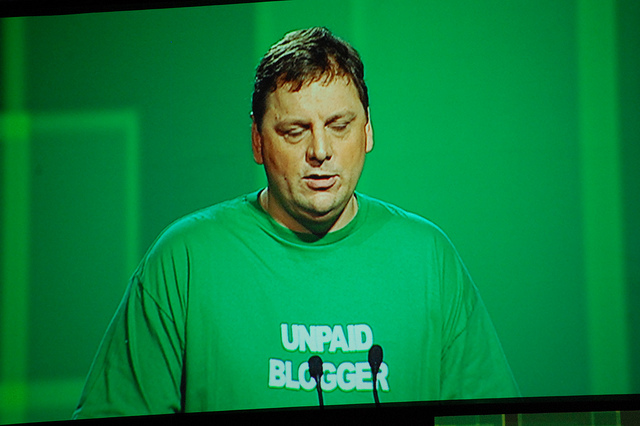
    Image of Michael Arrington from Kevin Krejci on Flickr.

    Similar posts: