Author: Paul Wallbank

  • A swelling feeling of pride

    A swelling feeling of pride

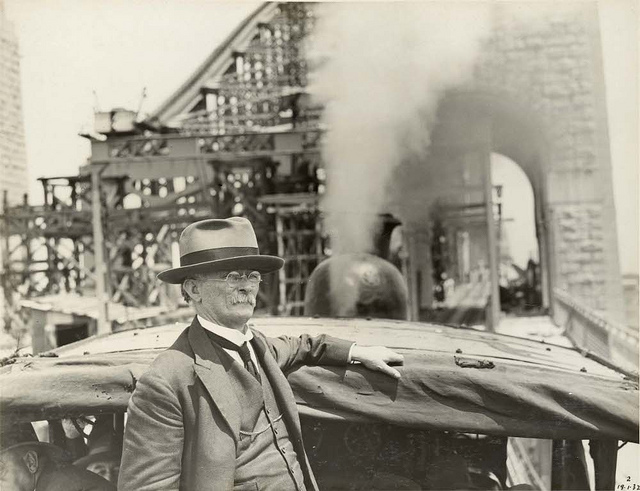
    Doctor John Bradfield shaped modern Sydney. His program of public works, such as building the Sydney Harbour Bridge and the city’s railway network served the city for nearly a century.

    The picture of him from the NSW State Records archives riding the first train across the Harbour Bridge shows him swelling with pride. And so it should.

    What we need to ask ourselves is whether our works could survive a century of massive change and become an international icon as the Sydney Harbour Bridge did.

    If we can just strive toward that – even though most of us will fail – we can be proud of our works as Dr Bradfield was when he rode that train across the Harbour Bridge.

    Similar posts:

  • Guarding your words

    Guarding your words

    US presidential candidate Mitt Romney and Australian radio commentator Alan Jones have in one thing in common – not understanding that almost every person they know is carrying a listening device.

    The smartphone is a powerful tool and one of its great features is how it makes a great dictation device, you can use the built in recording applications to jot down ideas or make a record of important conversations.

    Political events are a great opportunity to record the candidates’ or speakers’ talks and this is what has caught both Jones and Romney.

    The 47% dependent on welfare slur has probably sunk Romney’s presidential campaign. At the very least it’s exposed the contradictions at the heart of the Republican agenda as they try to demonise those receiving government entitlements while trying to win the votes of older Americans who rely on state subsidies to survive.

    In many ways the US Republicans are facing the problem of electorates that believe their entitlements are sacred that all Western politicians will be grappling with over the next quarter century.

    This contradiction isn’t something either the media or the Western political classes have the intellectual capacity to deal with, so there is little chance of a rational debate on the economic sustainability of the entitlement culture.

    For Romney, this contradiction now threatens to sink his campaign.

    The Jones problem is somewhat different, this nasty little man was speaking to the next generation of Australian Liberal Party apparatchiks and the controversy about his tasteless comments will probably improve his standing in the sewer in which he floats. In the wider community outside Jones’ increasingly narrow circle of influence his comments only confirm the low opinion decent people have of this man.

    Jones though is not naive when using the media, the real naivety is among his guests. It’s been reported that before the event the audience were asked “if there were any journalists present”.

    That question being asked betrays any claim that the organisers didn’t know Jones’ comments would be offensive. It also shows how the modern political fixer misunderstands the nature of today’s media. It’s likely a recording of proceedings would have leaked out through an enthusiastic supporter showing off.

    What’s really instructive is how the kindergarten apparatchiks of the Young Liberals believe that shutting down recording devices will remove the risk of being held accountable. That mentality is pervasive through government and politics – shut down discussion and lie about what happened.

    All of these politicians have to understand something Alan Jones has known all along; that a microphone should be treated like a loaded weapon and never assumed to be turned off and safe.

    The days of what was said to the Poughkeepsie Chamber of Commerce or the Cootamundra Country Womens Association not being reported outside the local community are long gone. If you don’t want something broadcast nationally, then don’t say it.

    On balance, this is good for democracy and leadership as it makes all politicians – and business leaders – far more accountable and transparent.

    Accountability and transparency are anathema to the apparatchiks who run the political parties of the Western world. These people, despite their access to power, are ultimately going to be found wanting in a world where there is a recording device in almost every person’s pocket.

    There are genuine privacy concerns with smartphones but for business and political leaders the days of “speaking with a forked tongue” are over. This is not a bad thing.

    Similar posts:
  • Squandering a reprieve

    Squandering a reprieve

    ABC Radio National’s Background Briefing has a terrific story on the struggles of the Fairfax newspaper empire during the early days of the Internet.

    One of the major themes that jumps out is how Fairfax, like many media and retail organisations, squandered the opportunity presented by the tech wreck.

    The tech wreck was an opportunity for incumbents to claim their spaces in the online world, instead they saw the failure of many of the dot com boom’s over-hyped online businesses as vindication of their view the Internet was all hype.

    As former Sydney Morning Herald editor Peter Fray said “In florid moments you could even think this internet webby thing would go away”.

    For Fairfax the profits from the traditional print based business were compelling. According to Greg Hywood the current CEO, for every dollar earned by the company, 70c were profits – a profit margin of 233%.

    The Internet threatened those “rivers of gold” and media companies, understandably, did nothing to jeopardise those returns.

    Another problem for Fairfax was the massive investment in digital printing presses in the 1990s. These behemoths revolutionised the way newspapers were printed as pages could be laid out on computer screens and sent directly from the newsroom to the press itself which printed out pages in glorious colour rather than with smudgy black and white images.

    Moreover these machines were fantastic for printing glossy coloured supplements and the advertising revenue from those high end inserts kept the dollars rolling in.

    When the tech wreck happened, the massive investments in printing presses were vindicated as the rivers of gold continued to flow while the smart Internet kids went broke.

    Fairfax’s management weren’t alone in this hubris – most media companies around the world made the same missteps while retail companies continued to build stores catering for the last echos of the 20th Century consumer boom.

    In 2008, the hubris caught up with the retailers and newspapers. As the great credit boom came to an end, the wheels fell off the established business models and the cost of not experimenting with online models is costing them dearly.

    Value still lies in those mastheads though as more people are reading Fairfax’s publications than ever before.

    Readers still want to read these publications, one loyal reader is quoted in the story that Sydney Morning Herald should aspire to “being a serious international paper.”

    That isn’t going to happen while management is focused on cutting costs to their core business instead of focusing on new revenue streams.

    Somebody will find that model, had the incumbent retail and media organisations explored and invested in online businesses a decade ago they may well have found that secret sauce.

    Now many of them won’t survive with their horse and buggy ways of doing business.

    Similar posts:

  • Shifting to a better return

    Shifting to a better return

    As part of Deloitte’s Building the Lucky Country series, the consulting firm had a briefing last week from John Hagel, co-chairman of Deloitte’s Silicon Valley Centre for the Edge, to discuss how industries are responding to shifts in the workplace and their markets.

    John’s thesis is that businesses can be broadly split into into three groups; infrastructure, product innovation and customer relationship business which he covers in his Shift Index that looks at how industries are being affected by digital technologies.

    Infrastructure businesses are high volume, transactional services like call centres, logistics and utilities companies.

    The product innovators are those who develop new products, get them to market quickly and accelerating adoption of those goods.

    Customer relationship businesses focus on understanding their clients and using that knowledge to add value.

    Each of these business models require different mindsets and because most large companies try to do all three, they manage to do none well.

    One of the results of this is a lousy Return On Assets, which Hagel says have fallen in the United States to one-third of the levels of 1965 and he doesn’t see this improving as the ‘competitive intensity’ of US markets increases.

    A big feature of this decline in overall ROA is how the best performers have travelled compared to the laggards with the ‘winners’ barely maintaining their returns while the ‘losers’ are seeing their results declining dramatically.

    How Hagel sees the solution to this poor performance is through rewarding creative and passionate workers better.

    Firms have untapped opportunities to reverse their declining performance by embracing pull. To accomplish this, firms must develop and encourage passionate workers at every level of the organization.

    Additionally, companies must tap into knowledge flows and expand the use of powerful tools, such as social software to solve operational/product problems more efficiently and effectively as well as to discover emerging opportunities.

    If Hagel is right, it’s the businesses who want to micro-manage their workers while stifling innovation, initiative and creativity in their businesses who will be the great losers in this next decade as we move to the next phase of the ‘Big Shift’ where knowledge flows improve business performance.

    Starting the process of dealing with these shifts involves understand what the DNA of your business really is; if it is a transactional infrastructure business then management needs to acknowledge this and not kid itself about being in customer relationships.

    There are weakness in John Hagel’s proposition – one being that businesses can be easily pigeonholed into three categories.

    Apple is a good example of this where a company that is clearly product focused has also shown it can be customer orientated with the success of the Apple Stores.

    There’s also the question of why are there only three categories? In the breakdown the immediate thought is that there are businesses that don’t fit in any of these boxes. Legacy airlines or struggling motor manufacturers are good examples.

    Despite the criticism, John and the Center For The Edge have some good points about the future of business and it’s something we’ll explore more over the next few weeks.

    Similar posts:

  • Management by fear

    Management by fear

    The sad story of the passing of Bea, the Golden Retriever who died while in the care of United Airlines portrays a fundamental problem in many organisations’ managements – the rule of fear by middle managers.

    A telling part of Bea’s sad tale is how her owner Maggie Rizer was treated when she went to collect her two dogs from United,

    When we arrived in San Francisco to pick up our dogs we drove to the dark cargo terminal and on arrival in the hanger were told simply, “one of them is dead” by the emotionless worker who seemed more interested in his text messages.  It took thirty minutes for a supervisor to come to tell us, “it was the two year old.”  Subsequently we requested that our dog be returned to us and were told that she had been delivered to a local vet for an autopsy. Whatever thread of trust remained between us and United broke and we then insisted that she be returned to us for our own autopsy by our trusted veterinarian, Shann Ikezawa, DVM from Bishop Ranch Veterinary Center. Over the next two hours the supervisor’s lie unraveled as it became clear that Bea was right behind a closed door the whole time and he had been discussing how to handle the potential liability with his boss who had left and sticking to the divert and stall tactic that they had been taught. Eventually Bea was returned and we drove her to the vet at midnight.

    The ‘divert and stall’ tactic took over two hours for Maggie and her partner to get around.

    When I recently flew United I saw a similar attitude from the cabin crew, their lack of initiative and beaten attitude was noticeable. As I said in the post;

    Overall the cabin crew seem tired and beaten, while they aren’t rude or unpleasant one wonders if they have all received too many stern memos from management about being friendly to customers.

    Those stern memos have a corrosive effect on a business where every employee worries more about being sanctioned for breaking a rule or directive rather than helping customers.

    Eventually the entire organisation becomes risk adverse and focused on protecting staff, or management’s, interests rather than looking after those of customers, shareholders or taxpayers.

    Too many organisations are like this, where the staff are motivated by staying out of trouble rather than helping and adding value to their customers.

    Making staff fear you is one way to run a company, or a nation, but ultimately those who are scared of the leaders lose all initiative and the empire collapses because every decision has to be sent to head office as the minions are scared to do anything that will be bring the Imperial Displeasure down upon their hapless heads.

    From ancient Rome to the Soviet Union empires have fallen because of this, in today’s private sector companies that run on fear are ultimately doomed, including the ones who can tap into government subsidies to kick the can down the road. Even public sector agencies where this attitude reigns will change when the chill winds of austerity blow through their corridors.

    One staff member taking a little bit of initiative probably would have saved Bea the golden retriever. One supervisor taking responsibility and helping Maggie Rizer would have avoided the PR disaster United now have.

    In an economy that’s radically changing, inflexibility and slow decision making are possibly the worst possible traits an organisation can have. It’s time for dictatorial managers, along with control freak politicians and their public service directors, to let the reigns go on their staff.

    Similar posts: