Author: Paul Wallbank

  • Digital businesses’ lost tribe of managers

    Digital businesses’ lost tribe of managers

    Are senior executives lost when discussing their company’s digital strategy?

    At the Huawei Connect conference this morning in Shanghai, Nigel Fenwick, a Vice President and principle analyst of Forrester Consulting, released his company’s study titled Business and Technology Leadership in a Post Digital Era.

    Forrester surveyed 212 IT and business managers across selected markets in North America, Europe and the Asia-Pacific for the survey and found only four percent of business leaders were confident they understood their companies’ digital strategy.

    Even more worryingly less than ten percent of business IT leaders claimed they understood their organisation’s digital strategies.

    The reason for this, Fenwick believes, is the pace of change in the technology sector as managers struggle to put digital innovations into the context of the business.

    Exacerbating this lack of understanding is how companies are ‘bolting on’ digital strategies to their existing business models rather than thinking about how their industries, products and markets are being transformed, Fenwick says.

    There’s little new or surprising in Forrester’s report and the small and selective data set doesn’t inspire confidence in the survey’s results. It is however a good reminder of the challenges facing today’s boards and executives in understanding the consequences of a rapidly changing economy on their businesses.

    Similar posts:

  • Autodesk and the China manufacturing challenge

    Autodesk and the China manufacturing challenge

    At the recend Autodesk University event in Sydney I had the opportunity to talk with Pat Williams, the company’s senior vice president for Asia Pacific.

    Williams’ beat covers all of Asia and he’s based out of Shanghai where he’s been based for the last eight years and prior to that he spent a decade in Japan.

    Having spent so much time in North East Asia, and heading to the PRC the following week myself, it was interesting to hear Williams’ views on how industry is changing in China and ther country’s attitude to American software companies.

    “There’s a lot of noise that gets made in China about their local IP and the local vendors and what I say is ‘the Chinese companies are competing in a global market and they are under the same competitive pressures as everybody else in the world so when they find a better tool they use it. Despite all the noise, business is quite good there.”

    For the Chinese economy, the aging and increasingly expensive workforce presents a problem, something addressed by the China Manufacturing 2025 plan which sees the country increasingly competing in high tech sectors such as aerospace, telecommunications and biotech fields.

    “China’s kind of an anomaly,” says Williams of the country’s immense growth rates. “From a government perspective there’s a lot of horsepower behind the things that they do – China 2025, their manufacturing initiative, you’ve got what they’ve been doing with Building Information Modelling (BIM) and our architectural tools.”

    They’ve really kind of spearheaded what we’ve been talking about on things like 3D printing of houses. China on its own is just this mushroom that’s happening.”

    While the industrial shift in China and the rest of Asia is promising opportunities to companies like Autodesk, that change is affecting their workforce as well with the company announcing plans to lay off ten percent of their workforce earlier this year.

    Those cutbacks are part of the adjustment to a new market reality says Williams, “it was part of right sizing the business.” He observed “we realised our margins were going to be compressed as we move to a subscription model.”

    Autodesk’s shifts illustrate how the opportunities in the new economy don’t come without costs even for the companies that seem to be winners in a shifting marketplace.

    In China, American companies are finding they have to a unique proposition – companies like Apple and Autodesk are good examples – and as the country moves its economy further up the value chain all foreign businesses are going to have to show how they add value.

    Succeeding in a changing economy isn’t without uncertainty. And it certainly isn’t without risks.

    Similar posts:

    • No Related Posts
  • Australia’s NBN debacle

    Australia’s NBN debacle

    One of the most stunning examples of Australia’s uncompetitive, post-mining boom economy is its National Broadband Network.

    Announced in 2009 to provide high speed data access to the nation to address the effects of thirty years of poor decisions and poorly thought out policies by successive governments, the project was intended to upgrade the telecommunications network and break the near monopoly of the incumbent telco, Telstra.

    Sadly the project quickly foundered as the managers of the company set up to build the network made a series of poor decisions that stemmed from their underestimating of the project’s scope and their arrogant hubris in rejecting the advice of those who did.

    To compound the problem, the project was politicised by the intellectually lazy and opportunistic Liberal opposition who promised they could build it for less by utilising existing telephone and Pay-TV infrastructure. On becoming government, the then communications minister and now Prime Minister changed the scope to do that and promised a quicker and cheaper rollout.

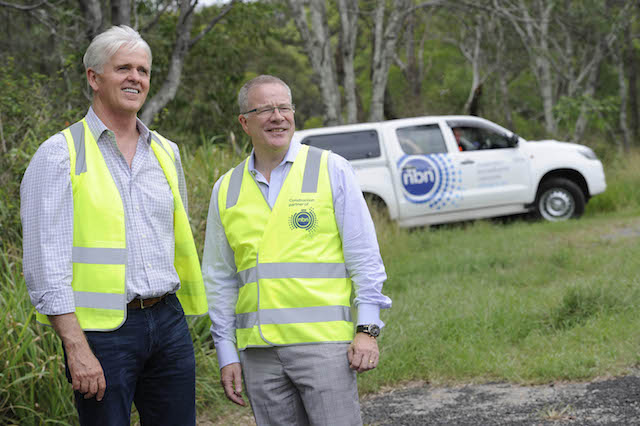
    Last Friday, the folly of the Liberal Party’s plans were shown when the National Broadband Network company, nbn™, issued their updated business plan that detailed a further retreat from both the original project scope and the government’s promises.

    The Melbourne Age’s Lucy Battersby illustrated how completely Malcolm Turnbull and the Liberal Party bungled their costings, showing just how mediocre and dishonest the government and Prime Minister have been in estimating the cost of the project.

    However, NBN Co underestimated the cost of using existing hybrid-fibre coaxial [HFC] cables laid by Telstra and Optus in the 1990s. Last year it calculated an average cost of $1800 per house. But detailed field work discovered the cost was actually $2300.

    In 2013 the Coalition estimated FTTN connections would cost about $900 per premise and this was raised to $1997 in a 2014 strategic review, and raised again in 2015 to about $2300.

    In the real world, being out by nearly 300% would cost an estimator or executive their job and for a small business could well see them being put out of business, but in the carnival of mediocrity that marks modern Australian politics, those responsible for such mistakes only thrive, as do the managers of nbn™ who recently awarded themselves fat bonuses.

    Adding insult to injury for the long suffering Australian taxpayers and broadband users is that the nbn™’s management have revised the scope again to overcome increased costs and now only 21% of consumers will get a fibre connection as opposed to the 40% claimed when the new government changed the scope.

    Those scope changes beg the question why anyone bothered in the first place. Had the network been left with Telstra there’s a reasonable chance 20% of customers would have ended up on fibre by early next decade as the economics of maintaining and installing the technology overtook the older copper system.

    Probably the biggest insult though to Australian customers though are the desperate attempts to make the new network profitable with plans to gouge the nation’s telco users as Fairfax’s Elizabeth Knight reported.

    Data use per user is anticipated to grow at a compound rate of 30 per cent per cent to 2020.

    At first blush these increases in usage might look exaggerated – but wait. Only last year NBN was working off the expectation that this year its existing customers would consume 90 gigabytes per month. But the current rate of consumption is actually 131 gigabytes per month – and rising.

    Thus as the years progress towards 2020, NBN not only gets an increase in customers, it get an increase in revenue per customer .Monthly average revenue per user is forecast to increase from $43 this year to $52 in 2020..


    So Australians will be expected pay more for their substandard connections to help an organisation that has consistently failed to meet its promises and targets. It should also be noted that rising Average Revenue Per User (ARPU) is the opposite of what’s been happening in the real world over the last twenty years as revenues, and profits have fallen.

    To be fair, it’s not just Australia that has struggled with rolling out fibre networks. In the US, Google Fiber is going through blood letting and scope changes as the company struggles to meet targets and keep costs under control. That same experience has been repeated around the world.

    However when it comes to missed targets, broken promises and the sheer scale of money wasted, Australia’s National Broadband Network dwarfs them all.

    Australian taxpayers, voters and telecommunications users should be asking hard questions of their political leaders


    Similar posts:

  • Cheap solar strands coal

    Cheap solar strands coal

    Last week Chilean power distributors signed a contract for solar generated power at the lowest rate ever, half the price of energy from coal powered generators.

    As  the cost of solar panels continues to fall, the need for coal and gas powered facilities continues to dwindle but given solar panels don’t need to be located in a central location, the nature of distribution networks is changing.

    With power generation becoming more localised, communities don’t need expensive connections to power grids. In disadvantaged regions and developing nations, villages that would have to wait decades to be connected, if at all, now have a pathway to dramatically improving their standards of living.

    Distribution companies that exploited their monopoly positions in providing power across wide networks are now having to reconsider the value of their expensive assets and lucrative business models.

    Those countries and companies who thought high coal prices would bolster their standard of living, such as Australia, must be rueing their focus on fossil fuels. The massive investments made by mining companies and compliant governments are now increasingly looking like stranded assets.

    Similar posts:

  • Uber’s grand experiment

    Uber’s grand experiment

    Yesterday reports emerged that the icon of the disruptive economy, ride sharing service Uber, lost 1.2 billion dollars in first six months of this year.

    Those losses show disruption doesn’t come cheap, although settling the damaging and costly battle with China’s Didi Chuxing will help the company’s cash burn.

    Despite on track to lose at least two billion dollars this year, the company still has a substantial war chest having raised $8.7 billion dollars in debt and equity raisings over the last eighteen months.

    While impressive, that war chest will only last four year at current rates and, given Uber’s already sky high 60 billion dollar valuation and the increasingly hostile Silicon Valley fund raising environment, it will be a relief to investors that the China battle appears settled.

    There remains though an ongoing weakness in Uber’s business however with the company reportedly spending hundreds of millions a year in subsidies to drivers in key markets. How sustainable their business is remains to be seen.

    In many respects Uber is following the Amazon example of beating down competitors by selling products at deep losses thanks to its access to capital and investors’ tolerance for building marketshare.

    As we’ve seen with Amazon, that tactic has been wonderfully effective both in retail and in providing cloud services. For customers and the economy though, the reduced choices in the marketplace may end up not being in their interests.

    Uber is an interesting experiment in how far the Amazon model can be pushed, for cities and states dealing with a deeply disrupted taxi and city transport network the results of that experiment may be telling.

    Similar posts: