Author: Paul Wallbank

  • Refocusing on Asia

    Refocusing on Asia

    One of the interesting things about Australian society and business in the last twenty years is how the nation seems to have turned away from Asia.

    In the 1980s and early 90s, the country was focused on exporting services and building long term relationships in sectors ranging from Malaysian construction, Thai diary farming and legal services in China.

    Twenty years later, Australian businesses and government seem to have given up with the consensus among industry and political leaders now being that all the nation can export is raw minerals, bulk agricultural goods with a sprinkling of third rate educational services.

    Globally focused Australian businesses – particularly those in the startup sector – look to Silicon Valley for funding, inspiration and markets. Only a minority are looking North to Asia rather than across the Pacific.

    ViDM – Ventures in Digital Media – is one of those businesses and CEO Willie Pang of the Sydney based advertising technology startup believes the time is to seize opportunities in growing Asian markets rather than concentrating on Silicon Valley financing and exits.

    “Focus on building a great business. If you have a great business someone will buy you,” says Willie.

    The opportunity ViDM sees is in advertising trading platforms bringing together publishers and advertisers across the digital, print and broadcasting channels. Willie expects this market to be worth eight billion dollars across Asia within five years.

    Many of those opportunities in the Asian market are in business-to-business markets such as advertising platforms which is another difference to the largely consumer focused Silicon Valley model.

    For Australian business, Willie doesn’t see funding as being an issue with money being available for smaller startups and mature companies.

    Like in Silicon Valley the real problem lies for business in the middle stages of their development where they are too big for angels and smaller funds but not interesting for the bigger investors. That grey zone lies between two and ten million dollars.

    For the companies that do raise the funds and go hunting in Asian markets, the rewards can be great. Not only do this economies have great growth rates, the diversities of Asian countries mean there are different opportunities lying in each nation or even provinces.

    Right now, US businesses are focussed domestically or just on a narrow range of opportunities catering to affluent Chinese consumers in Beijing, Shanghai and Guangzhou.

    Willie sees that as another opportunity, while US and European companies are distracted it’s a good time to be entering the Asian markets. But that window of opportunity won’t last forever.

    “We’ll either play in that space or the Americans will do it” says Willie.

    The opportunity is open to us. Will we grab it?

    Similar posts:

  • Breaking the media camel’s back

    Breaking the media camel’s back

    Speculation that News Corporation is going to split into two could be the straw that breaks the back of the media industry.

    News gathering has always been subsided by other revenues, mainly advertising in newspapers and commercial broadcasting.

    Since the rise of the internet, most of that advertising has followed the audience elsewhere and newspapers have only held on because some advertisers are slow to break the business habits of the last 150 years.

    Rupert Murdoch’s News Corporation took that subsidisation to another level, with profitable pay TV and movie divisions also subsidising the print operations that allowed Murdoch to reach his position of power.

    Should News now split those profitable operations away from the declining print divisions, those in the news media are going to find themselves in an even bigger world of pain as their revenue declines become even more apparent.

    We could be seeing the end game for print in News Corporation’s move. The challenge for all of us now is to figure out the journalism model that works in an era where information is a commodity and there’s no guarantees of easy advertising revenue.

    Similar posts:

  • Connecting the data dots

    Connecting the data dots

    One of the connected world’s weaknesses is its fragmented as various silos of data appear in the different social and cloud services.

    Bringing those sources together in a way that’s useful and relevant is one big opportunity for entrepreneurs.

    Sydney company Roamz is one of the businesses looking at this opportunity by bringing together a user’s Facebook, Twitter and Foursquare feeds to figure what interesting stuff is happening locally.

    Roamz’s CEO and founder Jonathan Barouch has a vision to “cut out the noise” from social media services by “curating and cleaning the data”.

    The idea of curation isn’t new in the online world, this is probably one of the biggest challenges for everyone on the web as we find ourselves swamped with data. To date, much of the idea of ‘curation’ has been around news sources where services like Google News try to deliver relevant current affairs to the user’s desktop.

    Social media sites are particularly in need of curation, particularly given your friends in Nevada are much help when you’re looking for a good coffee shop in Melbourne.

    This is the problem Roamz seeks to solve and we’re seeing this with various other services, not least the social media platforms themselves as Facebook tries to extend its reach and Google attempts to integrate their local services with the Zagat restaurant review system and Google+.

    Some would dismiss these services as “first world problems”, after all who cares about twittering hipsters trying to find a single origin, fair trade soy latte in Broadmeadows?

    There’s a point in that view, although there is a much bigger problem for businesses in this fragmented data world in harnessing and validating various sources of market intelligence.

    For businesses that get this right, they’ll be able to target advertising and marketing much more effectively while being able being able to tap into what their customers think and want.

    It’s no accident therefore that one of Roamz’s major investors is consumer communications giant Salmat, who can deliver great value to their corporate customers through supplying this data and market intelligence.

    The next IT buzzphrase is “Big Data” where businesses deal with this flood of information that is swamping all of us, by being able to understand customers and their behaviour things become far more efficient and cost effective.

    Bringing data together and making sense of the results is the big challenge of our times, those who can solve the problem will be among the next generation of business leaders.

    Similar posts:

  • 702 Sydney Mornings Technology

    702 Sydney Mornings Technology

    On 702Sydney Mornings this month with Linda Mottram, we’re looking at the continued story of the Flame and Stuxnet worms along with some trickery from the North Koreans who tried to shut down South Korea’s Incheon International Airport with a computer virus.

    To help you avoid being infected there’s a detailed description on the Netsmarts website on setting up your computer to avoid being infected.

    We’re also looking at protecting your digital legacy in an era when social media services like LinkedIn and Facebook can keep your memory alive long after your passing.

    Join us on 702 Sydney from shortly after 9.30am. We’ll probably take some calls on 1300 222 702 and we’d like to hear your views, comments or questions.

    Similar posts:

  • Mapping new industries

    Mapping new industries

    As smartphones become ubuiquitious in business, more applications are appearing that take advantage of the devices’ inbuilt features like GPS and cameras.

    To date, many of these have services have been in consumer based, social media style applications but as the market matures, more business orientated services are appearing.

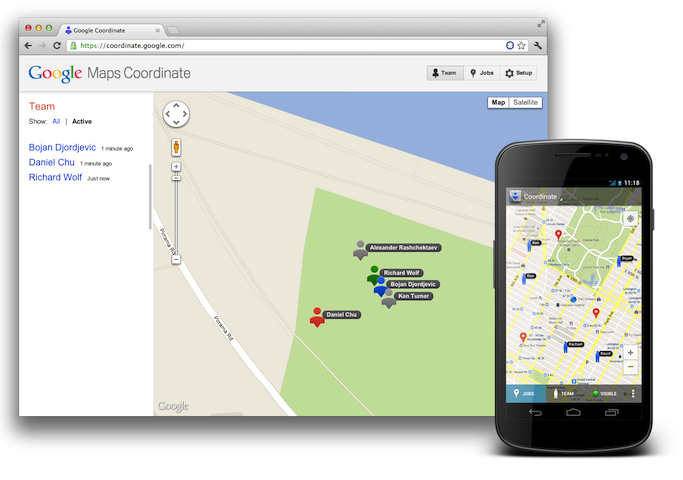
    Google Maps Coordinate, the latest service from the search engine giant, uses a smartphone’s built in location services to track field staff and allocate jobs through an Android smartphone app.

    On top of that, Google have added a Maps-style interface for businesses to schedule appointments and for staff to accept assignments.

    It’s a nice but basic product that doesn’t really address any gaps in the marketplace with job scheduling technology being available for over a decade in the logistics and field service industries.

    Connect2Field’s chief executive Steve Orenstein compared Google Maps Coordinate to his own product and while Steve is talking up his own company, the comparison does show this is a market that’s well catered for.

    Given the market already has plenty of participants, it would make sense for Google to make the API available to existing players and profit from the rich data they can provide, that move might even give the edge to Android devices in an enterprise market that will become a two horse race if Microsoft fail to execute on Windows 8 and their tablet devices.

    Unfortunately Google has chosen not to include these services into their enterprise API packages, leaving them competing against existing players rather than working with them.

    At the moment Google Maps isn’t on a roll, having dropped their developer rates by 88% to deal with threat from Apple’s new mapping service.

    Probably the biggest drawback to Google Maps Coordinate is its lack of integration with Google Docs, the increased siloing of Google’s operations makes the company start to resemble Microsoft and this is an issue Sergei Brin and Larry Page are going to have address lest the company find itself locked into the same inward looking stagnation.

    While its difficult to see Google Maps Coordinate surviving in its current form given the nature of the marketplace, the trend in business orientated geolocation services is changing how companies work.

    As smartphones take over the market and location based services become accepted, we’ll see more tools taking advantage of the business opportunities. For Google, this sector has huge potential and it will be interesting to see how they succeed in capitalising on their market dominance.

    Similar posts: