Author: Paul Wallbank

  • Security and cloud computing

    Security and cloud computing

    Last Friday cloud accounting service Saasu ran their Cloud Conference looking at the business benefits of online computing and business automation.

    Among the topics discussed was the security of cloud computing with Stilgherrian giving an excellent overview of the state of information security.

    Stil’s message is clear; online security is everyone’s problem – if the bad guys want to target you for whatever reason they will.

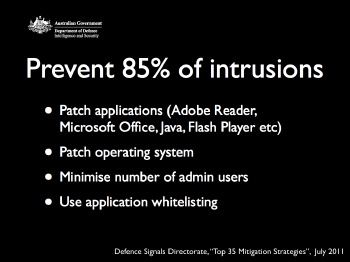
    As a business owner, it’s essential to take basic precautions. This is something I’ve covered before and something Stil raises in his presentation by pointing out that Australia’s Defence Signals Directorate lists 35 mitigation strategies based on the security breaches they examined in 2010.Stilgherrian's recommendations on securing computers

    Of those thirty-five, the top five would prevent 85% of security breaches. The top one – keeping your applications up to date – would avoid almost every PC malware attack along with Apple Mac’s Flashback worm.

    In answering my question about how Saasu and other cloud computing users can protect their system, Stil also raised a good point about using virtual machines for web browsing and even purchasing a computer just for business accounting and banking use so the services can’t be compromised.

    Related to this topic is an ongoing discussion on the Reddit forums between posters claiming to be malware writers and botnet operators.

    While it’s risky to trust everything you read on Reddit, the tips are worthwhile, particularly the advice to “disable addons in your browser and only activate the ones you need.”

    By reducing the number of programs running on your computer or the add ons in your web browser, you lessen the risk of being infected. Again this would have protected the victims of the Flashback worm.

    The security of our systems is our own responsibility, just like our home and office security.

    Cloud computing is no different to other computing – the basics of information security, or #infosec, are the same regardless of whether you’re using software on your computer or the cloud.

    Used responsibly, cloud computing is no less or more secure than any other computer or smartphone use. We shouldn’t underestimate the risks, or get hysterical about the threats.


    Similar posts:

  • Bringing your own device and business change

    Bringing your own device and business change

    Two years ago I realised that the management trend of staff bringing their own computers to work – BYOD – was more than a fad when I noticed executives were bringing the then new iPads to meetings.

    Most of these executives worked in organisations where IT departments had waged war on employees connecting their own equipment to the corporate network, so this was a serious development in the computing world.

    In many ways employees had been bringing their own technology devices to work for years. It was, and still is, quite common to see public servants and those working for other bureaucratic organisations arriving at meetings with an underfeatured work supplied handset and their own smartphone.

    IT managers hated this as they saw those private devices as a security risk and another headache for their overworked staff to deal with.

    When the iPod was enthusiastically adopted by the executive suite, the game was over for those IT managers. Suddenly they had to deal with these devices and the issues involved.

    At a seminar run by systems integrator Logicalis earlier this week looked at some of the issues around BYOD for companies. What was striking in their presentations were the need for HR and legal departments to be part of the process for adopting this philosophy.

    The BYOD philosophy is a big jump for organisations as it means relaxing controls on employees and for many managers that is the biggest challenge.

    Part of that challenge is controlling the organisation’s data on devices that could be going anywhere and doing anything.

    While companies like Logicalis and Citrix address this with remote desktop applications that create a virtual Windows desktop on the employee’s device, networking giant Cisco offer their ISE devices to run “identity services” that set up rules controlling what staff can access and where they can access it from.

    Cisco Australia’s Chief Technology Officer Kevin Bloch gave a good round earlier this week up of where they see BYOD driving business. To Cisco, the move to mobile devices is irresistible as shown in their Global Mobile Data Traffic Update.

    Interesting both Kevin and the Logicalis speakers see BYOD as being part of the recruitment process. Increasingly younger workers expect they will be able to use their own devices rather than relying upon employer issued workstations and mobile phones.

    According to Kevin, Cisco’s research is finding many employees would trade salary for the right to bring their own device which is something that should grab the attention of budget constrained managers.

    This also ties into other employer trends such as Activity Based Workplaces where companies provide hot desks and staff are expected to store their items away at the end of each workday.

    Ross Miller of the GPT Group described how this is another trend driving the paperless office as staff using hot desks find packing away files and paperwork each day is an unnecessary hassle.

    What we’re seeing with businesses adopting BYOD policies is a big change in the way places operate and this has consequences for all divisions of an organisation from HR and legal through to marketing and corporate affairs. It’s a genuine game changer.

    How the BYOD philosophy is changing business is good example of technology driving our habits and work practices in ways we don’t always anticipate.

    One thing is for sure, the workplace of the future is far more autonomous and diverse than those we’ve been used to for the last hundred years, the businesses who don’t adapt are those being left behind.

    Similar posts:

  • No exit

    No exit

    The men’s hairdresser down the road from me has hung up his scissors after twenty-four years.

    The sign on his shop window apologizes and the shop itself is up for lease. Shortly there won’t be any evidence a long standing local business was once there.

    Roy had no exit from his business and he sell the operation as a going concern.

    For Roy his retirement will be funded solely out of his savings. If he’s lucky he’ll have saved enough of his income from the business for a comfortable retirement – unfortunately many small business owners they’ll eke out the rest of their lives on the pension.

    Even for those who have planned for an exit, many of their plans have fallen over in the aftermath of the 2008 financial crisis.

    It’s always been questionable whether Gen X and Y entrepreneurs could afford to pay the sums for the affluent retirement of Baby Boomer business owners but now the post 2008 contraction in lending means it’s even less likely retiring business owners like Roy will find someone to buy their businesses.

    While the focus is on twenty something app developers selling their businesses for a billion dollars, the truth is that wealth for most business owners lies in the local newsagent, hairdresser or coffee shop owner being able to sell their operation for a reasonable return.

    For many baby boomer business owners it’s going to mean working more years than they intended and sharply reduced retirement expectations.

    Property values too are difficult. Many boomer businesses had the sensible model of buying the property their business occupies as a retirement nest egg.

    Again those properties are too expensive for the new generation and the deleveraging economy means the outlook for property values isn’t good.

    On every level, things are going to be tough for those wanting to sell businesses over the next decade.

    Those who do get good prices for their businesses are going to be those doing something exceptional to gain attention with income and profits that make them stand out from the cloud.

    Just being the best hairdresser in the neighbourhood or having a popular cafe isn’t going to be enough.

    Hopefully Roy The Barber managed to stash away enough for a well deserved comfortable retirement.

    Similar posts:

  • ABC Sydney Mornings: Explaining the Cloud

    ABC Sydney Mornings: Explaining the Cloud

    Paul Wallbank joins Linda Mottram on ABC 702 mornings to discuss how technology affects your business and life.

    This week we’re talking cloud computing from 10.40am this Wednesday May 9 on ABC 702 Sydney. A lot of this topic has been covered in my posts on The Connected Business.

    During the show we’ll be covering the following topics on cloud computing.

    • What is this? How does this – or how is it meant to – work?
    • What can you put there? Anything?
    • What use is it suited for?  And NOT suited for?
    • Is it meant to be archival storage?  or is it meant to be something more dynamic?
    • Can anybody access it?  Is there substantial technical limitation?
    • Is it secure, safe?  If yes, why do many people seem to be making lots of scary noises?
    • Does it work better for:
      •   individuals?
      •    small business?
      •    large business?

    We’d love to hear your views so join the conversation with your on-air questions, ideas or comments; phone in on 1300 222 702 or post a question on ABC702 Sydney’s Facebook page.

    If you’re a social media users, you can also follow the show through twitter to @paulwallbank and @702Sydney.

    Similar posts:

  • Continuing the online payments battle

    Continuing the online payments battle

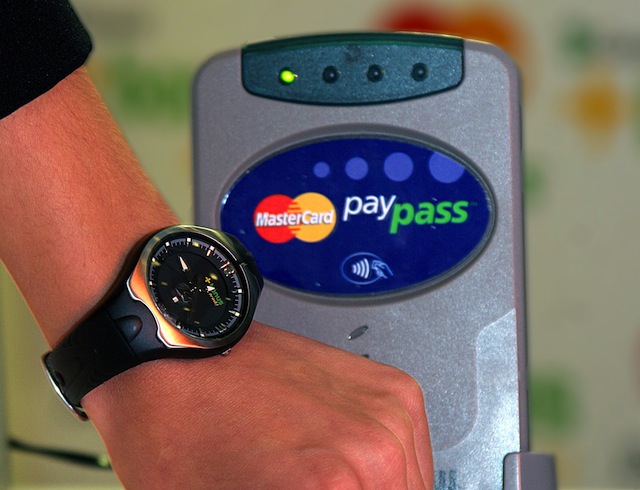
    Today Mastercard announced their PayPass service, a “digital wallet” that allows consumers to pay through various online channels including the web and their smartphones.

    Mastercard’s PayPass is the latest move in the battle to control the online payments industry as consumers move from plastic cards to using their mobile phones and Internet devices.

    One of the interesting aspects of PayPass is how it is a direct challenge to PayPal who in turn recently launched their PayPal Here service which threatens incumbent credit card services like Mastercard and Visa along with upstarts like Square.

    While its early days yet in the mobile payments space as consumers slowly begin to accept using smartphones and tablet computers to pay for goods and services, its clear the industry incumbents are moving to secure their positions in the market place.

    It’s going to be interesting to see how this develops, many merchants will be hoping this competition starts to drive down transaction costs.

    Similar posts: