Author: Paul Wallbank

  • Microsoft imagines its future markets

    Microsoft imagines its future markets

    Currently Microsoft are running their Imagine Cup, the company’s annual student developer competition at their Seattle head office.

    A regular fixture for the last 14 years, the Imagine Cup is Microsoft’s opportunity to show how emerging applications can be based upon their technologies. It tells us as much about the company’s successes as it’s missed opportunities.

    With Artificial Intelligence and machine learning being the upcoming battlegrounds for the software giants, it’s not surprising many of this year’s competitors are focused on applying those technologies.

    A good example of this is the Ani platform of Australia’s entrant, Black.ai, which analyses spatial movement and biometric information. In many ways this adds intelligence to smarthomes and has immediate applications in fields like aged patient care.

    Black.ai’s timing is very good as patient monitoring has become an issue in their home country and veteran tech investor Mark Suster predicts tracking the flow of people is going to be a huge market.

    The patient care angle of Black.ai’s  is particularly pertinent to the Imagine Cup competition as health services have been a focus in the past. Two years ago the winners were another Australian medical services platform, Eyenaemia that used a smartphone app to detect anemia.

    While the Imagine Cup is a good showcase for Microsoft, the competition also shows how the market has evolved around the company. Most of the contests have a smartphone component and the cloud features heavily in all the applications, both are fields where Microsoft has either struggled or is playing catch up.

    The focus on cognitive computing and artificial intelligence in this year’s event shows the company is keen to show off its prowess in the emerging battle with Amazon, Google, Apple and no doubt other companies. Microsoft will be hoping they won’t be left behind in the next wave of computing.
    Similar posts:

    • No Related Posts
  • Sending school projects into space

    Sending school projects into space

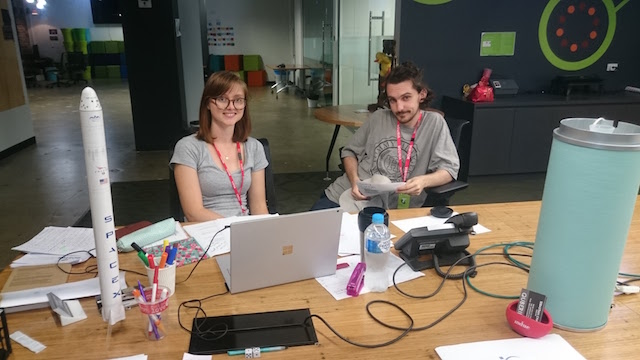
    “We’ve been completely blown away,” says Quberider founder Solange Cunin about the interest in the startup that looks to put science experiments into space.

    The company that was established by Cunin, a fifth year aeronautical engineering student, and her co-founder Sebastian Chaoui in early 2015 to provide school students with the opportunity to conduct experiments in space.

    “Quebrider is a company that focuses on teaching core STEM skills that the current curriculum doesn’t focus on,” Cunin explained about the company. “Things like coding, data analysis and problem solving – all of those things industry needs. We do that in the context of students building their own space mission.”

    The Quberider package starts starts at a cost of $5000 and includes a type of nanosatellite called a cubesat – a cube the size of a large coffee mug that contains ten sensors – along with teaching resources and a slot on one of the International space station launches. The program runs for three terms and integrates into the New South Wales high school science curriculum.

    “Students end up creating their own software experiments and they sent it up on their own space mission,” explains Cunin. “They get that big bang and their own awesome feeling of being on something big and hopefully that gets them motivated to be involved in science a tech.”

    In all, forty NSW high schools have prepared 60 projects ranging from one using the gathered information to create ‘space music’ through to an experiment measuring Einstein’s theory of relativity and time dilation to on the initial launch scheduled for the end of the month.

    “Because it’s space it captures their imagination,” Cunin says of the program designed for years 9 and 10 students (14 and 15 year olds) but they have participants ranging from year 5 up to undergraduate level.

    “We’re solving such an important pain point for many different people – getting students involved is a big problem for teachers and education and skills are a big problem for industry,” Cunin says.

    The project developed out of Cunin and Chaoui’s joint passion for space projects and they came together when working as interns at another space startup.

    While they are looking at a small amount of seed funding later this year, most of the startup’s capital has come from program fees and the support of the University of New South Wales where Cunin is a student and the University of Technology Sydney where Chaou studies. Quebrider is also part of Telstra’s Muru-D startup incubator program.

    “We’re quite aware we have a lot to learn,” says Cunin about the Muru-D program. “Signing up to this with a good mentor program is important. The big value for us is the mentorship, we meet our advisory board once a fortnight and they’ve become part of the family.”

    Ultimately Solange Cunin would like to see their program spread across the country. “What I’d really love to see is nationwide every single student that goes through year nine or ten has a space mission. They get to be part of something bigger and that inspires them and shows that science isn’t something nerdy and is cool.”

    As the price of loading payloads onto satellites falls, it’s almost certain these experiments will become more accessible for schools and students.

    Similar posts:

    • No Related Posts
  • Keynote speaking and presentations

    Keynote speaking and presentations

    How is your business or community adapting to radically changing marketplaces and society?

    Speaker, writer and broadcaster Paul Wallbank has been at the forefront of helping businesses and communities find opportunities in this rapidly changing era for twenty years.

    Paul’s presentations are lively, interactive and designed to both entertain and challenge audiences looking at how their companies, industries and communities are going to prosper in the connected century.

    Some of the areas Paul covers are the workplace of the future, employment in the age of robots, how the internet of machines is changing markets and what technologies like cloud computing, social media and Big Data mean to your business.

    All keynotes, presentations and workshops can be customised to suit your unique needs. Topics include;

    Future Proofing your business
    Decoding the new economy
    Leadership in a digital era
    Tools for the new economy
    Why Broadband Matters
    The Future of Business

    You can view many of Paul’s presentations at his Slideshare site.

    Previous presentations have included;

    The future office. What will the office of the future look like?
    Web 4 Free. Doing business on the web with a shoestring budget.
    The elder guru; exploding the myths of the digital divide.
    The top ten solutions for getting the most from small business IT
    What does it all mean? cutting through computer jargon.

    All presentations are available as keynotes or workshops and Paul will tailor the content to suit your organisation’s or industry’s unique characteristics.

    Paul connects the dots to show how your industry, business and family are being affected by changing trends in technology, economics and global demographics.

    In explaining trends and technologies such as the internet of everything, cloud computing, social networking and broadband technologies, Paul deciphers the jargon and helps audiences identify opportunities and understand the risks in the new economy.

    If you’d like to find how your business or community group can get more from their technology contact Paul for more information.

    Similar posts:

  • ABC Nightlife: Pokemon Go and the end of the ideas boom

    ABC Nightlife: Pokemon Go and the end of the ideas boom

    This Thursday night join Tony Delroy and myself on ABC Nightlife to discuss Pokemon Go, how tech is changing the workforce and the future of Australia’s technology industry following the Federal election.

    It’s taken a while but we finally have a video game that gets people off the couch and onto the streets. For the last two weeks we’ve been hearing stories of how hundreds of people are dodging cars, invading police stations and stampeding across parks as they try to catch virtual reality animals in the Pokemon Go game.

    What is Pokemon Go and is this the future of augmented reality are two of the questions Tony and I will be discussing. We’re also looking at what the Federal election means for the government’s much lauded Innovation Statement along with the Moonhack record of the greatest number of kids programming at one time.

    Some of the questions we cover include;

    • What is Pokemon Go?
    • Isn’t Pokemon somewhat old school?
    • Why did it take off?
    • So we’ve heard a bit about augmented reality. Is this what it’s really about?
    • Beyond games, are there any useful purposes for AR?
    • Are we all going to have strange headsets strapped to our heads?
    • Can we expected Australia to provide many of these AR applications?
    • What sort of support is the government giving these developers?
    • Apart from what was already announced what did the Federal election mean to the Aussie tech sector?
    • After all the noise late last year, tech and innovation wasn’t really much of an issue during the election?
    • Does all this talk of tech really matter to the average Australian worker?

    Join us

    Tune in on your local ABC radio station from 10pm Australian Eastern Summer time or listen online at www.abc.net.au/nightlife.

    We’d love to hear your views so join the conversation with your on-air questions, ideas or comments; phone in on 1300 800 222 within Australia or +61 2 8333 1000 from outside Australia.

    You can SMS Nightlife’s talkback on 19922702, or through twitter to @paulwallbank using the #abcnightlife hashtag or visit the Nightlife Facebook page.

    Similar posts:

    • No Related Posts
  • Embracing business disruption

    Embracing business disruption

    “A lot of companies are trying to figure digital disruption out,” says the Chief Operating Office of Infor, Pam Murphy. “For many companies they are seeing all this stuff and thinking ‘oh my god, what on earth do I do?’. They know they need to evolve and they know they have to evolve.”

    Murphy, who joined Infor in 2011 after over a decade at Oracle, has seen a lot of that change. Infor itself embraced the cloud and in the company’s has been on an acquisitions spree as it seeks to expand its product offerings.

    Having dealt with so many acquisitions – eight since Murphy joined five years ago – the company has become adept at absorbing new businesses. “It does require a lot of thinking that you’re going to be respectful of that,” she says. “A lot of stuff is easy to standardise but culture is difficult.”

    Another area that Murphy doesn’t see as being standardised is in developing talent. “You have to be open minded,” she says in answer to my question about encouraging women into senior roles and increasing the diversity of senior management.

    Murphy’s main advice to business leaders is not to shy from the business world’s shifts, “embrace the change.” She says, “don’t think of it as being something that’s scary and threatening, get ahead of it. Embrace the fact we’re in a completely different era.”

    Similar posts: