Author: Paul Wallbank

  • The corporates are getting social media and local search

    The corporates are getting social media and local search

    Shopping centre owner Westfield’s announcement this week that they’ll be offering Facebook Check-in Deals  at their local malls shows the corporate sector is beginning to rise to the challenges of the social, local and mobile driven marketplace. Smaller businesses need to be taking notice.

    Consumer behaviour is changing quickly as the SoLoMo revolution, a term invented by investor John Doerr, sees customers bringing together social media and local search on their mobile phones and iPads. That presents a lot of opportunities for savvy marketers and business owners.

    In the early days of mobile commerce we saw the idea of local, mobile based marketing being SMS based along the lines of nearby vending machines texting you on a hot day to say “hey, I have cold drinks” on a hot day.

    Thankfully for our sanity that concept never really took off and it’s taken the arrival of social media services and smartphones for this type of marketing to become feasible.

    Social media services also have the advantage that messages, particularly those appearing on a user’s Facebook wall, come from trusted sources, further increasing the credibility of a message.

    How the check-in deals work is a shopper checks into their local shopping mall which triggers messages there are deals available at stores in the centre. If the customer takes an offer, a “Like” appears on their Facebook wall.

    All of the customer’s friends then see the hot deal and that encourages them to visit the store and shopping centre. In this respect it’s similar to the social media aspect of group buying services, another area that Facebook have entered and which will almost certainly be integrated into this the Check-In Deals program.

    There are some issues with this for both the merchant and the consumer. The most obvious are the privacy and identity issues of the customer as social media sites work harder than ever to find angles on using our private information.

    For businesses, there’s the risk of being held hostage by Facebook and Westfield. Both organisations are well known for their strict terms and control of tenants and users, so having your business’ long term interests may not be served by being locked onto their platforms.

    Driving traffic to your website is the key objective of a social media presence, so the website has to tie into the proprietary social media, local search, group buying and whatever channels you’re using to promote your business online.

    What this emphasises is the importance of smaller businesses getting their local search listings working on services like True Local, Google and Facebook Places to compete on this platform against the big boys who are now making aggressive moves into the social and local services.

    The clear message from Westfield’s partnership is that corporate Australia is now beginning to understand how social media, e-commerce and online concepts like group buying fit into their businesses.

    Smaller businesses had a head start with online media as the larger corporations struggled to understand the new services. Now that advantage is gone, it’s time to make sure you’re getting local services right.


    Similar posts:

    • No Related Posts
  • Greater fools and lesser fools

    Greater fools and lesser fools

    As Groupon struggles to get its public offering to the market and the startup mania continues in the tech sector, it’s worthwhile having a look at what underpins the modern Silicon Valley business model along with it’s limitations and risks for those who want to imitate it or invest in it.

    Distilled to the basics, the aim of the venture capital funded startup is to earn a profitable exit for the founders and investors. While there’s some exceptions – Apple and Google being two of the most notable – most of these businesses are not intended to be profitable or even sustainable, they are intended to be dressed up and sold onto someone else.

    This can be seen in what many of these companies spend investors’ money on; in an example where a startup receives 10 million dollars VC investment, we may see a million spent on developing the product, five million allocated customer acquisition and four million on PR. The numbers may vary, but the proportions indicate the investors’ and management priorities.

    Focussing on PR and customer acquisition is essential to attract buyers, the public relations spend is to place stories in the business media and trade press about the hot new business and spending millions buying in customers backs the narrative of how great this business is. By creating enough hype about a fast growing enterprise, the plan is prospective buyers will come knocking.

    But who buys many of these business? In some cases a company like Microsoft or Google may buy the startup just to get the talents of some smart developers or entrepreneurs, but in many cases it’s fools being parted from their money.

    Greater Fools

    The greater fool model the core tech start up model; two guys set up a business with some basic funding from their immediate circle; the friends, family and other fools. A VC gets involved, makes an investment and markets the company as described above.

    With enough hype, the business comes to the attention of a big corporation whose managers are hypnotised by the growth story and possibly feel threatened by the new industry or have a Fear Of Missing Out on the new hot, sector.

    Eventually the big business buys the little guys for a large sum, meeting the aim of the founders and venture capital investors. The buyer then steadily runs down the acquired business as management finds they don’t understand it and find it a small, irritating distraction from their main business activity.

    While there are hundreds of examples of this in the tech sector, the funny thing is the biggest examples are in the media industry with Time Warner’s purchase of AOL and News Corporation of MySpace.

    Lesser Fools

    As a bubble develops we start seeing the Initial Public Offering arrive and this is where the lesser fools step in.

    The mums and dad, the retiree, German dentists, the investment funds and all the other players of the stock market are offered a slice of the hot new business.

    Usually the results are interesting; the IPO is often underpriced which sees a massive profit for the initial shareholders and underwriters in the first few days then a steady decline in the stock price as the pie in the sky valuations and the realities of the underlying business’ profitability become apparent.

    Steve Blank, a Silicon Valley investor and entrepreneur, put the greater or lesser fool scenario well in a recent article asking Are You The Fool At The Table? Sadly too many small and big investors, along with big corporations, are the fools at the table ignoring Warren Buffet’s advice on avoiding businesses you don’t understand and finding themselves the patsies that the Silicon Valley startup model relies upon.

    The fundamental misunderstanding of the venture capital driven Silicon Valley model of building businesses is dangerous as our governments and investment mangers are seduced by the glamorous, big money deals. It’s also understandable funding from banks and other traditional sources is difficult to find.

    An obsession with this method of growing businesses means that long term ventures with profitable underlying products and services are overlooked as investors flock to the latest shiny startup. That’s a shame and something our economy, and investment portfolios, can’t really afford in volatile times.

    For business owners, the venture capital model might be a good option if your aim is a quick, profitable sale to a fool. If your driving reasons for running a business are something different, then maybe the Silicon Valley way of doing business isn’t for you.

    Similar posts:

  • The Privacy Processors: How social media is re-manufacturing our identities

    The Privacy Processors: How social media is re-manufacturing our identities

    Most of us accept that things we don’t pay for – such as broadcast TV and Internet sites – are supported by advertising or have some sort of catch in order to pay their bills.

    Social media sites have been a great example of this, millions of users on services like Facebook and LinkedIn have accepted targeted advertising and the associated privacy trade offs as the cost of getting a free online service.

    The price of “free” though is escalating, the social networks have moved on from just using our data for displaying advertisements to processing our private information and distributing it in ways we may have never expected.

    Professional networking site LinkedIn caused an uproar last week when their social advertising feature started adding what appeared to be users’ personal endorsements to adverts for products, businesses and websites based on behaviour monitored by the site’s tracking software.

    Facebook, the leading social networking site, also had a recent privacy scare when users discovered the services’ Phonebook feature gleefully displays all the mobile phone numbers of their online contacts and, given the right settings, merges them with those from a mobile phone.

    The recently launched Google Plus takes these risks even further as the search engine giant requires a personal profile before you can use the service which can then be integrated into your search and email histories.

    What we’ve ‘Liked’ or ‘Followed’ online – or even just looked at – is now being processed, regurgitated and delivered to our friends and the public as endorsements and recommendations just like a retired sportsman selling air conditioners or hair restoration products.

    At least the retired cricketer flogging hair products or long past it soap opera star promoting washing powder gets a paycheck, all a social media user gets from the transaction the privilege of sharing their private information along with personal and professional relationships with a multinational advertising platform.

    In some ways the social advertising functions are worse for the user than the celebrity endorsement; most people know the retired sportsman or actress is doing it for a paycheck, the social network advertising clearly implies your friends like that product or company.

    We should also remember it’s not just the sites themselves, one of the reasons for Facebook’s popularity has been the games and applications people can use. Every one of these features has some access to your data and most have a business model for using it to make a buck.

    It’s become common for online applications to send out messages on new users’ accounts, pretending to be a personal message from them. Just this week a new service invoked the ire of Facebook’s founder, Mark Zuckerberg, for doing exactly this.

    This processing of our own data and services is a logical step for social media services desperate to justify billion dollar valuations of their business but few people signed up to these sites to endorse random products or allow someone else to send advertising on their behalf.

    Privacy is no longer the issue with social media services, we’ve now moved into the corporate ownership of our identities. What a corporate algorithm decides are our likes is now being processed and publicly displayed as our endorsements, our tastes and dislikes.

    What interests us, what we enjoy and what we like forms the core of our identities, friendships and personalities. That social media sites seek to take this from us should be our greatest concern with these platforms.

    We need to be careful with what, and whom, we share, like and connect with online.

    Similar posts:

    • No Related Posts
  • What services does Google Plus really threaten?

    What services does Google Plus really threaten?

    Google+, the search engine giant’s latest attempt at competing with services like Facebook and Twitter, has seen 25 million people joining the service in the month since its launch at the end of June.

    Such a stellar growth rate – it took three years for Facebook to reach the same number of users – means it could be one of the most popular social media services ever. What does this new platform mean to business owners and start ups and how does it affect other platforms like Facebook, Twitter, Yammer and LinkedIn?

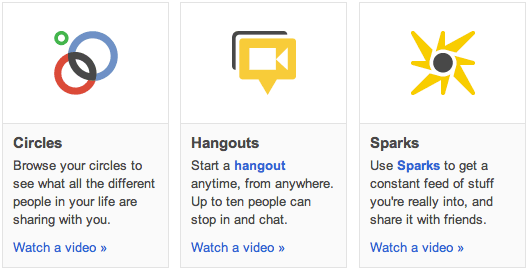
    Google+ differs from most social networks – particularly Facebook – in that you can divide your online connections into different groups called circles and restrict shared information to those segments.

    This addresses the biggest problem with social media; that what we share with our friends is not necessarily what we want our family or work colleagues to see, an issue identified last year by then Google designer Paul Adams, who has not co-incidentally since moved onto Facebook.

    Along with Circles, Google+ has a few other unique features such as Hangouts which allow impromptu video conferences and Sparks which are random popups of things you might be interested based upon your search history and posts.

    The collaboration aspect as the ability to create Circles and Hangouts for specific projects is one of Google+’s great strengths – and probably to be expected from an Engineering organisation like Google – which may make it an alternative to corporate social media services such as Yammer and possibly even LinkedIn groups.

    At the core of Google+ is the Google Profile which is shared with most Google services such as Gmail and Blogger which gives rise to quite a few privacy concerns as those you share with can get access to this information, although this is the same with most other social media services.

    Marketing is one area where businesses have focused on in the social media world and the lack of broader take up is one of Google+’s drawbacks as Facebook has a much bigger diverse spread of users and so marketing reach.

    At present the discussion of Google+ for marketing is moot as businesses aren’t allowed to create Google profiles which is another powerful advantage for Facebook.

    The question remains on how Google is going to integrate their other services, the obvious one is to incorporate Places in a similar way to Facebook so that businesses can create profiles that can then plug into local search.

    Coupling social media with local search along with Google’s Android mobile phone service pretty well touches all the bases of the SoLoMo revolution which is redefining the consumer world and is almost certainly part of the bigger game plan.

    Adwords will prove to be the greatest challenge, although we’re already seeing concerns being expressed about the potential for Google to misuse their databases and profiles of users and as social media tool plugged into profiles and personal search may be a bridge too far form some.

    Indeed there’s a question of how Google+ will affect other social media tools like LinkedIn and Twitter. Right now it’s difficult to see either being affected by the new service however we shouldn’t underestimate the size of Google’s war chest or how compelling a service that integrates email, search, local search and applications like documents will be.

    Another big advantage of Google+ is the lack of clutter as the game invites and people sending pictures of fluffy cats or their big night out aren‘t around – though this may change as the service moves from being used primarily by business geeks to the general public.

    Whether Google+ supplants Facebook or any of the other social media services remains to be seen as we’re only a few years into the decade where personalised services are changing how we use the web, it would be dangerous to make any bets on who will succeed.

    The stakes are quite high for Google with this product as the overwhelming amount of data at every Internet user’s fingertips is seeing people seeking out sources they trust for answers, recommendations and advice. The social aspect of the online world is going to define the web in this decade just as search did in the previous decade.

    For businesses, or anybody interested in social media who wants to experiment with the new service, it’s worthwhile having a play with the program to see if it works for you but abandoning Facebook, Twitter or even your own website for Google’s service is probably making too early a call at this stage.

    Anyway, the beauty of social media services are that you aren’t forced to use all or any and you may well find that other channels work better for your business regardless of Google’s success.

    Similar posts:

    • No Related Posts
  • ABC Nightlife: The Spare Room Tycoon

    ABC Nightlife: The Spare Room Tycoon

    Our retailers, the media and many other industries are struggling as a new generation of entrepreneurs are springing up from home and changing the way we shop, work and socialise.

    Whether you’re looking at starting your own business or looking to grow an existing business, you need to understand how these free or cheap online social media, local search and cloud computing services can help you.

    Join Paul Wallbank and Tony Delroy on ABC Nightlife to discuss how our work and business is changing and how you can use these powerful online social media, local search and cloud computing tools.

    Aspects we’ll discuss include;

      • How can someone take on the big boys from their spare room?
      • What sort of costs are involved?
      • How difficult is it to setup an online business?
      • Are juggling home and business demands likely to cause problems?
      • What are the challenges of keeping the kids off your home systems?
      • How do you stop hackers and security risks?
      • How can existing businesses adapt to this new world?

    If you’d like to add to the list or join the conversation with your on-air questions or comments are welcome, phone in on 1300 800 222 within Australia or +61 2 8333 1000 from outside Australia.

    Tune in on your local ABC radio station or listen online at www.abc.net.au/nightlife.

    You can SMS Nightlife’s talkback on 19922702, twitter @paulwallbank using the #abcnightlife hashtag or visit the Nightlife Facebook page.

    Similar posts:

    • No Related Posts