Author: Paul Wallbank

  • Rethinking cancer research

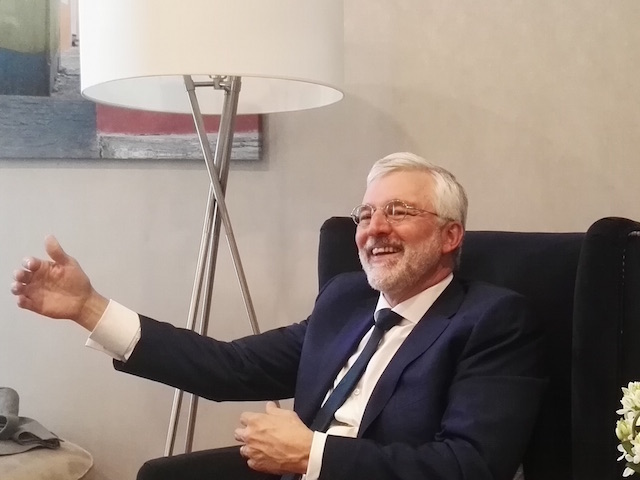
    Netsuite founder Evan Goldberg hopes the lessons he’s learned from building a software company can help researchers find new ways to treat cancers.

    When Netsuite founder Evan Goldberg was contacted by his birth mother it was not all good news, she revealed to him she had one of the BRAC genetic markers, an hereditary trait that indicates a high risk of breast cancer.

    A day before the official launch of the BRAC Foundation he has founded with a ten million dollar donation, Goldberg spoke to Decoding the New Economy at the Suiteworld conference in San Jose about how he believes he can help improve the treatement of cancers.

    “How I think I can make a difference is applying some of the things we’ve learned at Netsuite,” he explained. “Netsuite has been all about breaking down silos, it’s not a system to run a department, it’s to run a business.”

    “Much research and money is focused on a particular type of cancer – breast cancer, lung cancer, prostate cancer but it turns out from what we’ve learned from genetic research that cancers can be more similar to each other across different cancer types than to those in the same organs.”

    “So in the same way we’re trying to break down silos between parts of a business, trying to break down silos between researchers, different institutions has sort of been a theme of mine.”

    “What’s really interesting this notion of looking at where the cancer started, which is what we’ve been doing for a hundred years, looking at what is the mechanism underneath it is kind of how we’ve looked at business at Netsuite.”

    “We’re supporting research in the BRCA Foundation from numerous different institutions and researchers that are looking at all different types of cancer. So bringing them together and cutting through all sorts of silos, these sort of artificial silos – some of which still have value in some ways – but fostering collaboration where there wasn’t any before.”

    “It’s not a perfect analogy,” Goldberg admits, “but I do think that this notion of looking at cancer across different dimensions is similar to how we’ve been looking at business.”

    “It’s a totally different world, the world of medics, research institutions, hospitals and clinicians, it’s a very different world to the businesses I’m used to deal with. Although there are still similarities in the motivations and the barriers to success.”

    One has to hope BRAC Foundation will be successful however Goldberg is the first to admit the bulk of the work lies with the scientists. “The real hard work is done by the researchers,” he says. “Hopefully we can help them.”

    Similar posts:

    • No Related Posts
  • The benefits of being public

    The benefits of being public

    Both the public cloud and a publicly listed company are good things for a business says Netsuite’s Zac Nelson.

    “Managing a public company is a great discipline and in some ways gives us an advantage over non-public company who don’t have to have discipline and make good investments,” says Zac Nelson, the CEO of Netsuite.

    Nelson was talking to Decoding the New Economy yesterday at the annual Suiteworld conference, Netsuite’s annual gathering in San Jose.

    The CEO’s comments are in contrast to a common view that being publicly listed company distracts a company’s management from focusing on long term objectives, a sentiment Nelson rejects.

    “In terms of managing a public company I think it’s an important discipline, I think a lot of people are opposed to these SOX (Sarbanes-Oxley) rules but when I look at these rules I think they are just common sense. Are you managing your business right? You want to have control of your business so you aren’t blindsided.”

    Probably the biggest advocate of taking companies private is Michael Dell who took his eponymous business off the markets three years ago and is now looking at doing the same thing with EMC in what will be the biggest IT merger in history.

    Dell going private

    Nelson doesn’t think Dell going private was a mistake though, “I saw Larry Ellison say it was one of the greatest business moves in the history of man, I’ll agree with Larry – he’s usually right on that stuff,” he laughed.

    “The thing I see Dell doing that I understand is they are giving their smaller division more autonomy. Dell Boomi is going back to being just Boomi and Secureworks just went public. Certainly from a structural standpoint and business model innovation that makes sense and it’s what I understand.”

    As a public company, Netsuite does come under scrutiny and one of the criticisms is that it continues to post losses, something that Nelson puts down to the treatment of stock options. In the last earnings report, the company claimed capitalising stock options added $30 million in costs and not including them would see the company reporting an eight million dollar profit last quarter.

    “We’re cash flow positive, we generate over $140 million in cash,” Nelson says. “People are happy with it, we’re still investing. What we’re investing in this year is different to the past, we’re investing in services to enable our customers to invest in product.”

    Integrating the stack

    One of the advantages Nelson sees that cloud based companies like his have are integrated systems, “the client server world created this perspective that dis-integrated systems actually work – you have Windows, you have third-party apps – but what really works well are integrated systems.” he says. “Look at the most common system you guys use, called Apple, it’s an integrated end-to-end system. Same with Amazon, that’s what we’ve built.”

    “The detour we took in the client-server world is still being taken in the software world, a lot of software people believe you can compile this stuff and it will magically work. No, it doesn’t. Integrated systems work better.”

    Securing the cloud

    One area he specifically sees where cloud services have an advantage in being integrated is with security, “a problem that large enterprises have that we to some degree don’t have is we have one system, we have five data centers. You look at some of these large enterprises and some of them don’t even know where some of their data centres are. How on earth do you secure that environment? It’s not a product problem, it’s a process and IT management problem.”

    Nelson’s comments on security are a swipe at competitors like SAP and Oracle who are often criticised for having disparate systems.

    With Suiteworld moving to Las Vegas next year, it will be interesting to see who’s taking bets against cloud services like Netsuite. Certainly with salesmen like Zac Nelson, they’re able to tell a good story. The key though is to show some profits in the longer run.

    Paul travelled to Suiteworld in San Jose as a guest of Netsuite.


    Similar posts:

  • Invite only collaboration

    Invite only collaboration

    The success of Silicon Valley is partly based on the sharing of information. Can a closed group of business leaders replicate that success?

    Currently I’m in the United States interviewing Australian startup founders who’ve moved to the Bay Area on why they’ve chosen to move their businesses in Silicon Valley.

    Naturally there’s a whole range of reasons for relocating across the Pacific – for some most of their market was in the US, for others it was the accessibility of investors while for many the move was always part of their plan to go global.

    A place you fall in love with

    The almost unanimous comment though from the founders was one of the attractions of the Bay Area are the support networks, “It’s a place you fall in love with straight away – it’s the people and the attitude,” says Holly Cardew.  “People ask what can I help you with.”

    Cardew, the founder of image management service PixC, sums up the consensus on the Bay Area business culture of ‘paying it forward’. Almost every entrepreneur who’d moved to San Francisco mentioned how the question “how can I help you?” was key to building a network and finding customers, staff and investors.

    That openness to helping the ecosystem was greatly appreciated by Carl Hartmann, co-founder of logistics startup Temando. “I’m here today because people were kind enough to pay it forward,” he states.

    Since then Harmann has become one of the ‘go-to guys’ for Australian entrepreneurs arriving in San Francisco and almost everyone we spoke to mentioned Carl as being a great help for them in obtaining initial introductions.

    Building a community

    Those introductions and helpful acts are essential in a community where the most valuable asset is the people, not just investors but the entire complex ecosystem of coders, lawyers, publicists, designers and various other disciplines essential for an industrial hub to thrive.

    Which raises the question about yesterday’s announcement of the TechSydney initiative, a project claiming “to address the Sydney innovation ecosystem’s greatest challenge: collaboration.”

    This is a good idea, and one this writer was involved in seven years ago with the failed Digital Sydney program in 2010 which aimed to bring together the disparate groups that make up Australia’s disparate tech and digital media sectors.

    Government failures

    Digital Sydney failed because the state government is poor executing at such initiatives so the fact TechSydney is being led by experienced startup founders, investors and advisors should give hope this attempt would be more successful.

    However, TechSydney’s press release quickly dispels that hope with the opening line.

    Australia’s most successful startups and global tech giants, including Atlassian, Airbnb and Airtree Ventures are backing a new not-for-profit aimed at turning Sydney into Australia’s Silicon Valley.

    The “Australian Silicon Valley” line shows a focus on the current Bay Area tech startup model funded by venture capital and seed investors who are happy to forgoe profits in the hope of big capital gain when the business is acquired or goes public – the Silicon Valley Greater Fool model.

    Silicon Valley itself is pivoting away from this model with businesses across the Bay Area now frantic to at least have the illusion of being profitable or on the path to making money. In narrowly promoting the tech startup model TechSydney seems to be trying to catch a wave that has already broken.

    Slamming the door

    The main worry from the TechSydney announcement though is that it seems to go against the open door policy that makes Silicon Valley so successful. Rather than encouraging questions and new entrants, TechSydney is slamming the door shut with only the successful and well connected invited.

    The group will launch at an exclusive invitation-only Dinner on May 30 at the Powerhouse. Sydney’s top 200 technology companies will be in attendance. The first 100 have already been invited, and the group is now taking applications for the next 100 attendees at TechSydney.com.au, and is urging companies to register their interest today.

    In some respects this is to be expected of the Sydney business community – the city’s industry is based upon the Rum Corps model of the colony’s early days where success is based upon connections and influence rather than being open and collaborative. This attitude underpins the ‘mates culture’ that is critical to acquiring power and wealth in New South Wales and across Australia.

    With an attitude of having an ‘invite only’ group leading the push the hopes of creating an ‘Australian Silicon Valley’ are doomed. By locking out new entrants or dissenting thinkers, it’s impossible to create a vibrant hub.

    Creating an open mindset

    For Sydney, or any other Australian city, to succeed as a global hub in any industry that legacy of the Rum Corps, the mates network, needs to be suppressed and a more open, collaborative mindset put in place.

    TechSydney can do that if its leaders choose to do so. Hopefully at their invite only meeting at the end of the month the wise men of Sydney’s tech elite will decide that an open initiative that welcomes newcomers and tolerates new ideas is the best opportunity to make the city a global leader.

    Similar posts:
  • Equity crowdfunding arrives late to the party

    Equity crowdfunding arrives late to the party

    Equity crowdsourcing comes late to the Silicon Valley party but could it help the capital starved small business sector?

    As of today, equity crowdfunding is now legal in the United States.

    The interesting thing is it appears Silicon Valley is shifting away from the VC model that this initiative was intended to promote among smaller investors.

    Whether equity crowdfunding can be applied to ventures outside the tech startup industry remains to be seen, it may be in a world where banks have stepped away from their traditional role of providing capital to business that this is the way for proprietors to raise essential funds.

    Similar posts:

  • A constancy of change

    A constancy of change

    One constant about the technology sector is change, and a visit to Silicon Valley’s Computer History Museum emphasises just how much the industry has changed over the years.

    Notable are all the gone and forgotten brands that were in their day giants of the industry along with the efforts by various countries, Britain in particular, to compete with the US in computing.

    But most striking are the old roles that rose and fell as technology evolved over the past century, from the Morse Code operators whose skills were essential for safe shipping and telegraph communications through to punch card operators and the ‘tape apes’ of the 1980s.

    Most of those roles rose, became lucrative and then disappeared as technology evolved, just as the loom weavers’ jobs did in the eighteenth century.

    Like the loom weavers and the companies that employed them, history and technology overtook them. Something that today’s business giants and high paid occupations need to keep in mind.

    No industry is static and few jobs are safe in today’s rapidly changing world. It’s why we need to be making the investments in the skills and technologies that will define the future economy.

    We can’t assume today’s jobs will be those of tomorrow.

    Similar posts:

    • No Related Posts