Category: Australia

  • For God’s sake get a website

    For God’s sake get a website

    The annual MYOB Business Monitor was released earlier this week with the depressing news that half of the Australian businesses surveyed didn’t have a basic website.

    MYOB’s survey reinforced the finding of PayPal’s Digital Literacy Report a week earlier that found only 34% of Australian small businesses list their contact details online.

    This is madness – over a decade ago consumers moved online and now with the mobile internet any business without a website is almost invisible in the marketplace.

    What is really dispiriting about these reports is that listing with the various online services and setting up a website is not hard, at worst it should take half a day for a simple site and to complete Google Places, Facebook and Yellow Pages listings.

    The easiest way to create a website is to setup a free Blogger page, it takes about twenty minutes and is more than adequate if you just need a site that lists your services, location, contact details and phone number.

    While Blogger is good for the basics, it does run the risk of locking a growing business into Google’s walled garden which is why WordPress is the better alternative for more advanced companies or proprietors.

    Most readers of this site already know how important an online presence is for any organisation, but it’s almost certain that everyone knows a business owner who doesn’t have a website.

    If one of those business owners is someone close to you, then the best thing you can do for them is to sit down with them and setup their basic online presence.

    Unless you think it’s time they went out of business. In which case you won’t have to wait long.

    Similar posts:

    • No Related Posts
  • An expensive place to do business

    An expensive place to do business

    Job search site Staff.com has an infographic showing the cost of setting up a startup business in selected cities around the world.

    Staff.com founder Rob Dawson looked at the cost of hiring two developers and one designer and paying rent on an office in eight cities around the world.

    Of the six Zurich came in the most expensive followed by Sydney, New York, San Francisco, London and Paris. Manila and Mumbai were obviously the cheapest.

    What Does It Cost to Run a Startup? Infographic
    Staff.com – Connecting Great Companies with Global Talent

    While the wages are the headline in this admittedly unscientific survey, the rents are a factor worth examining. If we arrange those cities by rents, then London jumps to the highest spot while Sydney remains second.

    Cost of renting in each city

    London 63,984
    Sydney 47,616
    New York 45,600
    Paris 38,400
    Zurich 36,000
    Mumbai 29,184
    San Francisco 22,080
    Manila 9,984


    This table illustrates a number of things; that Mumbai is a very uncompetitive location by Indian standards, being an app developer with a London startup is a miserable existence and that Australia is a very expensive place to do business.

    Last week at The Hub Sydney discussing the global workforce with O-Desk’s Matt Cooper, expatriate Aussie and founder of The Fetch Kate Kendall emphasised the high cost of doing business in Australia.

    “You don’t realise how expensive Australia has become until you get off the plane,” said Kate who pointed out the burden of massive mortgages mean labour rates have to be high so people can afford to meet their bank repayments.

    I’ve argued in the past that those high property prices are a form of economic cholesterol that sap Australia’s economic strength and these discussion illustrate that point.

    The bizarre thing is that Australian property prices are expected to go higher and, most worrying of all, the consensus among mainstream economists and business writers is that current levels are not overpriced at all.

    If we accept that the current high property prices are the long term normal for Australia, then the Aussie economy has a major adjustment to make.

    The problem for any industry that is internationally exposed, which is almost the entire service economy, is that Australian producers are hopelessly uncompetitive at current wage and cost levels.

    For startups the question is what value are they actually getting from being based in Australia and that is a question being asked by many businesses.

    Those deciding to stay in Australia are going to have to figure out how they can deliver high quality value from a cost base equal to Switzerland’s.

    At present most Aussie businesses are not prepared to deal with the problem and it’s a question that’s going to be faced by the nation’s workers, retirees and governments.

    Similar posts:

  • Solomon Lew and Australia’s perfect storm

    Solomon Lew and Australia’s perfect storm

    One of Australia’s leading retailers, Solomon Lew, joined the conga line of business whiners this week with complaints that the recently departed Labor government had been bad for his industry.

    Yesterday I posted an interview with Susan Olivier of Dassault Systemes about how the retail and fashion industries – Solomon Lew’s businesses – are being radically changed by technology and changing consumer behaviour.

    Lew, along with most Australian retailers, has completely missed these changes and instead remained focused on their 1980s model of screwing down suppliers while charging customers high prices for poor goods and substandard service.

    Now that 1980s business model has come to an end Lew and his other retailers like David Jones’ Paul Zahra, Myer’s Bernie Brookes and, most vocal of all, Gerry Harvey bleat about government taxes, high labour rates and almost anything else apart from the obvious factors they can fix themselves.

    Bigger storms ahead

    Along with the two factors Olivier identified, there’s two much bigger factors threatening Australian retail – the tapping out of the credit boom and the aging population.

    The aging population is simple, consumer tastes are changing as the population ages and the need for conspicuous consumption and the latest fashions tapers off as one gets older. The demographic boom of the late Twentieth Century is over.

    More immediate though is the tapping out of the credit boom, since the Global Financial Crisis Australians have swung around to be net savers which immediately pulls a large chunk out of the discretionary consumer spending pie which had kept the retail industry ticking along through the 1980s and 90s.

    Another aspect is the end of the home ATM – while Australian Exceptionalists deny this happened down under, it certainly did as banks sought to ‘liberate’ the equity householder had locked in their properties. This too fuelled the credit boom.

    Perversely we may be seeing the home ATM receiving a reprieve as Australian property prices accelerate from their already bubble-like levels, however that short term sugar hit for retailers and the economy is only creating bigger problems for the country’s merchants.

    Funding an uncompetitive economy

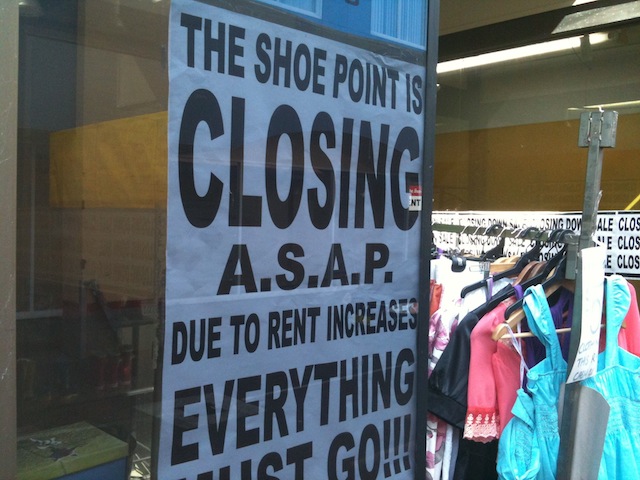
    Contrary to the bleating of Australian retailers, the biggest problem facing the sector is the nation’s high rents and property prices.

    For consumers, those huge rents and huge mortgages take money that could otherwise be buying more consumer goods, at the same time retailers are being slugged by some of the highest rents in the world, pushing up their costs and reducing competitiveness.

    That lack of competitiveness is affecting all parts of the Australian economy, particularly tourism, and the retail industry isn’t immune to those forces.

    Anyone who visits an Australian eating establishment will have experienced this, personally I had another experience last night at a pub that charged $4 (3.70 US) for a soda water.

    This wasn’t a trendy downtown bar but a pub in a lower middle class suburb with two overworked and under trained young bar staff. During the three hours there, our table of six was cleared once.

    no-table-service-in-australian-business.jpg

    Swiss prices coupled with service that would be barely acceptable in a 1970s outback Queensland roadhouse is not the formula for a successful economy.

    The business challenge

    Which brings us back to Solomon Lew’s whinge about the government, Sol handily overlooks the previous government’s  stimulus packages which kept the nation out of recession and put money straight into his and other retailers’ pockets.

    There’s a lesson there for the Australian Labor Party that the tweedle-dum, tweedle-dumber strategy of offering near identical corporate and middle class welfare policies to the Liberal Party is not going to win you friends with the nation’s business sector and its entitled leaders.

    For the incoming Liberal government, it is faced with the challenge of making Australia a competitive, high-cost economy along the lines of Japan, Switzerland or Germany.

    It’s hard to be optimistic about the Abbott government meeting this challenge given the bulk of its ministers are holdovers from the previous Howard Liberal government that was largely responsible for Australia flunking the transition to being a high cost economy along with institutionalising a middle class welfare culture into Australian society.

    Even if Abbott does genuinely attempt to address Australia’s lack of competitiveness, he can be sure he will get absolutely no help from the whingeing captains of the nation’s industries, as Solomon Lew has shown.

    While Solomon Lew and the Australian managerial class struggle with their perfect storms of economic, demographic and technological change, the nation also faces those headwinds.

    Hopefully for Australia there are capable leaders who can navigate those storm waiting to take the helm.

    Similar posts:

  • Kinkabool – the highrise past and future

    Kinkabool – the highrise past and future

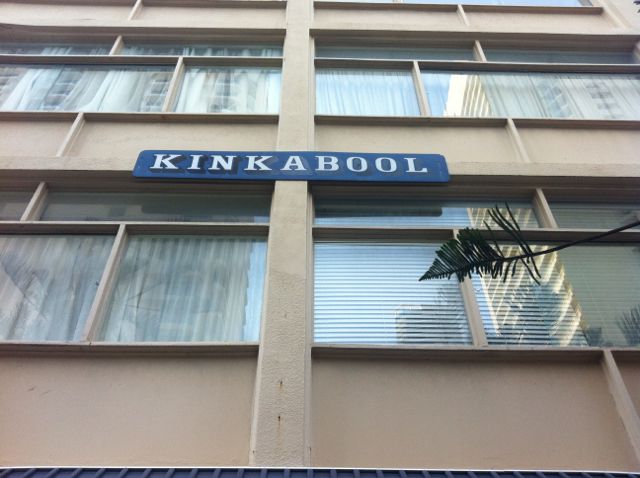
    Today high rise buildings are the norm on Queensland’s Gold Coast, but just over fifty years ago in Surfers Paradise, nine storey Kinkabool was the first of the breed to be built. Its condition today is a warning on how skyscrapers can turn into expensive liabilities for owners.

    ABC Open has an interview with one of the workers on the building and in the accompanying video Bob Nancarrow shows just how Kinkabool dominated the then sleepy seaside resort of Surfers Paradise in 1960.

    kinkabool-overshadowed

    A visit to Kinkabool today reveals a building struggling in the face of poor maintenance and an undercapitalised ownership. Luckily for the owners’ corporation,  the Queensland government pitched in to repair the roof but much of the rest of the complex is showing its age.

    kinkabool-lobby

    The rabbit warren lobby with its orange tiles indicate some of the building was upgraded in the 1970s but apart from a lick of paint, it hasn’t seen much love since.

    kinkabool-lift-lobby

    The lift is are where the building’s age and owners’ lack of investment really shows. An old, slow elevator that hasn’t been upgraded since the first residents moved in clunks its way up the building. Even Hong Kong’s Chunking Mansions – the world’s best example of a dysfunctional high rise – gets its lifts upgraded sometime.

    kinkabool-lift-interior

    Inside the lift, it’s a depressing scene and one wonders if the antiquated equipment would meet today’s building standards. Even if it does meet the regulations, the dispiriting ride on its own would knock a big chunk off the asking prices for buyers or renters.

    kinkabool-lobby-stairwell

    Stepping out of the lift, the view in the stairwell isn’t much better. The lack of maintenance or investment begins to show in old fittings, damaged glass and hints of painted over graffiti.

    kinkabool-stairwell

    While standing on the ninth floor, music from unit 1B drifts through the building – it’s lucky the occupant has a taste in cheesy 1970s music as some thumping headbanger music could to serious damage to the building along with the residents’ sanity.

    One wonders just how noisy the building would be with a party happening or a young, crying baby although it seems families aren’t really interested in these apartments or the central Surfers Paradise location.

    Though a very undistinguished building, it does have one touching little architectural feature in  the different tile patterns on each floor, although probably not enough to redeem it in the eyes of most people.

    kinkabool-tile-featurekinkabool-tile-feature-2

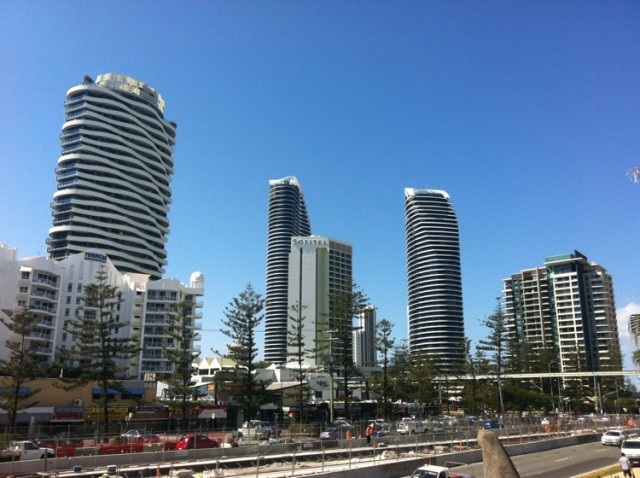
    Probably the saddest thing about Kinkabool is how a building that once dwarfed everything in the region is now overshadowed by its much bigger neighbours.

    kinkabool-neighbours

    Across the road, and blocking out most of Kinkabool’s sunlight, is the 1980s Paradise Centre.

    Time isn’t proving any kinder towards the Paradise Centre with the lack of maintenance beginning to show on the thirty-year old complex as this vent across the street from Kinkabool illustrates.

    kinkabool-neighbours-rusting

    Generally, if the landlord or owners’ corporation is too stingy to afford a coat of paint, then you can be sure there are more nasty surprises

    Both the Paradise Centre’s and Kinkabool’s declines illustrate a much more fundamental problem in an economy driven by property speculation and taxation allowances — there isn’t a lot of money to go around for maintaining older buildings.

    While Kinkabool’s residents can get by with a clapped out lift, inhabitants of larger and more modern complexes like the Paradise Centre will find the costs of running and maintaining their buildings an increasingly difficult burden.

    It could just turn out that Kinkabool, should it escape the wrecker’s ball, may well turn out the more desirable dwelling than its bigger, more modern neighbours.

    For the meantime though, Kinkabool marks the beginning of a far more sophisticated era in Australian and Gold Coast history. Whether that era became too sophisticated for itself remains to be seen.

    kinkabool-goodbye

    Similar posts:

  • We came, we saw, we were ripped off.

    We came, we saw, we were ripped off.

    One bad schnitzel on Queensland’s Gold Coast illustrates the biggest economic problem facing Australia.

    As we approach the 2013 Australian election, it’s notable how the debate – if it can be described as that – hasn’t touched on the biggest issue facing the country, the hollowing out of the nation’s economy.

    In the 1980s the Gold Coast was going to be the centre of a Japanese led tourism boom.

    That boom petered through a combination of greed and incompetence on the part of Australian tourism and hotel operators, a process being repeated with Chinese tourists twenty years later.

    Like the rest of the Australian economy, in the 1990s the Gold Coast looked inwards with a focus on property speculation and construction that kept the workforce employed pouring concrete and fitting out kitchens.

    In the meantime, the Gold Coast’s tourist assets were left to rot through under investment. Jupiter’s Casino is a good example of this, a building stranded in the 1980s and in desperate need of a capital injection.

    The Gold Coast was not alone in this, a review of Perth’s Rendezvous Grand Hotel — built by Alan Bond in the 1980s — illustrates exactly the same problem at the other end of the country.

    A lack of investment plagues all of Australia’s hospitality industry, a dinner at the Bavarian Bier Cafe on the Gold Coast’s Broadbeach* was a disaster as poorly trained staff were overwhelmed by a half full establishment and let down by poor business systems.

    That shocking meal — which saw the staff struggle to get out a salad and two beers in over two hours with the greasy, overcooked mains arriving nearly three hours after the diners arrived — is not untypical in Australia.

    Soviet style service is fine when beer and a poorly cooked, mostly breadcrumbs, schnitzel costs fifty kopecks, however at modern Australian prices the service, food and cooking should be world’s best.

    That high prices rarely translate to superior standards in Australian establishments shows how poorly the nation has adapted to being a high cost nation.

    While it’s fashionable to blame the mining industry for the down under manifestation of the Dutch disease, the answer to what has driven Australia’s under investment in tourism, agriculture and manufacturing lies in the cities and suburbs.

    On the same day as the disastrous Bier Cafe meal, the Gold Coast media was reporting that relaxed zoning restrictions would allow unrestricted high rise building heights.

    While the real estate industry welcomed this, the reality for local property speculators hasn’t been pretty with buyers in the twin tower Gold Coast Hilton development being hit with forty percent losses.

    Part of the reason for the poor performance in property speculation is that Gold Coast industry has been hollowed out with local office vacancy rates varying between 27 and 14% percent.

    While much of the rest of Australia’s property markets have been spared similar declines to date, the emphasis on real estate speculation over investment in industry has been similar across the nation.

    That lack of investment in productive industries, whether in tourism or manufacturing is already hurting Australia,  more critically it’s preventing Australian businesses’ from dealing with the transition to being a high cost economy more akin to Switzerland, Japan or Germany than the United States.

    One bad schnitzel on the Gold Coast might not tell us much in itself, but the under investment in systems, training and staff is a bad omen for Australia’s economy.

    Regardless of who wins Australia’s federal election on Saturday, it’s unlikely the group of pampered apparatchiks occupying the Treasury benches will have any idea of helping business or society transition to the realities of the Twenty-first Century.

    *Paul travelled to the Gold Coast and ‘dined’ at the Broadbeach Bavarian Bier Cafe as a guest of Microsoft Australia

    Similar posts: