Category: Big Data

  • Blind faith in the algorithm

    Blind faith in the algorithm

    It’s fairly safe to say Apple’s ditching of Google Maps for their own navigation system has proved not to be company’s smartest move.

    The humiliation of Apple was complete when the Victoria Police issued a warning against using the iPhone map application after people became lost in the desert when following faulty directions to the town of Mildura.

    Mapping is a complex task and it’s not surpising these mistakes happen, particular given the dynamic nature of road conditions and closures. It’s why GPS and mapping systems incorporate millions of hours of input into the databases underlying these services.

    Glitches with GPS navigations and mapping applications aren’t new. Some of the most notorious glitches have been in the UK where huge trucks have been directed down small country lanes only to find themselves stuck in medieval villages far from their intended location.

    While those mishaps make for good reading, there are real risks in these misdirections. One of the best publicised tragedies of mis-reading maps was the death of James Kim in 2007.

    Kim, a well known US tech journalist, was driving with his family from Portland, Oregan to a hotel on the Pacific Coast in November 2006 when they tried to take a short cut across the mountains.

    After several hours driving the family became lost and stuck in snowdrifts and James died while hiking out to find help. His wife and two children were rescued after a week in the wilderness.

    Remarkably, despite warnings of the risks, people still get stuck on that road. The local newspaper describes it the annual ritual as find a tourist in the snow season.

    Partly this irresponsibility is due to our modern inability to assess risk, but a more deeper problem is blind faith in technology and the algorithms that decide was is good and bad.

    A blind faith in algorithms is a risk to businesses as well – Facebook shuts down accounts that might be showing nipples, Google locks people out of their Places accounts while PayPal freeze tens of thousands of dollars of merchants’ funds. All of these because their computers say there is a problem.

    Far more sinister is the use of computer algorithms to determine who is a potential terrorist, as many people who’ve inadvertently found themselves on the US government’s No Fly List have discovered.

    As massive volumes of information is being gathered on individuals and businesses it’s tempting for all of us to rely on computer programs to tell us what is relevant and to join the dots between various data points.

    While the computers often right, it is sometimes wrong as well and that’s why proper supervision and understanding of what the system is telling people is essential.

    If we blindly accept what the computer tells us, we risk being stuck in our own deserts or a snowdrift as a result.


    Similar posts:

  • Rethinking customer support

    Rethinking customer support

    One of weaknesses in most organisations is getting customer service right, good support takes time which costs money and leads many big and small companies  to scrimp on support to save a few costs.

    In a conversation with BMC Software’s Suhas Kelkar about customer support – Remedy, one of the biggest helpdesk software packages is a BMC product – the discussion turned to how the process has changed in recent years.

    Not too long ago we reached for manuals, but those vanished as CDs and then downloads became common. Then we’d call the manufacturer’s helpline or our unfortunate store who sold us the item.

    Today we Google a problem to see if we can find a quick solution and if that fails we reach out to our social networks by posting the question on Twitter or Facebook. We may even post the problem to a support forum to see if anyone has an answer.

    Only if can’t find the solution anywhere else do we call the support line, for most of us it is the last resort.

    In some ways this is a success for corporate cost cutting as most of us call a “helpline” only in desperation as we’ve trained to expect long waits, confusing menus and poorly trained operators.

    That model developed in the 1980s – in order to pay rockstar salaries to executives it was necessary to cut staff wages and training costs with after sales support often being the first business area to suffer cuts.

    Eventually this started to backfire and the Dell Hell saga as one of the leading examples where the computer manufacturer’s lousy support became industry legend. It’s fair to argue that Dell has never quite recovered from the damage the period of poorly outsourced support did to their brand.

    To repair the damage to their brand, Dell adopted a crowdsourced support model where company forums were available for customers to ask about problems with the hope other customers could answer before expensive staff became involved. Eventually other companies adopted this system.

    Social media has created a doubled-edged sword for businesses, it’s easier for people to ask their friends for help but it also increases the risk of brand damage if online posts aren’t monitored and responded to.

    All of this is forcing a rethink of how customer support works. For businesses big and small, social media and crowdsourcing tools are changing the way we talk to customers and how they can talk about us.

    The big data push is also changing customer support as businesses now have the computing power available to mine knowledge bases, issue registers and call logs to identify market trends and weaknesses in their products or sales teams.

    For business owners and managers stuck in the 1980s ways of customer support, they are in for a wretched time over the next few years.

    Similar posts:

  • Big Data, Bad Data

    Big Data, Bad Data

    “What about bad data?” an audience member asked me at a recent presentation where we looked at how social media and big data were changing business.

    His question came from an experience where he had sacked a staff member who now refuses to change their status as being employed by his company.

    The former employee wants to keep up appearances that they are still being employed and this causes reputation problems for their old employer.

    All of this makes that LinkedIn information on the employee and the business junk data. Rather than being useful, it’s misleading noise and that is a risk to LinkedIn’s business.

    This ties into Facebook’s problem with groups, if people can be added without their consent then the risk of mischief making and false information increases. In turn, this makes Facebook’s targeted advertising less effective.

    Similarly, Google’s aim to become an “identity service” becomes less feasible when the information they’ve gathered isn’t accurate – again something that is increases with their opaque policies and poor support.

    In Terry Gilliam’s movie Brazil, a man is arrested and dies under interrogation because of a fly getting stuck in a typewriter. We’re in the age of a billion flies being stuck in typewriters.

    LinkedIn, Facebook and all the other social media and “identity” services need to build in systems where those mistakes can be managed and the consequences limited. If they can’t do this then their value and relevance will be limited.

    Big Data shouldn’t mean bad data, and we all need to be confident that the data about us and the data we use in our lives is reasonably accurate.

    Similar posts:

  • Meeting the solid state Woz

    Meeting the solid state Woz

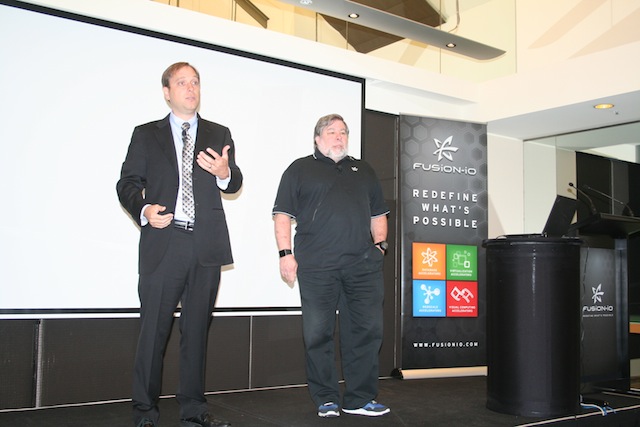
    When the opportunity comes to meet co-founder of Apple computer Steve Wozniak you jump at it, despite being jet lagged from the previous day’s flight.

    One of the tough things when writing about Steve Wozniak is that he is a fast talker. You have to be quick to keep up with his ideas and words.

    Steve was in town to show off the range of solid state computer memory cards manufactured by Fusion-iO, a company based in Salt Lake City.

    Wozniak liked the idea so much he became Fusion-iO’s chief scientist in 2009. “When I first saw the iO drive, it was so beautiful I had to buy one from the company and put it in a frame just to frame it at home.”

    What enthused Woz were Fusion-iO‘s range of NAND flash memory cards that speed up servers while reducing their power and cooling requirements.

    Those power savings are important for data centres when hundreds of thousands of servers might be in one building, Fusion-iO’s CEO and co-founder David Flynn estimates this could save up the industry a $250 billion a year in operating costs.

    Probably the biggest benefits though are in the corporate space, one Flynn’s boasts is how one movie studio used Fusion-iO’s products to reduce transcoding between formats from two hours to 39 seconds.

    Another case study they show off is how grocery chain Woolworths were able to reduce the 17 hours to run their weekly trading reports to three hours meaning they were able to capture weekend figures for their weekly Monday morning board meetings.

    For smaller businesses, the biggest benefit is these products can turn fairly basic desktop computers into workstations with the $2,500 ioFX card promising some serious post production capabilities for a system although one would expect an entry level box wouldn’t have the data connection, hard drive or – most importantly – power supply to cope with the demands of such a device would put on the typical cheap components in a basic desktop system.

    All of these changes though are heralding some pretty big changes for big and small businesses.

    Where Steve Wozniak sees the greatest application of moving data faster is in Artificial Intelligence applications like voice recognition. Apple’s Siri is a good example of this.

    The barrier to effective voice recognition is the sheer amount of data processing required to effectively understand voice commands. Doing this on cloud services is a far more efficient and effective way of doing this.

    As we saw at Dreamforce last week, the sheer amount of data pouring into companies is changing how they manage information. Getting access quickly to relevant information is an important part of managing it.

    “I’ve never gotten so excited about or fell in love with a technology like this since Apple.” Says Wozniak.

    Having a chance to speak to Steve Wozniak up close shows that fast talking enthusiasm is for real. The Woz is a real geek.

    Like all true geeks Wozniak is passionate about what he believes in – whether it’s about NAND flash cards or becoming an Australian resident he bubbles with enthusiasm. Just don’t try writing notes down while he’s in full flight.

    Similar posts:

  • Redefining the social business

    Redefining the social business

    Over the last two years Salesforce.com have been one of the more aggressive buyers of cloud computing and social media startups with acquistions of companies like Rypple, Desk.com, Buddy Media and Radian6.

    Today, ahead of the company’s annual Dreamforce conference in San Francisco, Salesforce.com announced a revamped product range that brings together the social media and big data tools from these acquisitions along with some in house innovations.

    Salesforce expect nearly a hundred million enterprise tablet computer users and smartphones by 2016, so like all web based services, they have to make their platform available as an app. Salesforce’s new Touch iOS App allows users to use Salesforce.com as an app on the iPhone.

    Despite Mark Zuckerburg’s disavowal of HTML5 last week, Salesforce remains committed to the standard despite developing an app for the iPhone.

    “Initially we’re rolling out Touch in a way we’ve made sure works the way people want it to work on an iPad,” Peter Coffee, Vice President of Platform Research at Salesforce.com, says.

    “We are reiterating our commitment to HTML 5 as a device and platform neutral cluster of standards.

    “As HTML5 begins to clearly coalesce we’re making a major commitment to that and we’re going to lead the way while the opposition is still trying to work on one browser.”

    Salesforce continues their focus on social media with their Chatter service becoming a key part of their Force.com cloud applications platform. Chatter itself is being extended with a new feature to enable companies to create their own branded communities.

    That social integration continues as the company rolls out Social Key, an application which, as Andy MacMillan, senior vice president and general manager of Data.com says “will empower companies to derive value from social data for the first time.”

    If Social Key does achieve a real measure of value from retweets and Facebook posts it may well mean many social media experts will have to return to multi-level marketing or real estate sales. This in itself is not a bad thing.

    The new Salescloud platform uses Chatter to build business intelligence on customers, bringing data across a business to help sales teams target their efforts more effectively.

    While sales is by definition the focus of Salesforce they are also launching a similar Chatter service for support teams. This compliments the acquisition of Assist.ly at the beginning of the year.

    Marketing too is being targeted by Salesforce with the launch of Marketing Cloud that combines the Buddy Media Facebook marketing service and the Radian6 social media monitoring platform.

    While already the leader in business cloud applications, Salesforce are making a strong bid to dominate the sector in a way that Microsoft did in the desktop computer industry twenty years ago.

    Browsing through the 400 partner stands at the Dreamforce Expo shows Cloudforce  are building a deep ecosystem around their products that will make it hard for competitors to break into the space.

    Whether Salesforce achieve this dominance remains to be seen, but they are certainly giving a new set of tools for businesses to understand their customers.

    Pricing and Availability
    Salesforce Touch is generally available today on iOS devices, and included in all Salesforce editions.

    Sales Cloud Partner Communities is currently scheduled to be available in limited pilot in Fall 2012.

    Sales Cloud Partner Communities is currently scheduled to be generally available the second half of 2013.

    Data.com Social Key is currently scheduled to be generally available the second half of 2013.

    Pricing of Sales Cloud Partner Communities and Data.com Social Key will be announced at general availability.

    Similar posts: