Along with the carpark test, a lack of customer service is one of the best indicators that a company has lost its way.
Unattended reception desks, closed cash registers and deserted delivery docks are reliable indicators management has focused on short term staff savings which will ultimately cost the business dearly.
Walmart is the latest example of this with Bloomberg Businessweek reporting that US shoppers are deserting the chain because shelves are empty and stores don’t have enough staff.
The claim stock is piling up out the back of stores is particularly concerning, the just in time inventory management of modern retail chains means there’s little room for error as outlets don’t have a lot of space whil the cash flow of the business and its suppliers is based on getting goods quickly into the hands of eager consumers.
Some of Walmart’s pain will be spread among suppliers as the store’s contracts will push undoubtedly some of the costs of rejected deliveries back onto logistics companies, effectively creating problems through the entire supply chain.
No doubt there’s plenty of angry suppliers and truck drivers who are grumbling about lost time and payments on Walmart contracts. That won’t be good news for the company’s buyers when contracts come up for negotiation.
Walmart’s isn’t the only retailer who’s fallen for the short term fix of cutting store staff to give a quick profit boost as department stores and big box outlets around the world struggle with the damaging effects of not being able to serve customers.
That Walmart, one of the industry’s global leaders, would make such a mis-step shows the pressures on managements as economies deleverage and credit wary consumers decide that don’t need more junk in their homes.
Cutting costs isn’t going to address those bigger trends, it’s going to take original thinking and management commitment to adding real value to customers.
Service is just the start of a long process of refocusing the retail empires.
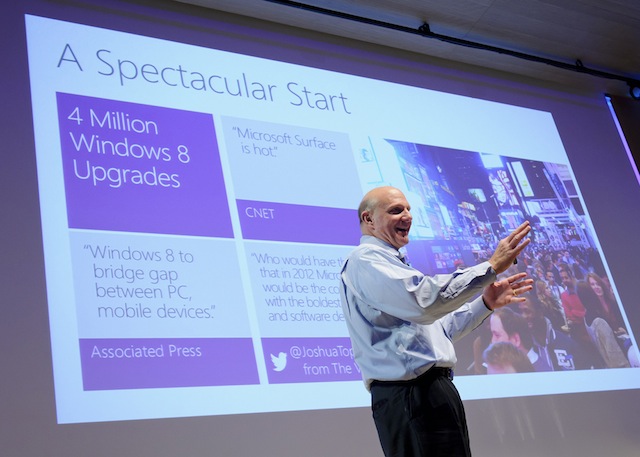
Killing a technology product is never a clean process, as Google well know. Microsoft show the way to deal with a failed project and we’re seeing their five stages of abandoning a product as they prepare to retire Windows 8.
The stages of Microsoft are abandoning a product are well known – the failure of Microsoft Vista is the best example, but not the only one.
As Microsoft smooths Window 8’s pillow and prepares for its imminent demise we can see the process at work.
Denial
At first the company denies there is a problem, the flashy advertising campaigns are boosted and the various ‘in the camp’ commentators get informal briefings from company evangelists to fuel their snarky columns about people getting Microsoft’s latest product all wrong.
This usually goes on for around six months until the market feedback that the product is dog becomes overwhelming – usually this happens at the same time the first reliable sales figures start appearing.
Anger
As the consensus in the broader community becomes settled that the new product isn’t good, the company’s tame commentators turn nasty and lash out at the critics for ‘misrepresenting’ the new product.
This is usually a touchy period for Microsoft and other vendors as they can’t risk being too aggressive but they have to allow their allies to both let off steam and try to recover the credibility they lost in hyping what’s clearly been a market failure.
Bargaining
Once it’s clear the perceived wisdom that the product isn’t very good isn’t going to be shaken, the vendor comes out with special offers and pricing changes to try and coax users over to the new service.
With Windows 8 Microsoft tried something unusual, rather than cutting prices, Microsoft announced they would increasethe cost of Windows 8.
The idea was probably to panic people into buying the product and giving Microsoft a revenue and market share bounce for the quarter.
It didn’t work – the consensus that Windows 7 is a better product meant people stayed away.
Depression
As the realisation that pricing tweaks and promotional stunts won’t work sends the company, and its supporters, into a funk.
For experienced industry watchers, the silence around a product that’s been heavily hyped and defended for the previous year or two is a good indication that the next version is being accelerated.
Acceptance
Eventually the vendor accepts the product has failed and starts working on its own exit strategy – hopefully one that doesn’t see too many executives sacked.
With Microsoft’s this process starts with a quiet announcement that the replacement version of Windows is on the way, in this case Windows Blue.
At the same time, the tame commentators start talking about ‘leaks’ of the wonderful new system that is in the pipeline. Early beta versions of the new product start popping up in developers’ forums and file sharing sites.
Eventually you get stories like this one that appeared in The Verge yesterday – Windows Blue leaks online and we can be sure the Microsoft public relations machine has subtly moved onto the next version.
Vale Windows 8
So Windows 8 is coming to an early end. In one way this is a shame as it was a brave gamble by Steve Ballmer and his team to solve the ‘three screen’ problem.
Computer users today are using three or more screens or devices – a desktop, a smartphone and a TV or tablet computer.
Microsoft were hoping they could develop a system that unified all these platforms and gave users a common experience regardless of what they were using.
It appears to have failed, probably because the different devices don’t have the same user experience so a keyboard based system doesn’t work on a touchscreen while a touch based system sucks really badly on a desktop or laptop computer – which is Windows 8’s real problem.
Unrealistic expectations
Another problem for Microsoft were the unrealistic expectations that Window 8 would halt the slide of personal computer sales.
PC manufacturers have been baffled by the rise of smartphones and tablet computers – vendors like Dell, HP and Acer have miserably in moving into the new product lines and they hoped that Microsoft could help arrest their market declines.
This was asking too much of Windows 8 and was never really likely.
So the cycle begins again with Windows Blue, the question is whether it will be the last version of Windows as we move further in the post-PC era.
A strange thing about Australian business reporting is that its often full of gossip and name dropping as any third rate scandal magazine.
In a perverse way, treating business executives like the Kardashians gives the average mug punter – and shareholders – a glimpse into how these companies do business. Like this story in the Australian Financial Review;
Hamish Tyrwhitt was unaware of the latest drama unfolding within the Leighton board as he relaxed in the Qantas First Class Lounge in Sydney on Friday morning.
Indeed, the contractor’s chief executive officer was busy chatting to former Wallabies captain John Eales while waiting to board a flight to Hong Kong where he was due to close a recent deal to build the Wynn Cotai hotel resort in Macau and enjoy the Sevens rugby tournament.
The timing was not good. Tyrwhitt had only just boarded the flight when the news broke that chairman Stephen Johns and two directors had resigned. Tyrwhitt was forced to change his plans and is expected back in Sydney for a board meeting convened this weekend.
One July evening about four years ago, off the south coast of France between Cannes and St Tropez, two men sat in the jacuzzi on the top deck of a 116-foot Azimut motor yacht. It was about 3am and the sea was rough. The spa water was sloshing about and had given the latest round of caprioskas a distinctly bitter taste.
Dodo boss Larry Kestelman was telling his good friend, M2 Telecommunications founder Vaughan Bowen, about the challenges of growing his internet service provider business.
It’s tough doing business when the spa waters are choppy. One expects better from a seven million dollar boat.
That second article raises another point that’s often overlooked, or unmentioned, when reporting Australian business matters.
on Thursday the 14th, something unexpected happened. At 12.30pm, after no activity all morning, shares in the thinly traded Eftel started to rise sharply. By the time the market closed at 4pm, Eftel had soared 44 per cent to 39.5¢. Someone with knowledge of the deal was insider trading.
Insider trading? On the Australian Security Exchange? Somebody had better call those super-efficient regulators who were responsible for Australia cruising through the global economic crisis of 2008.
Somebody obviously wanted their own 116ft luxury yacht or corporate box at the Hong Kong Sevens.
Both of these stories illustrate the hubris and privileges of corporate Australia and its regulators.
One wonders how well equipped these organisations are for an economic reversal when their leaders are more worried about caprioskas and their spots in the first class lounge.
It seems the company’s dropping Google Reader into the deadpool proved the final straw for many of the tech early adopters who’d invested too much time building their feeds and other digital assets only to find services taken away from them.
Google are suffering corporate Attention Deficit Disorder (ADD) where management find a bright shiny thing, play with it for a while then get bored and wander off.
This is trait particularly common amongst cashed up tech companies. In the past Microsoft and Yahoo! were the best examples, but today Google is the clear leader in the Corporate ADD stakes.
Corporate ADD requires a number of factors – the main thing is a big cash flow to fund acquisitions.
In companies with this luxury, bored managers find themselves looking for things to do with all the money flowing through the door and when a hot new product or market sector appears those executives want to be part of it.
So a company gets acquired or a project is set up and the advocate drives it relentlessesly within the corporation, usually with lots of PR and write ups in the industry press.
Then something happens.
Usually the advocate – the manager or founder who drives the project – gets bored, promoted or sacked and the project loses its driving force within the organisation.
Without that driving force the service stagnates as we saw with Google Alerts or Reader and eventually company closes it down.
This has unfortunate effects on the marketplace, users invest a lot of time in the company’s service while innovators in the affected market struggle to get funding as the investors say “we can’t compete with Google’.
A changed perspective
What’s interesting now though is the sea-change in the attitude towards Google’s Keep announcement – rather than dozens of articles describing how competing services like Evernote are doomed in the face of the search engine giant entering their market, most are saying this validates the existing startups’ investment and vision.
More importantly, most commentators are saying they are going to stick with the services they already use because they no longer trust Google to maintain the product.
This is what happens when you lose the trust and confidence of the market place.
One of the mantras of the startup community is “focus” – focus on your product and the problem you want it to fix. That large businesses lack that focus shows how far from being a lean startup they have become.
Google’s real challenge is to regain that focus. Right now they have rivers of cash flowing through their doors but in an age of disruption, it may well be that they could dry up if no-one pays attention.
“Nobody got girls on the helpdesk” says Mikkel Svane, founder of online customer service company Zendesk.
Mikkel hopes to make customer service sexy again as businesses find they have to focus on keeping clients happy.
This is a reversal of management thinking of the 1980s where, as Mikkel says, “customer service is a cost centre, outsource it, don’t spend any time on it and don’t let customers steal any of your time.”
Now the internet gives customers to tell the world about a company’s service, the days of outsourcing or disregarding support are over.
Mikkel Svane and Michael Hansen of Zendesk
Cloud technologies are changing how software is used in business, as Mikkel found when he and his partners started Zendesk.
It became very obvious that building something that was easy to adopt, web based and integrated with email, websites. Something easy to use that didn’t clutter the customer service experience.
Something that moved from managing the customer service experience to focusing on customer service.
We built it, put it out there and customers starting coming.
A lot of these companies thought they could never implement a customer service platform. Suddenly small companies found they could compete with bigger competitors.
The appeal to investors
Having customers signing up proved to be a big advantage in Silicon Valley, no-one knew anything about a Danish company, but with local customers starting coming on board US Venture Capital firms understood what the company does.
That customer base proved powerful as Zendesk has to date raised $84 million dollars over four rounds of VC funding and is looking at a stock market float with an IPO in the next few years.
“Silicon Valley has a great tradition of building businesses.” Says Mikkel, “coming to Silicon Valley was such a big step for Zendesk, in taking it from being some little startup to being a real company that could scale very quickly.”
A question of scale
Groupon is a good example, when Mikkel and his team first met the Groupon team the group buying service was a team of four guys in Detroit. Groupon founder Andrew Mason personally signed off on the initial Zendesk subscription.
“What the hell is this company, we don’t get it.” Mikkel said at the time.
Three years later Groupon was the fastest growing company in history with thousands of support agents on their systems supporting hundreds of thousands of products.
Despite Groupon’s recent problems, Svane is proud of how Zendesk helped the group buying service with growth that no business had seen before.
“With Zendesk they got not only a beautiful, elegant system they also got the scale and the trajectory. Imagine if they’d tried to do that with an Oracle database? You’d have never been able to grow so quickly.”
On being a good internet citizen
In the past we talked about platforms – the Oracle platform, the Microsoft plaftorm – today the Internet is the platform.
“We are a good citizen on the Internet platform,” says Mikkel. “Shopify is a good citizen of the internet platform, these type of tools are easy to integrate. We are all good citizens of the Internet platform.”
Having these open system is the great power of the cloud services, they way they integrate and work together adds value to customers and doesn’t lock them into one company’s way of doing things.
The threat to incumbents
Vendor lock in has been a curse for businesses buying software. The fortunes of companies like Oracle, Microsoft and IBM have been built holding customers captive as the costs of moving to a competitor were too great.
Cloud services like Zendesk, Shopify and Xero turn this business model around which is one of the attractions to customers and it’s why huge amounts of money are moving from legacy solutions to cloud based services.
Another reason for the drift to cloud services is the reduction in complexity, the incumbent software vendors made money from the training and consulting services required to use their products.
Having simple, intuitive systems makes it easier for companies to adopt and use the new breed of cloud services.
Focusing on the business
Mikkel’s aim is to help businesses focus on their customers and products rather than worry about IT and infrastructure. In the long term it’s about helping organisations establish long term relations with their clients.
“Companies today realise that it doesn’t matter how much it matters how much I can sell to you right now, it pales into in comparison of how much I can sell you over the lifetime of our relationship. This ties into the subscription economy. It’s much more important for companies to nurture the long term lifetime relationship.”
Having a long term relationship with customers is going to be one of the keys for business success in today’s economy.
The days of transaction based businesses making easy profits from skimming a few percent off each sale are over and companies have to work on building long term relationship with customers.
Services like Zendesk, Xero and Salesforce are those helping new, fast growth companies grab these opportunities. For incumbent businesses, it’s not a time to be assuming markets are safe.