
Category: business advice

  • Disruption and leadership

    Disruption and leadership

    As new communications tools appear, the challenge for managers is to deal with the disruptions these technologies bring to their businesses.

    Launching Deloitte Digital’s release of Taking Leadership in the Digital Economy last week the Executive Director of Telstra Digital Consumers, Gerd Schenkel, described how business is changing as consumers are being empowered by smartphones.

    A good example of this is the taxi industry where applications like GoCatch, InGoGo and Uber give passengers the opportunity to fight back against poor service from protected operators.

    Sydney is an attractive market for taxi industry disruptors as the current protected market fails both passengers and drivers. Travis Kalanick, the CEO of Uber, said at the Sydney launch of his service earlier last week that the city is one of the more ‘problematic” markets they’ve entered alongside San Francisco and Paris.

    That letting down drivers along with passengers is an also an important point – drivers get 80% of Uber’s charges while InGoGo and GoCatch free operators from poor booking systems that frustrate everybody involved in the industry while making the system as unaccountable as possible.

    Similar changes are happening in other industries as technology changes the way suppliers, customers and staff work.

    A good example of changing work practices is the adoption of Bring Your Own Device (BYOD) policies in the workplace. A few years ago in most businesses it was unthought of that staff could be allowed to bring their own computers to work. Today it’s common and soon the companies that don’t have a BYOD policy will be exception.

    BYOD has happened because of the arrival of cheap consumer devices like smartphones and tablets along with IT departments rolling out web based services.

    We’ve seen this before – probably the greatest influences on the shape of modern society had been electricity and the motor car. These, and many other technological changes have shaped today’s workplace.

    Many businesses though suffer for those changes as we’re seeing with the drying up of the newspapers’ “rivers of gold”.

    For Telstra this is seen in the demise of their phone directory business; Sensis was a true river of gold in the days of printed phone directories, but a number of management mis-steps over the last 15 years meant they totally missed the transition to digital.

    The tragedy for Telstra that Sensis’ strength in the local advertising market should have been a positive given Google’s failure to execute on their local search strategy.

    On reflecting about the struggle to deal with transitions to new technology, just how many business are like Sensis and Fairfax in having leaders that aren’t equipped to deal with these changes.

    The leaders of the 1980s whose business models were based on the assumption of economic growth underpinned by easy credit, cheap energy and demographic growth and now finding those factors are moving against them at the same time technology change is disrupting their industries.

    For the upcoming generation of leaders, both in business and government, having the ability to adapt to the changed power relationships between customers, suppliers and workers is going to be essential. For those steeped in last century’s certainties, it’s going to be a tough time.

    Similar posts:

  • Bringing manufacturing home

    Bringing manufacturing home

    In the 1980s General Electric, like most US companies, sent most of its appliance manufacturing offshore.

    Now its coming home.

    The Atlantic Magazine looks at how General Electric is resuscitating manufacturing at Kentucky’s Appliance Park as management finds US workers are more skilled and productive than their equivalents in Mexico or China.

    An important part of the article is how critcal supply chains are; manufacturing hubs rely upon having a community of skilled service providers and suppliers around the factories while being close to customers improves and simplifies logistics.

    In the latter case, it now take hours or days to deliver products to customers’ stores or warehouses rather than the five weeks it takes from China.

    The cost of those goods is lower too, the Kansas made GeoSpring heater sells for $1299 while the Chinese product sells for $1599.

    What is most notable though is how designers and managers now have a better understanding of the manufacturing process; where under the oustourced model the difficulties in assembly were none of their business, now they are far more deeper and directly involved.

    This really goes to the core of what an organisation does – in the 1980s it was fashionable to talk of the “virtual corportation” where everything the business did was outsourced except for the managers who were employed solely to pocket their bonuses.

    In the 1990s and early 2000s that “virtual corporation” became a reality as manufacturing and customer support were offshored and logistics was outsourced.

    One of the best examples was customer support where looking after the needs of those who buy the company’s products were secondary to the need to cut costs.

    This focus on cost cutting over customer service hurt Dell badly in the 2000s and it continues to hurt many organisations – particularly telcos and banks – today.

    The weakness in the “virtual corporation” model was the company ended up adding little more value than the brand name and eventually those offshored manufacturers and call centres took control of the business’ goodwill and intellectual property.

    Eventually the hidden costs of offshoring became too obvious for even the most craven, KPI driven manager to ignore and suddenly manufacturing in the Western world became competitive again.

    Sadly, the fixation on dirt cheap labour has damaged many industries beyond the point where they can be salvaged with too many skilled workers lost and the ecosystem of capable suppliers destroyed. These are costs where tomorrow’s managers will rue the short sighted actions of yesterday’s corporate leaders.

    Similar posts:

  • Comparing Management costs

    Comparing Management costs

    Telecoms analyst site Asymco has a look at how much Samsung spends on marketing compared to other tech companies, particularly Apple, with Coca-Cola added as a sanity check from outside the bubble.

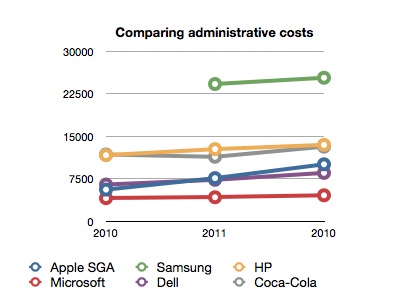
    While the results are stunning with Samsung dwarfing the others, the Asymco story also touches on the total cost of sales and general administration expenses with the observation that, as a proportion of revenue, Sumsung’s are soaring while Apple’s are declining.

    Teasing those figures out a bit more is interesting, when we track the sales and general administration costs of all the business we see that with the exception of Apple they’ve been remarkable flat in straight dollar terms over the last three years.

    Of course this comparison is a little unfair as this is an absolute number, not as a proportion of revenue and as Horace Dediu points out in the Asymco posts Apple’s expenses as a ratio to sales has fallen.

    For companies like HP, Dell and Microsoft where sales have been stagnant or falling it might be that the ratio is rising while spending is flat.

    We’ll tease these figures out over the next few days.

    In the meantime, the fact that Samsung is spending such an awesome amount on marketing should cause us to treat Android sales figures with caution as that spend in undoubtedly inflating their sales figures. More on that in the future as well.

    Similar posts:

  • What would you do if the computer screen went dark?

    What would you do if the computer screen went dark?

    What would you do if the computer went dark? originally appeared in Smart Company on November 29, 2012.

    One of the truisms of business is the more ways customers can pay; the more likely you are to make the sale.

    This is particularly true when something goes wrong – the customer hasn’t any cash, the till is jammed or the EFTPOS system is down.

    Exactly this happened to thousands of businesses across south-west Victoria last week when a fire burned down the Warrnambool telephone exchange.

    Unfortunately for the people and businesses of the surrounding region, much of the telephone, internet and Telstra’s mobile network runs through the burned out telephone exchange, sending the district back into the pre-telephone days.

    This presented real problems as customers couldn’t use EFTPOS or get cash out of ATMs, while businesses struggled to get payrolls done or place orders with suppliers who couldn’t comprehend that it wasn’t possible to place orders over the net or by fax.

    A hundred kilometres north of Warrnambool in the Grampians town of Dunkeld, a cafe worker told the ABC, “suppliers say ‘send a fax’ and you’re like ‘we can’t’ and they’re like ‘oh, we don’t want to handwrite it’.”

    Those suppliers are a good example of not having the systems or staff in place to deal with ‘out of the box’ situations.

    Unexpected events like the phone network being down for a week, major floods, devastating bushfires or zombie invasions will test businesses and it’s why having a real Business Continuity Plan (BCP) is important for business.

    A workable BCP is one that identifies all the critical failure points for the business such as not having the internet for a week, a flooded office or, as happened to one of my clients, their entire building collapsing into the construction site next door.

    The various state business agencies have guides on what to consider in a Business Continuity Plan including a good one from the South Australian government.

    Regardless of how comprehensive a plan your business has, the most important part is going to be your people. If your organisation is staffed or managed by people who like to say “computer says no,” then they are going to be particularly useless when the computer is stone dead.

    As the Warrnambool outage shows, unexpected business disruptions can come from anywhere, so flexible thinking and initiative is what matters in a crisis. It’s something worth thinking about with your staff and systems.

    Similar posts:

  • A weird case of Stockholm syndrome

    A weird case of Stockholm syndrome

    Hacks and Hackers are regular informal meetups where technologists and journalists get together to discuss how news gathering is changing in the digital age. The November Sydney meeting featured a discussion with Aron Pilhofer, founder of the original event and Editor of Interactive News at The New York Times.

    Aron had some great views on how journalism is changing and some of what he mentioned about the New York Times’ digital adventures was off the record

    Some gems from Aron included just how ‘dirty’ raw data is from government agencies and how journalists can help open data advocates make their stories more accessible. Those topics are for future blog posts.

    One of Aron’s comments about the challenges of the media was how many news organisations are trapped in “a weird case of Stockholm syndrome” – where their output is limited by their Content Management Systems.

    It’s notable how many businesses, not just in media are constrained by their own systems – what was set up to serve the organisation has instead has become the master.

    Of all the take aways from Aron’s talk, the Stockholm Syndrome of poor CMS’ is the most universal across industries – organisations pay a fortune to multinational consultancies for poor software platforms that management then tries to shoehorn their staff and business processes into.

    This rarely ends well and usually creates more problems as the business loses flexibility, which is exactly what has happened to new organisations.

    Sometimes biting the bullet and writing off a poor investment, particularly in software, makes damn good sense.

    Similar posts:

    • No Related Posts