One of the interesting points about the story was the two businesses featured, Elanation and Pod Tracker, didn’t use professional designers as the founders of both had expertise in that field themselves.
But it is clear, good design matters to users and it will avoid problems down the track with manufacturers shippers and possibly regulators so for most small businesses and founders hiring a professional could be a very good investment indeed.
Thinking about design and getting to market should be a priority for startup businesses says Murray Hunter, founder of Sydney’s Design + Industry.
Having won over 160 design awards during 30 years of running Design + Industry and employing 50 specialist designers and engineers in his Sydney and Melbourne offices, Murray has many insights in what makes a successful product.
“Some of those companies have gone on to become world leaders, it’s a hell of ride and it’s a fabulous relationship where 15 or 20 years later you have a client relationship that’s dominating the world.” he recalls.
Thinking like designers
The current startup scene in Australia provides an opportunity for the country, Murray believes.
“We’re losing manufacturing industry but there’s a whole new wave of businesses and startups based around new technologies, particularly around IoT”
Cyclone pruning shears
“The world wants to think like designers and lead by innovation, which is a really interesting line. You have the American government that wants to design think and you have all these large accounting firms that want to be design thinkers as well.”
“But everyone wants to be innovative and provide a better experience to the customer and we have all these new technologies that are giving us the ability to have a lot more information, be more informative.”
“It started with Apple with the iPod and then the iPhone and it’s led right through so we now have high expectations of what we want for products and services.”
Finding funding
His advice to startups is blunt, “the first thing you need is funding, If you don’t, start the process of development sufficient to develop collateral which enables you to gain investors.”
The development process itself starts with knowing the market.
“Products should be designed to suit the market, not on a hunch,” he says. “So you start with what the market wants and you go backwards. You don’t get dressed and say ‘where are we going’, you find out where you’re going and then get dressed.”
“The intelligent and qualified entrepreneur will have a lot of the problems solved, they’ll have done research, they’ll have knowledge of the market, they’ll know the segments it’s aimed at and quite often they’ll have route to market realised.”
BlueAnt Pump HD earbuds
“Crowdfunding makes a big difference as entrepreneurs can run a crowdfunding campaign, get initial sales and worldwide recognition for it. If it isn’t successful, that could be the end of it. Others know people who can fund it.”
“They may not have funding or they may, we have quite a few suppliers around us who will help with the funding process. We also know private individuals with deep pockets who are interested in investing.”
Changing the design industry
Over the past few years, the design industry has changed dramatically with the rise of Computer Aided Design, 3D printing along with new materials and manufacturing methods. Medical devices are one area that’s seen a rapid change.
“Thirty years ago medical products were low volume,” Murray recalls. “In Australia typically we’d make them out of sheet metal. Now the volumes have increased because the world is more easily accessed so we’re designing for higher volumes.”
CliniCloud non contact thermometer
“We’ve also got low cost manufacturing sources to provide solutions so we can develop a more sophisticated product that will be better received worldwide.
“The biggest change I think has been CAD (Computer Aided Design), the Internet and 3D printing.”
“CAD because we went from 2D drawing to 3D models, the internet because we no longer send DVDs or CAD files to our manufacturing partners and it means we can access manufacturers all over the world.”
“We’re working on a 3D printer that can make biomatter, in other words skin, there’s talk of doing teeth with the rigid externals and soft nerves. So where we go I can only think of organs, prosthetics, replacing cartilage which is a big thing for the elderly.”
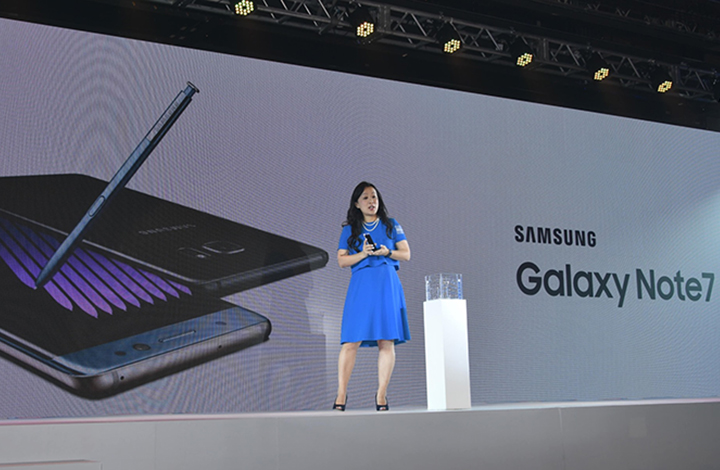
One of the most humiliating corporate crises of recent history has to be last year’s recall of the Galaxy Note.
Airlines around the world started telling passengers that the devices were banned during their pre flight briefings, causing untold damage for the Samsung brand.
That review shows the design and manufacturing errors that resulted in the batteries bursting into flames. How Samsung are fixing it or putting in systems to prevent that happening again isn’t discussed.
What the infographic does show is how complex the design, engineering and manufacturing is in modern technology – something that is often overlooked by many technologists.
Battery technologies are particularly fraught as a lot of energy is compressed into a small space and the chemistry of Lithium Ion batteries makes them particularly dangerous should they be damaged or incorrectly used, as Boeing found with the early models of the 787 Dreamliner.
Modern life and the devices that we take for granted are complex and that complexity though can easily come back to bite us. As Samsungs’ exploding batteries show, sometimes that complexity is difficult to manage.
As the cost of solar panels continues to fall, the need for coal and gas powered facilities continues to dwindle but given solar panels don’t need to be located in a central location, the nature of distribution networks is changing.
With power generation becoming more localised, communities don’t need expensive connections to power grids. In disadvantaged regions and developing nations, villages that would have to wait decades to be connected, if at all, now have a pathway to dramatically improving their standards of living.
Distribution companies that exploited their monopoly positions in providing power across wide networks are now having to reconsider the value of their expensive assets and lucrative business models.
Those countries and companies who thought high coal prices would bolster their standard of living, such as Australia, must be rueing their focus on fossil fuels. The massive investments made by mining companies and compliant governments are now increasingly looking like stranded assets.
For a moment Yiying Lu seems a bit sheepish about her title of ‘Unicorn Whisperer’ at 500 startups. “It was Dave’s idea,” she smiles referring to the tech accelerator’s founder, Dave McClure.
Yiying – whose more conventional title at 500 Startups is Creative Director and says her name translates to ‘happy creative’ in English – doesn’t do bashful very well, particularly when discussing the importance of design.
“If content is king, engagement is queen.” Yiving says when we interviewed her at 500 Startup’s San Francisco office in May, “if you look at the Bay Area community they look at the content rather than the design.”
Getting magic
“When you put them together that’s when you get magic,” says the designer who’s best known for creating Twitter’s Fail Whale and now counts companies ranging from Disney and Microsoft through to Mashable and a range of startups as clients for her design practice.
Captivating people with good design is the key to successful business, Yiying believes. “At the end of the day, it’s the engagement,” she says. “If you remember Google Wave, it was a great concept but it failed and look today – it’s Slack! Google Wave failed because there was no engagement. They didn’t really look at what the user wants.”
As someone who now spends most of her time in the Bay Area having shifted from her Sydney base several years ago, Yiying laughs while describing her belief that the entire region has been gripped by a mania. “98 percent of startups won’t survive, but everyone in the Bay Area wants to do it. They’re collectively insane,” she says. “Everybody is giving it their best shot.”
Seizing the collective insanity
When she arrived in the city, Yiying embraced that collective madness, “When I first came to San Francisco, I immediately thought I was home” and cites the city’s small size but dense community of talented, committed people as the main reason for the region’s success.
For areas wanting to copy the Bay Area’s success the key lies in getting all of the industry’s players improving their game. “If you want an awesome ecosystem then anyone should work. It shouldn’t be just one part of the ecosystem working,” she states. “Investors should get better as well.”
One of the many things Yiying is passionate about is not focusing on money and her advice to those intending to make the move is to look beyond the cash, “A dollar exchange is a narrow view,” she states. “We have a lot of real smart people coming here to TechCrunch Disrupt and South by South West thinking about finding investors. That’s not the way to to it.”
Looking beyond money
“Don’t think about finding investors, that’s a fear based model.” Is Yiying’s advice, “look at putting things into the community. You can only become really successful if you’re prepared to let other people be successful.”
For Yiying herself her priorities are a long way from cash. “When I make people happy, that’s more important than money,” she explains. “You can only become really successful if you’re willing to let others be happy and successful.”
Having made the jump to the Bay Area, she’s philosophical about where home is, having been born in Shanghai and spending much of her life in Sydney, Australia. “Home is where your heart is, but if your heart is big enough you can live anywhere.”
Seize the opportunity is Yiying’s advice to those looking at making the move, “a lot of things are in your head and things are more difficult if you let them worry you so it’s best to just do it,” she says. “Make it happen. Do stuff. There is no time to hesitate.”
For the creative worker, it seems ignoring the money and not hesitating is the way to stay happy. For tech business, getting engagement in a noisy world is everything.