Category: design

  • 4D printing and the next generation of design – ABC Sydney

    4D printing and the next generation of design – ABC Sydney

    I’ll be on ABC Sydney this morning discussing 4D printing and the future of design as the Sydney Vivid Festival swings into gear.

    Some of the areas we’ll be looking at in the spot that should start around 10.20am is what exactly is 4D printing, how can materials build themselves and how designers are creating more sustainable devices like Google’s Project Ara.

    One particularly interesting Vivid session is the Electric Dreams to Reality session that will feature local entrepreneurs and makers explaining how they are using the internet of things and new design.

    We’d love to hear your views so join the conversation with your on-air questions, ideas or comments; phone in on 1300 222 702 or post a question on ABC702 Sydney’s Facebook page.

    If you’re a social media users, you can also follow the show through twitter to @paulwallbank and @702Sydney.

    Similar posts:

    • No Related Posts
  • Gadi Amit – the designer as a contrarian

    Gadi Amit – the designer as a contrarian

    Gadi Amit, founder of San Francisco’s New Deal Design, has been on the forefront of designing  many of today’s wearable devices including the Fitbit, Lytro Camera and Google’s modular Ara phone.

    Ahead of his visit to Sydney to speak at the Vivid Festival last June, Gadi spoke about his philosophy on design and the future of wearable technologies.

    “As a matter of method we always try to look for the contrarian point of view,” Gadi says about his approach to a new project.

    “The initial point of view is better served by being tested against a contrary point of view, in about fifty percent of the cases we find the contrarian point of view actually wins.”

    Cherishing sustainable devices

    One of the key challenges facing designers today is creating sustainable product and Gadi sees the answer lying in developing durable, adaptable products.

    “I’m focusing most of my work on maintaining the usage of the object for as long as we can and extending its meaningful life to people.”

    “This way we make sure that that it’s usuable, it’s beautiful, it’s loved and it’s cherished.”

    project-ara-google-phone

    Google’s Project Ara is an example of Gadi’s philosophy of extending a mobile phone’s life by building the device up from modular units that allow handsets to adapt to users’ needs.

    Rejecting big data

    One of the effects of wearable and smart devices is the explosion of big data, Gadi sees this as problem for users and the result of a mismatch between the development of software and hardware.

    “The hardware design is actually ahead of the software design. Software is still lagging behind and still spewing data all over the screen.”

    “I think people don’t want more data, they want less data. They want meaningful cues that will be served with very little fanfare. You don’t need to know you walked 10,000 steps, you need to know if you’ve walked enough or not enough.”

    Gadi cites the early design of the Fitbit where the software showed a flower blooming to indicate the wearer was meeting the fitness objectives as an example of a simple and elegant way to convey complex information.

    Moving to a world of unlimited screens

    One of the opportunities Gadi sees with wearable devices is how methods of conveying complex information are going to change radically.

    “There’s greater understanding that we have to distil user interfaces into something more basic,” Gadi explains. “It’s a new design process that involves a lot of experimentation with the human body and hardware.”

    Escaping the boxes of design

    What excites Gadi about the design industry today is the diversity of opportunities.

    “Ten years ago an industrial designer dealt with maybe four or five types of boxes – you might design a mobile phone, which was a small level box, you might design a laptop which was a mid level box and you might design a PC which was a bigger box.”

    “I remember one executive describing the world to me as ‘we have four screens; there is the large TV screen, there is the PC screen, the notebook and the mobile. That was the grand unifying theory of the universe.”

    “What we have now in the studio are objects the size of a human finger that are made of soft material and have amazing kinematics and we have objects the size of a fingernail that are still interactive with humans.”

    “I’m really excited about it.”

    Similar posts:

    • No Related Posts
  • 4D printing and the quest for elegance

    4D printing and the quest for elegance

    Many of us are still getting comfortable with the idea of 3D printing, but MIT’s Skylar Tibbits is working on a fourth dimension that he hopes will move us into a more elegant era of design.

    Ahead of Skylar’s visit to Sydney for the Vivid Festival in June, Decoding the New Economy had the opportunity to interview him about what 4D printing is and his quest to create materials that can build themselves.

    What is 4D printing

    “We called it 4D printing because we wanted to add the ability for things to change and transform over time,” explains Skylar. “Time is the fourth dimension.”

    Skylar’s mission at MIT’s Self Assembly Lab is to create materials that assemble themselves. In a TED presentation he demonstrates how these materials may work and the philosophy behind them.

    Part of that search involves developing techniques for building large and complex structures from small components. “People know and utilise this in biology, chemistry and material science domains and we’re trying to translate that into larger scale applications.”

    Avoiding big machines

    “We don’t want to build bigger machines than the things we want to build, we want to build distributed systems,” Skylar continues. “If you want to build a skyscraper, you don’t want to build a skyscraper sized machine.”

    Not only does this philosphy offer benefits for manufacturing and building but it may also save energy, transport and labour costs as things can automatically build themselves once they’re delivered to a customer.

    “Materials should be able to assemble themselves or at least error correct or respond to active energy. There’s a whole application of packaging and minimising volume after manufacturing and transforming on site.”

    Over time they could also adapt to changed conditions Skylar believes: “There’s also how products themselves can transform and be smarter adapt to my demands or adapt to the environment as it’s fluctuating around.”

    Redefining the makers’ movement

    Worldwide we’ve seen the rise of the makers’ movement as affordable 3D printing and cheap electronics has made it possible to build new things; Skylar sees the Self Assembly Lab as being part of, but slightly apart from this group.

    “We make machines that make things, we’re integrated into that theme. We’re arguing that people can collaborate with materials and materials can be collaborative. It’s not just us making stuff and forcing materials into place, it’s materials making themselves.

    “A lot of methods are top down, big machines force materials into place and we’re trying to argue you can have bottom up applications in manufacturing.”

    So more than just simply printing components, Skylar sees the opportunity for embedding the intelligence into components so they can assemble themselves; the real task lies in programming the materials.

     The internet of elegant solutions

    Similarly, Skylar sees the internet of things as being a far more passive, perhaps even friendlier, field than that dominated by machines and plastics.

    “It’s not about the number of sensors and electronics and motor and things so that we can make these smart devices, we’re interested in how materials and fundamentally elegant solutions responding to external energy can have the same capabilities.”

    “We certainly believe in a connected internet of things, but it’s more a material based internet of things.”

    “I think that any solution in the beginning you throw a lot of money, technology and motors at it but over time you find more elegant solutions where materials can do more for you.”

    “The wearable space is a good example where people don’t want to wear electronics all over their bodies, they don’t want bulky things that are expensive and hard to assemble and clunky to wear.”

    “You want materials that you want your skin to touch, so we’re trying to find elegance in the solutions with smart devices.”

    Seeding the forest

    The challenge for Skylar, the Self Assembly Lab and those looking at changing the worlds of design and manufacturing is – like many other fields – funding.

    Material sciences, particularly those being explored at the MIT, have long lead times that aren’t suited to the current Silicon Valley led model of innovation and Skylar believes we need a different model.

    “We need to invest in super, long term radical innovation, to seed the economy and global technology development. We gained substantially in the Silicon Valley model with short term wins – with apps and simple technologies with incremental progress.”

    “It’s sort of like we need to seed the forest, we can’t just keep taking all these things from the top like low hanging fruit we need to create a forest effect so that we create many new technologies.”

    What comes out that forest of 4D printing and smart materials is anyone’s guess; but if Skylar Tibbits has his way, it will certainly be elegant.

    Similar posts:

    • No Related Posts
  • Three screens, four screens, infinite screens

    Three screens, four screens, infinite screens

    This morning I had the opportunity to interview designer of the Fitbit, Gadi Amit, ahead of his visit to Sydney next month.

    I’ll have the full interview written up in the next couple of days, but Gadi made an interesting point about not being in a ‘four screen world’ anymore, but in one where there’s infinite screens ranging from wearable glasses and watches through to smartphones and intelligent signage.

    A few years ago the concept of the ‘third screen’ came into use when we started talking about the smartphone supplementing the PC and the TV, it quickly morphed into four screens as the tablet computer appeared.

    Now the five year old idea of limiting ourselves to three screens seems quaint when there doesn’t seem to be any limits in the way we can view information.

    The end of the three screen theory is an interesting illustration on how quickly technology is moving, it also shows how rapidly business is changing.

    Similar posts:

    • No Related Posts
  • Building a house with 3D printing

    Building a house with 3D printing

    Much of the discussion around 3D printing has focused on making your own coffee cups, toys and small mechanical parts, but what if we start thinking about using these devices to build houses?

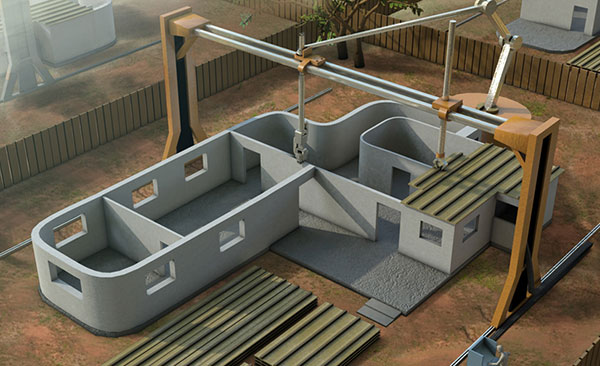
    University of Southern California spin off Contour Crafting received attention at the CES over the bold claim by the program’s director, Professor Behrokh Khoshnevis, that it will be soon possible to build a house in 24 hours.

    That’s an audacious claim although it doesn’t include site works or fitting out, much less the design of the structure.

    Contour Crafting isn’t the only university spin off experimenting with 3D printing to build structures; Freeform Construction, part of the UK’s University of Loughborough, has also been working on developing the technology.

    The British team haven’t been as audacious as their US colleagues and, rather than see whole buildings being constructed, they see potential applications being in fabricating specialised parts including cladding panels and complex structural components.

    Like all robotic applications working in hazardous environments is another aspect touted for the technology.

    The British team is almost certainly right in their view, 3D printing is unlikely to fabricate entire buildings onsite but it will have applications in the building industry which will have ramifications for tradesmen, architects and project managers.

    For architects this technology could prove to liberating as it gives designers the opportunity to create structures that haven’t been feasible or possible with existing materials and techniques.

    Some trades though may not fare so well should this technology appear on building sites, it certainly doesn’t look like good news for bricklayers and form workers.

    It will probably take sometime for this technology and it’s still very much under development, Contour Crafting itself won awards in 2006 and the machines are still under development.

    Bill Gates famously pointed out that in the short term we over-estimate the effects of technology while in the long term we underestimate them and that’s almost certainly the case with using 3D printing to build structures.

    Similar posts:

    • No Related Posts