Category: Disruption

  • Facebook incurs the users’ revenge

    Facebook incurs the users’ revenge

    On the web, no-one likes being forced into downloading a new app. That could be the main lesson from Facebook’s splitting messenger into a new app.

    Users aren’t happy and it shows in the product reviews as Mashable reports. Across the world the new Facebook Messenger app is getting the thumbs down in App Store reviews.

    Which goes to show how the public now have the power to strike back when they believe a corporation isn’t behaving fairly.

    The ball’s now in Facebook’s court to win back trust with an app that delights users. If they don’t, there’s always another disrupter on the horizon.

    Similar posts:

    • No Related Posts
  • Blackberry’s quest for its future

    Blackberry’s quest for its future

    This is the unedited, submitted version of ‘is BlackBerry ripe for a comeback‘ that appeared in Technology Spectator on 30 July, 2014.

    “What do we well?” is the question Blackberry CEO John Chen asked when he took the reigns of the Canadian communication company last November.

    Chen was speaking on Tuesday at Blackberry’s Security Summit in New York where he and his executive team laid out the company’s roadmap back to profitability.

    Since the arrival of the iPhone and Android smartphones, times have been tough for the once iconic business phone vendor as enterprise users deserted Blackberry’s handsets and the company struggled to find a new direction under former CEO Thorsten Heins.

    Back to BlackBerry’s secure roots

    In Chen’s view, the company’s future lies in its roots of providing secure communications for large organisations, “It became obvious to us that security, productivity and collaboration have to be it.”

    “This is not to say we are not interested in the consumer, but we have to anchor ourselves around the enterprise.” Chen said in a clear move distancing himself from his predecessor and products like the ill fated Blackberry Playbook

    An early step in this process of focusing on enterprise security concerns is the acquisition of German voice security company Secusmart which was the cornerstone of Chen’s New York keynote.

    Blackberry’s acquisition of the company is a logical move says the CEO of Secusmart, Dr Hans-Christoph Quelle, who points out the two organisations have been working closely together for several years.

    “It fits perfectly,” says Quelle. “We are not strangers having worked together since 2009,” in describing how Secusmart technology has been increasingly incorporated into Blackberry’s devices.

    Secusmart’s key selling point has been its adoption by NATO and European government agencies; the Snowden revelations on the US bugging of Angela Merkel coupled with the Russian FSB leaking intercepted US state department conversations along with the release of Ukrainian separatist conversations after the shooting down of MH17 has focused the European view on the security of voice communications.

    Launching new services

    Along with the acquisition of Secusmart, Blackberry will also be launching an new enterprise service in November, the new Passport handset in December along with a range of security applications including BlackBerry Guardian, a new service that will scan Android apps for malicious software.

    Blackberry’s executives were at pains to emphasise their products aren’t focused on any single smartphone operating system and not dependent on customers buying their smartphones although to get the maximum security benefits.

    “We will provide the best level of security possible to as many target devices out there as possible,” said Dan Dodge who heads Blackberry’s QNX embedded devices division.

    Longer term plans

    In the longer term, Blackberry sees QNX division as being one of the major drivers of future revenues as the Internet of Things is rolled out across industries.

    QNX was acquired by Blackberry in 2010 to broadband the communication company’s product range, now it is one of the pillars of the organisation’s future as Chen and his team see that connected devices will need secure and reliable software.

    Dodge says: “With the internet of things, you can have devices that can change your world.”

    While QNX is best known for its smartcar operating system – it underpins Apple’s CarPlay system being rolled out for BMW as well as its own system deployed in Audis – the company’s products are used for industrial applications ranging from wind turbines to manufacturing plants.

    Despite Blackberry’s announcements in New York, the company still facing challenges in the marketplace with the Ford Motor Company announcing earlier this week it will drop the Blackberry for its employees by the end of the year and replace them with iPhones.

    Chen’s though is dismissive about Apple’s and IBM’s moves into Blackberry’s enterprise markets, “what we do and what they do is completely different.”

    Focusing BlackBerry

    The focus for Chen is to differentiate Blackberry and play on its strengths, particularly the four markets it calls ‘regulated industries’ – government, health care, financial and energy that the company claims makes up half of enterprise IT spending.

    Whether this is enough to bring Blackberry back on track remains to be seen but Chen says this is where he sees the company’s future, “This is why we are so focused on enterprise and so focused on these pillars.”

    For Blackberry, the emphasis on enterprise communications is a step back to the profitable past. It may well be successful as businesses become more security conscious in a post-Snowden world.

    Paul travelled to the Blackberry Security Summit in New York as a guest of the company.

    Similar posts:
    • No Related Posts
  • Mapping AirBnB in San Francisco

    Mapping AirBnB in San Francisco

    The San Francisco Chronicle has a great feature mapping apartment rental service AirBnB’s effects on the city’s economy.

    By trawling through the AirBnB database, The Chronicle found 4,800 properties for rent in the city to glean a great deal of information that the company is not keen to share.

    A key point from the survey is that over 80% – 3200 – of the properties are householders renting out spare rooms or their places while they are away, which is exactly what AirBnB claim their service is designed for.

    The other, professional hosts are what’s attracted the wrath of regulators in cities like New York, where it appears unofficial hotels are skating around taxation and safety regulations.

    A new breed of middleman

    Catering for these professional hosts has seen another group of middlemen service pop up and The Chronicle features Airenvy, a service that helps landlords manage their properties.

    Airenvy is now the biggest San Francisco host, managing 59 properties on behalf of its clients and charging 12 percent commission for dealing with the daily hassle of looking after guests. Since launching in January it employs twelve staff.

    Unlike many of the internet middlemen, Airenvy does seem to add value to the renting process above being a simple listing service. For absentee hosts, the fees would seem to be worthwhile in reducing risks and problems.

    Filling the gaps

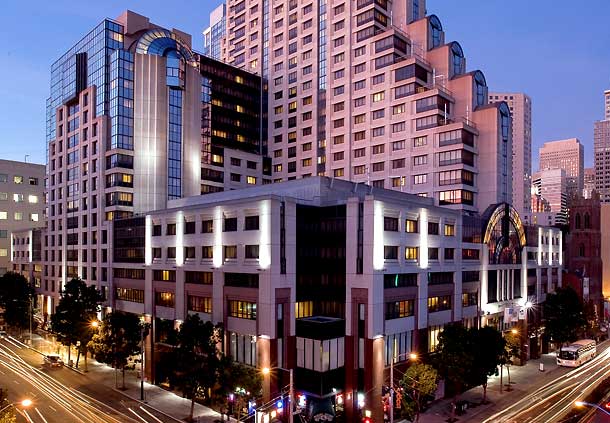
    A unique thing about San Francisco is the concentration of hotels around Union Square with 20,000 of the city’s hotel rooms within a ten minute walk of the Moscone Centre.

    For non-convention visitors, particularly those visiting family or friends, AirBnB is an opportunity to get a place out of downtown.

    The price ranges reflect the service’s diversity as well; from $18 a night for a couch through to $6,000 for a mansion. The average though is close to a typical hotel rate of $226 a day.

    The effects of AirBnB

    What the survey shows is AirBnB has diversified San Francisco’s accommodation options without the problems being encountered in New York.

    That isn’t to say there aren’t problems – the Silicon Valley model of pushing responsibility and consequences onto users leaves a lot of risk for the both the service and its customers – however AirBnB is another example of how industries are evolving as information becomes easier to find.

    Another thing this survey shows is the new breed of data journalism and how analysing the numbers can be the foundation of building great stories.

    The AirBnB and the changing global travel industry is a great story in itself as the San Francisco Chronicle has shown.


    Similar posts:

    • No Related Posts
  • Uber’s Travis Kalanick on the highly valued business of disruption

    Uber’s Travis Kalanick on the highly valued business of disruption

    For a four year old business, hire car service Uber is certainly causing a lot of trouble.

    Bloomberg Businessweek’s Brad Stone has an interview with the company’s founder and CEO Travis Kalanick on his plans after announcing a 1.2 billion dollar fundraising that values the venture at $17 billion.

    Seventeen billion dollars is a hefty valuation for the business and many believe it marks the peak of the current tech bubble, although many of us though Facebook’s billion dollar purchase of Instagram two years ago was that marker.

    Kalanick’s views are interesting in his take on that valuation – as he points out the San Francisco taxi market alone turns over $22 billion each year, so Uber’s valuation isn’t beyond the bounds of possibility.

    Uber and Logistics

    Also notable is Kalanick’s view on the logistics market, something that this blog has maintained is the real business of Uber. In that field, Fedex’s stock market value is $44 billion although Kalanick is discounting the company’s potential in that field.

    Right now Uber is on a high, and regardless of any set backs they may get with their ride sharing services, it’s hard to see how the company isn’t going to grab a healthy slice of the global taxi industry and possibly disrupt the logistics industry as well.

    Even should Uber end up being the poster child for today’s tech sector irrational exuberance, the company is a stunning example of how businesses we once thought were immune from global disruption are now being shaken up.

    Similar posts:

    • No Related Posts