Category: economy

  • Living in an age of grey boxes

    Living in an age of grey boxes

    If an era’s architecture tells us about the times, what do today’s houses tell us about modern society and values?

    On Sydney’s North Shore lies a collection of old army bases, from the 1980s onwards the military started moving out and some of the land was handed over as national parks, other parts were converted into office parks or cafes while the disused married quarters were sold off to private home builders.

    The old stores and administrative buildings have been adapted into artists’ studios and elegant, if expensive, offices. Overall, that’s been a success which has created quite a thriving businesses and creative community.

    old army store converted into an art gallery
    old army store converted into an art gallery

    Many of the colonial officers’ and NCO’s quarters, impressive sandstone and wood structures, have become offices, restaurants or function centres. Although some are still looking for a purpose.

    Old Colonial Military residence
    Old Colonial Military residence

    What happened to the functional three bedroom 1960s and 70s brick veneer homes that housed a generation of army brats is less encouraging and tells us much about the times in which we live.

    A few of the old post World War II homes remain for Navy families in the still operating, and expanding, HMAS Penguin and these show us the houses that once lined Middle Head Road in Mosman.

    old-mosman-military-family-home
    1960s Mosman military home
    old-mosman-militrary-family-home-2
    Another old Mosman military family home

    These are perfect examples of the functional family homes that covered Australian suburbia during the 1960s and 70s. While nothing exciting or particularly pretty, they were adequate for their task as baby boomers built their families in the post war prosperity.

    When they were sold by the Federal government most those modest family homes on Middle Head were bulldozed to make way for the grey behemoths of the 21st Century.

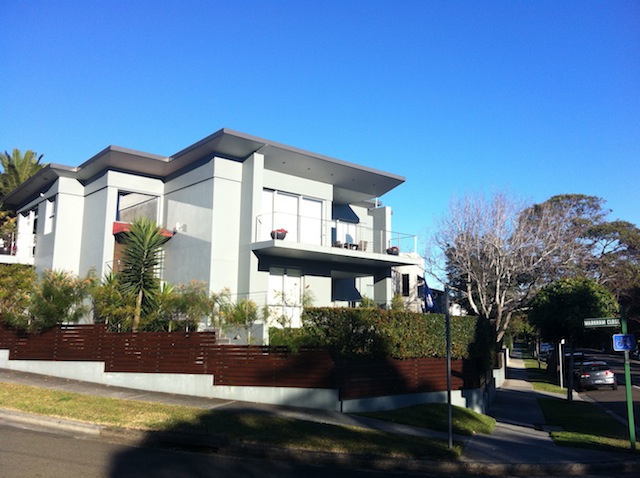
    new-grey-mosman-mansion
    New grey mosman mansion

    Like the Mc Mansions that crowd today’s suburbia, these feature four, five or even six bedrooms with on-suites, multicar garages and games rooms. Just as every child today has to win a prize, every room has to have a plasma TV.

    These monuments to the modern consumerist economy triumphantly march along a road that once featured modest homes with gardens, trees and lawns.

    Line of grey mosman mansions
    Line of grey mosman mansions

    In many ways these modern buildings represent the ethos of our time – grey, non-descript, poorly built, overcapitalised and dependent on cheap, never ending debt.

    A striking aspect about them is their hostility to the pleasant surroundings and the 1930s mansions that make up most of the street. With their battleship grey, security features and blocky air raid shelter lines they look much more like some sinister military installations than the red brick army homes they replaced.

    What’s also notable about these new buildings is many are empty. Some of them are being refurbished, only a few years after being built, and many are undergoing substantial repairs – a testament to  how Australian building standards have declined in the past two decades.

    Strolling along Mosman’s Middle Head Road its hard not to imagine that if Dorothea Mackellar were writing her iconic My Country poem today, she would have included the lines;

    I love a sunburnt country
    a land of capital gains

    The tragedy for Australia is those old three bedroom houses could have been used by a visionary government to help low income families in Sydney’s increasingly unaffordable suburbs.

    However we don’t live in visionary times and government assets today exist to be sold off as quickly as possible to Australia’s rapidly growing rentier classes.

    There was little chance those modest housing blocks would become anything more than expensive, over capitalised gin palaces for bankers and the city’s well connected business elite who are never slow to see a coal mine or old military property going cheap.

    Architecture tells us a lot about our times and the abandoned Middle Harbour army base is a good commentary on the phases of Australian development through the twentieth Century and the beginning of this century.

    The houses also tell how Australians see speculating on overcapitalised property as a safer investment than building the technologies and businesses necessary to prosper in this century. How that will turn out remains to be seen.

    What will be interesting is how our great-grandchildren see us and our legacy when they look upon the grey, hostile buildings we built to celebrate our good fortune in the early 21st Century.
    Similar posts:

  • Cutting the middle management fat

    Cutting the middle management fat

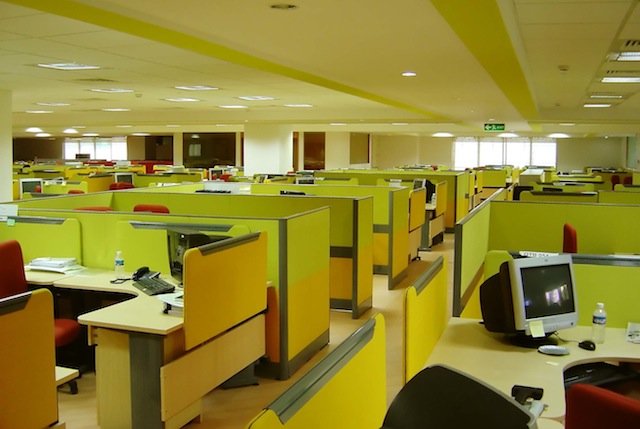
    No-one can say life is comfortable at Cisco when every two years the company engages on a round of job cutting that tends to keep employees on their toes.

    While this year’s job cuts are relatively mild – only 4,000 as opposed to nearly 13,000 in 2011 – it’s notable the focus on culling middle management positions.

    “We just have too much in the middle of the organization,”  the Wall Street Journal reports Cisco CEO John Chambers as saying.

    One of the challenges for businesses is become more flexible when markets are rapidly changing. Having ranks of middle managers makes it harder for organisations to respond.

    John Chambers and Cisco are reducing their middle management head count to respond to that need. Many other companies are going to have to do the same.

    Similar posts:

  • Can Russia build a Silicon Valley?

    Can Russia build a Silicon Valley?

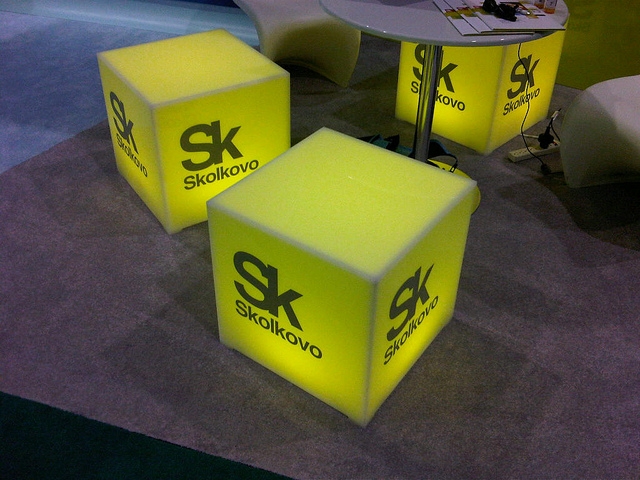
    Like many other countries, Russia is trying to build its own equivalent of Silicon Valley at Skolkovo on Moscow’s outskirts as Tech Crunch reports.

    Across the world governments are trying to find a way to replicate Silicon Valley – from London’s Tech City to Australia’s Digital Sydney, the hope is they can create the same environment that built California’s success.

    In some respects, Russia should be well placed to create their own Silicon Valley having had the same massive Cold War technology investments as the United Stated. The old Soviet system also left a deep scientific and mathematics education legacy.

    As the Tech Crunch article points out though, the Russian financial and legal systems are working against the nation with most local startups looking at incorporating in offshore havens like Luxembourg and Cyprus rather than taking their chances with the local tax laws and courts.

    If finance was the sole criteria for succeeding then Skolkovo would be almost guaranteed success with twenty billion US Dollars of private and government fundiing behind the project.

    Funding alone though isn’t enough, and most industrial hubs are the result of happy accidents of transport, natural resources and skills being found in one region.

    It might take more than a load of cash for Russia to build their own Silicon Valley, but with a shrinking and aging population the nation needs to find a way to diversify away from simply being an energy exporter.

    Image courtesy of Skolkovo Foundation through Flickr

    Similar posts:

  • Downward trends and demographics mark the end of consumerism

    Downward trends and demographics mark the end of consumerism

    One of the features of the late Twentieth Century economy was how consumer spending came to dominate the economy – as manufacturing moved offshore, mines closed down and agriculture became largely automated, many developed nations’ growth came from retail spending.

    Today’s release of retail spending figures by the Australian Bureau of statistics shows how that economic model too has come to an end. A post on the Macrobusiness blog illustrates the steady, structural decline of retail spending in Australia.

    ScreenHunter_10 Aug. 05 11.36

    Since 2000, the rate of growth has been declining, only low interest rate policies over the last two years has kept retail sales at a steady level.

    Those businesses whose business models are built on the assumption of high growth rates have a big problem – its no coincidence it’s the department and clothing stores are among the loudest complainers about taxes, labour costs and rents as they see their sales and profits shrinking.

    Basically the Twentieth Century era of consumption has come to an end as households have maxed out their credit cards. Now that many of those households are now older, they simply don’t need to spend as much anyway.

    With the demographic, economic and cultural changes now happening in society it’s a bad time to be planning on massive expansions in household spending and debt as we say in most western countries from the 1960s onward.

    It’s time to think different, and be a lot smarter about getting consumers to buy your products. The era of the 72-month interest free deal is over.

    Similar posts:

  • Is Australia falling behind on the internet of everything?

    Is Australia falling behind on the internet of everything?

    Last Friday Cisco Systems presented their Internet of Everything index in Sydney looking at how connected machines are changing business and society.

    Cisco Australia CEO Ken Boal gave the company’s vision of how a connected society might work in the near future with alarm clocks synchronising with calendars, traffic lights adapting to weather and road conditions while the local coffee shop has your favourite brew waiting for as the barista knows exactly when you will arrive.

    While that vision is somewhat spooky, Boal had some important points for business, primarily that in Cisco’s view there is $14 trillion dollars in value to be realised from utilising the internet of machines.

    Much of that value is “being left on the table” in Boal’s words with nearly 50% of businesses not taking advantage of the new technologies.

    Boal was particularly worried about Australian businesses with Cisco lumping the country into ‘beginner’ status in adopting internet of everything technologies along with Mexico and Russia, with all three lagging far behind Germany, Japan and France.

    cisco-country-capabilities-internet-of-everything

    In Boal’s view, Australian management’s failure is due to “the focus on streamlining costs has come at the cost of innovation.”

    This something worth thinking about; in a business environment where most industries only have two dominant players and the corporate mindset is focused on maximising profits and staying a percentage point or two ahead of the other incumbent, being an innovator itsn’t a priority – it might even be a disadvantage.

    For Australian business, and society, that complacency is a threat which leaves the nation exposed to the massive changes our world is undergoing.

    Similar posts: