Category: economy

  • Enniskillen and the G8’s Potemkin Village

    Enniskillen and the G8’s Potemkin Village

    In the middle of this month the G8 group of world leaders will meet in Northern Ireland when the UK takes their turn to host the annual conference.

    With the leaders of eight of the world’s biggest economies – which includes Canada but not China – coming to visit the Northern Irish government is anxious to present a prosperous face to the world, including allocating £233,000 to give Enniskillen’s town centre a ‘facelift’.

    It seems a good chunk of the facelift money has been spent on creating fake shops in the distressed town’s centre.

    In a little over two weeks they and other leaders will gather for a G8 summit at a golf resort in Enniskillen. And as the date approaches the cleanup is moving into high gear. It includes new coats of paint on houses, tidying up lawns, and putting up fake storefronts on shuttered businesses.

    For the visiting dignitaries, their advisors and the media caravans that follow them, Enniskillen’s shops will be looking prosperous when the reality is very different.

    “The County of Fermanagh has suffered terribly as a result of the credit crisis and the resulting recession,” says Dan Keenan of the Irish Times.

    Fermanagh County’s efforts to present a brave, if false, face to the world is symptomatic of the Western world’s refusal to accept the consumer based economy that drove the Corporatist model of government over the past fifty years is over.

    Just as the fall of the Berlin Wall in 1989 signalled the end of the Soviet experiment, the global financial crisis of 2008 marked the end for the big spending, big debt era which had driven the Western economies through the last half of the Twentieth Century.

    Unlike the Soviets, we refused to accept the game is up and have kept a failing economic philosophy alive with massive borrowing and money printing. In this respect, we’re dumber the Russian communist leaders who accepted the reality of the world they found themselves confronting in 1989.

    All of which will probably amuse Russian President Vladimir Putin as his motorcade speeds past the repainted shopfronts of Enniskillen and no doubt he’ll be thinking of the face Russia will present next year when they host the G8 Summit.

    Perhaps its time for the G8 leaders to invite the People’s Republic of China to join their privileged club – at present Japan is the only non-‘white’ nation.

    If the G8 decide to let the Chinese join, there’s the South China Mall that would be a perfect counterpoint to the Potemkin Village of Enniskillen and the world’s great leaders can continue to believe that the business rules of the 1980s still hold true today.

    Yesterday’s men are still pursuing yesterday’s dreams, dressing up Enniskillen may cater to their fantasies but it won’t help today’s economy.

    Picture of a propped up facade courtesy of Ingolfson through Wikipedia Commons.

    Similar posts:

  • Are Australians becoming apathetic towards retail?

    Are Australians becoming apathetic towards retail?

    This morning IBM launched their Retail Therapy report where they looked at the state of online shopping around the world.

    One interesting aspect to the report is that Australians seem to have become indifferent to stores with 60% of the 2000 respondents claiming they were ‘apathetic’ towards their choice of retailers.

    At least this is an improvement on the 2011 report where 46% of those survey said they were ‘antagonistic’, this year that proportion is a mere 5%.

    So, have we gone from hating our retailers to simply not caring any more? The answers should be focusing the minds of Australian CEOs if they are hoping for consumers to reopen their wallets.

    Image of a bored girl by ChristieM through sxc.hu

    Similar posts:

  • And your message is? How Silicon Valley wrote its own history

    And your message is? How Silicon Valley wrote its own history

    Sitting in on the Storytelling and Business panel of the Sydney Writers’ Festival it occurred to me how well Silicon Valley and the tech startup community have crafted an image for their times.

    Author of What’s Mine Is Yours, Rachel Botsman focused on the need of businesses to articulate the organisation’s sense of purpose. While this begs the question of what’s the message if the business’ purpose is to enrich their senior management, it is an a good point.

    What is a business’ purpose and how do you articulate it? More so, what is the purpose of your industry?

    One group of businesses that has done very well in articulating their message is the Silicon Valley tech community who’ve portrayed themselves – regardless of the reality – as being driven by the altruistic aim of changing the world.

    Steve Jobs was one of the leaders of this and, while we shouldn’t overlook his talents, he was a ruthless, driven businessman.

    On the panel advertising industry elder Neil Lawrence raised Jobs’ ability to articulate Apple’s mission, telling the story of when the Apple CEO was challenged on the ‘Thing Different’ slogan not being good English, he replied “it’s Californian.”

    Apple’s success in branding itself as a visionary, creative company – and Google’s image of ‘Don’t Do Evil’ – show how it’s possible to create an image for an organisation, an industry or even an entire industry.

    In reality, Silicon Valley and the tech industry are as full of snake oil salesmen, mercanaries and paper clip counting corporate bureaucrats as any other sector, but legends have been built, and continue to be built, on the myth of  selfless entrepreneurs sacrifice all to make the world a better place.

    Contrasting Silicon Valley’s success with the Australian experience was interesting, Botsman was scathing about the ability of Aussie managers in telling the story about their businesses finding most of them have lost her by the second slide of their Powerpoint presentation.

    We shouldn’t get too hung up though about the nobility of telling a business’ story, Shehan Karunatilaka, former copy writer and author made the major point about business communications “story telling in business is about shifting product.”

    He went on to describe the tragic career path of the advertising copy writer who comes into the ad industry believing they are a world changing artist and ends up being burned out.

    “you are not an artist – you are a mouthpiece for businesses” said Shehan.

    The truth is most of us in business are not artists, some parts of our work may involve creative skills – like copy writing, design or financial engineering – in reality most of us are there to make a decent living, if not a fortune.

    Silicon Valley’s mythmaking shows how you can cover the mundane truth with a noble, a constant narrative which has  allowed ruthless businessmen like Steve Jobs and Mark Zuckerberg to portray themselves as selfless visionaries rather than the modern equivalents of  John Rockerfeller, Cornelius Vanderbilt and other 19th Century robber barons.

    This is possibly the greatest message of all in business communications – history is written by the victors.

    When you’re winning in your industry, you get to write the story.

    Similar posts:

  • Ending the motor industry’s 1950s delusions

    Ending the motor industry’s 1950s delusions

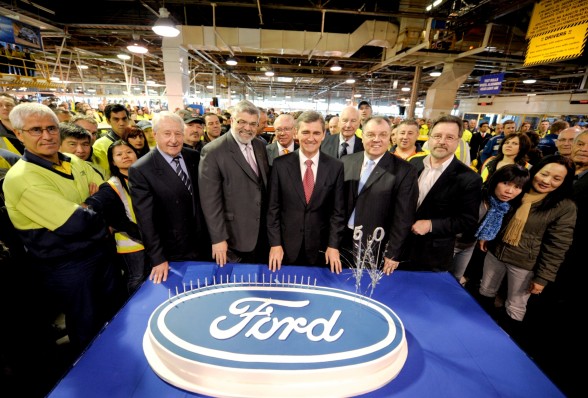
    Today Ford announced the pending closure of its Australian manufacturing operations, bringing to an end ninety years of the company building automobiles down under.

    Ford’s announcement is small on a global scale – the Broadmeadows factory built 40,000 cars out of a worldwide supply of sixty-three million – it does illustrate some major structural issues facing both the global automobile industry and the Australian economy.

    An Automotive Depression

    Over capacity has been the curse of the automobile industry for decades as governments have propped out producers around the world.

    KPMG’s 2012 Global Automotive Survey forecast the global industry would be 20 to 30 percent over capacity in 2016.

    This doesn’t seem to worry industry executives or their government supporters, as KPMG reported;

    Alarmingly, most auto executives still seem to regard the risk of overcapacity and excess production as a necessary evil to remain competitive. As the rapid growth of recent years eventually slows down, manufacturers that fail to address overcapacity could face some tough decisions.

    Ford’s Australian executives could at least be credited with facing some of those tough decisions.

    Many governments though are still in denial as they continue to subsidise motor manufacturers in an effort to copy the industry model that worked for the US Midwest during the 1950s.

    Indeed, the Australian government in 2008 committed 5.2 billion dollars to support their domestic industry through to the end of this decade. Ford’s announcement today coupled with General Motor’s cutbacks last year show that policy is in ruins.

    At the Ford and government press conferences, journalists pressed the Prime Minister and the Ford Australia’s CEO about repaying some of the millions of corporate welfare doled out to the multinational over the last decade. Naturally little was to be said about that.

    In a stark comparison to Ford Australia’s announcement, US electric car manufacturer Tesla Motors repaid a $465 million US government loan.

    While no-one can say Tesla’s future is certain, at least US investors are putting their money on 21st Century technologies instead of propping up declining industries of the last century.

    Australia’s predicament

    The car industry is just one sector that faces global overcapacity – ship building, real estate and mining are just three with similar excess production.

    For Australia, the mining industry is winding down investment as worldwide production capacity expands. At the same time, the blue sky projections of China’s resources demand are being challenged.

    While the mining boom comes to an end, Australia now has to face the consequences of the nation’s economic decision to focus on resources and property speculation in the 1990s and early 2000s.

    As the Thais and Indonesians found in 1997, and the Irish and Icelanders a decade later, economies based on unsustainable foundations seem to work fine until suddenly they don’t.

    It may well be that Australia is about find out what happens when the economic tide suddenly changes.

    One bright side is that the government has the best part of five billion dollars to invest in new industry – assuming Australia’s politicians can wean themselves off their 1950s view of the world economy.

    Image of Ford Australia celebrating 50 years of Falcon Production courtesy of Ogilvy Communications.

    Similar posts:

  • Silicon Valley’s network effect

    Silicon Valley’s network effect

    Philip Rosedale, the founder of Second Life and various others startups has an interesting take on why San Francisco and Silicon Valley are the centres of the tech startup world.

    He puts the region’s success down to the network effect where like minded groups share knowledge and encourage each other.

    If you want to create a vibrant start-up ecosystem somewhere else that is competitive with San Francisco and Silicon Valley (and this is starting to happen right now in places such as Boulder and Austin), you want to do two things: You want to pack the people working together into as dense an area as possible, with public areas and co-working venues where they will see each other constantly, even when they aren’t working in the same company. And then you want to encourage them to let down their guard and be as open as possible about what they are doing.

    Of course the network effect doesn’t just apply to the Silicon Valley tech startup model, it’s just as true for China’s manufacturing hubs, South Korean shipbuilding or historical centres like Detroit’s motor industry and the English Midlands during the industrial revolution.

    We shouldn’t forget that fifty years ago governments sought to to emulate Detroit’s success and a century ago cities strived to be like Birmingham.

    That’s something we should keep in mind when looking at ways to emulate Silicon Valley – in trying to copy today’s successes, we may be mimicking a model that has already peaked while overlooking our own unique advantages and the opportunities in new industries.

    For cities striving to become world centres of industry, it might be best to first figure out what they do well and then find a way of attracting the smartest people in that field to move there.

    Then again, it may just be that most industrial hubs are accidents of history and the best we can do is try to attract smart people to our communities.

    Similar posts: