Category: economy

  • Are small business owners whingers?

    Are small business owners whingers?

    People of the same trade seldom meet together, even for merriment and diversion, but the conversation sends in a conspiracy against the public, or in some contrivance to raise prices.” Adam Smith – The Wealth of Nations.

    At a meeting with the state’s Small Business Commission I was once again reminded of Adam Smith’s words – that business owners will try to seek whatever opportunity they can to raise prices and whinge when they can’t.

    Over the last few months I’ve heard business owners complain the government doesn’t do enough to protect the quality of their imports, give them more onstreet dining permits, stop their neighbours from having onstreet dining permits and, my favourite of all, regulating discounts offered on group buying websites.

    Restauranteurs are complaining their customers don’t appreciate the cost of running a business – which is true, but it isn’t the customers problem.

    A spectacular example is the anti-carbon tax propaganda where local businesses are displaying letters from a political party claiming their prices will go up and one franchise chain was dumb enough to even write down their plans to blame price rises on the new tax.

    We also have the ongoing narrative that local councils – particularly those controlled by Green or Independent groups – are “anti-business” and killing commerce through unfairly enforcing parking rules and building bicycle lanes. Something that nicely fits the talking points of the Corporatist political parties that anyone who isn’t endorsed by a major party is “a dangerous radical”.

    The best of all though is the ongoing campaign to eliminate the GST and import duties threshold for overseas purchases, which claims all the problems of the nation’s retailers would be solved if customers were forced to wait a week a pay a couple of hundred dollars in administrative fees.

    Some of these gripes are fair – some councils are unreasonable (interestingly usually in areas where local government is seen as a stronghold a big party), the current tax rules are unfair and there are truly stupid people deeply discounting on group buying sites – but most of them are just excuses.

    Business is always tough, if it wasn’t everybody would be doing it and taking it easy.

    If all you can do is whinge about prices, your council, the government, your competitors, staff or your customers then maybe you should think about getting a job or at least taking a holiday.

     

    Similar posts:

  • Darling Harbour and the peak of consumerism

    Darling Harbour and the peak of consumerism

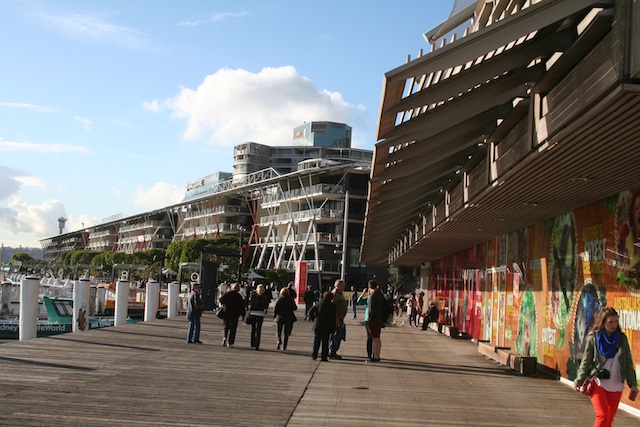
    Sydney’s Darling Harbour was one the centre of the nation’s mercantile economy, from across the country millions of tons of grain, wheat, sugar and other commodities were loaded onto ships and exported to the empire.

    Eventually Darling Harbour fell into disuse, the docks became containerised, bulk goods moved to specifically designed loaders and the new breed of cargo ships were often too big to fit under the Sydney Harbour Bridge.

    What really sealed Darling Harbour’s fate was Australia moved from being a largely export based agricultural export economy to a service based consumerist economy.

    Today Darling Harbour illustrates that change, the docks have become expensive restaurants, hotels and shopping centres. The notorious “hungry mile” of docks is being converted into “Barangaroo” complex of office blocks, apartments and possibly even a casino for “high roller” Chinese gamblers.

    Even the cruise liners are going. The 1980s vision of Darling Harbour as a temple to consumerism and property speculation is complete. In this way, Darling Harbour has become a picture of the Australian economy.

    Just as Australia’s mercantile era peaked just before The Great Depression of the 1930s – the depression of the 1890s was actually far harder on Australia, particularly Melbourne and Victoria – the consumerist era finished with the Global Financial Crisis of 2008.

    It will be interesting to see how Darling Harbour evolves over the next hundred years.

    For a glimpse of the final days of the old Darling Harbour, Island Shunters an ABC documentary from 1977 showed the working lives of railway workers in the goods yards on the Western side of the docks. Today those railyards are the Australian office of Google and Fairfax’s headquarters.

    Similar posts:

  • Looking at the wrong curve

    Looking at the wrong curve

    “We don’t understand it, there’s a property shortage but prices are going down,” bleats the property expert in a recent interview.

    Property booms are always excused with claims of “shortages”. The US, Ireland and the UK in recent years property markets all collapsed despite business and political leaders claiming there was a “property shortage”.

    The shortage meme happens because the property spruikers, economists and finance writers focus on the wrong curve – they look at the supply curve and assume prices are going up because there isn’t enough property to go around.

    What drives speculative booms is easy credit – demand driven by access to money drives speculation, not supply shortages.

    Australia’s long term property boom which started in the late 1960s and went onto steroids in the late 1990s has been driven by access to credit. Banks were prepared to lend to property buyers, who were increasingly speculators, and government policies favoured those speculating on property over investing or building businesses.

    The crisis of 2008 was the end of the easy credit era and the Australian property speculation boom is over. For the policy makers, politicians and economists the basis of the 1980s corporatist ideology is crumbling around them.

    No ideologue lets go of their beliefs easily – that’s why Western governments who bought into the corporatist worldview are pumping trillions of dollars into supporting zombie banks and releasing constant stimulus packages to prop up the property market.

    Like the communists of the 1970s, today’s corporatists are looking at choosing the statistics that suit their ideological views.

    To support their beliefs they look at the wrong curve and then wonder why the world isn’t working as they thought it would.

    Times have changed. Have you?

    Similar posts:

  • Falling Dominos, Fading Businesses

    Falling Dominos, Fading Businesses

    “When the tide goes out, we find out who’s naked” goes the saying – nowhere is this more true than in the engineering and construction industries.

    One of the hallmarks of an economy that has passed its peak is the systemic failure of contracting companies.

    During a boom, or a steady growth phase of an economy, contracting companies see cashflows increase as more projects come online.

    That growth affects contractors in a number of ways – they start getting used to fatter margins and management starts to believe in their own invulnerability.

    Blue sky seems to stretch on forever and massive growth rates seem guaranteed far into the future.

    As the market matures the sky starts to turn grey as more contractors start fighting for lucrative jobs seeing cost estimates being fudged and dodgy deals done to win jobs.

    Those dodgy contracts eventually come in at a loss and management starts desperately winning more projects to cover the losses on earlier work.

    And so a spiral begins.

    To make matters worse, the more aggressive contractors start buying out smaller competitors.

    Often those competitors have similar bad projects on their books and their impressive growth rates are based upon winning jobs they should never have tendered for.

    Eventually the spiral ends when the market stalls and there aren’t enough new projects available for the loss making contractors to cover the accumulated losses. Then the failures begin.

    Collapses of the Hasties Group, Reed, St Hilliers and other construction and engineering contractors are classic examples of this cycle.

    While shareholders and management carry some of the burden, the real pain of failure is felt by the armies of sub-contractors – largely small, family owned businesses – these companies employ.

    Most of these subcontractors will not get paid for their outstanding invoices, forcing all of them to cut back their own employment and spending. For some, they will be forced into liquidation as they can’t pay their own bills.

    For the families that own those small businesses the financial and emotional pain is real and immediate. Spending stops, debts go unpaid and relationships fail.

    In some cases that small bankrupt plumber, bricklayer or concreter finds the stresses of failure too great and a family loses their breadwinner.

    This multiplier effect of business failures and redundancies is one of the reasons the real economy is in a much tighter position than Australia’s political, business and media elites can bear to admit.

    Another saying is “a recession is when your neighbour loses their job, a depression is when you lose yours.” For most families, the economy has been in recession for three years as they’ve seen friends and relatives accept reduced hours or have contracts terminated.

    Much of the commentary about Australians being irrationally pessimistic misses this aspect of our economy. It’s amusing when the smug comments come from financial and economic journalists who don’t seem to have noticed the difficulties their own industry going through.

    There’s a lot of naked people treading water at the moment and the tide is heading out. The question for all of is where the deep water is and where the hell did we leave our speedos.

    Similar posts:

  • Giving a damn

    Giving a damn

    Twenty years ago a lady unexpectedly passed away leaving her estate to her infant daughter. Included in the estate was a modest apartment in Sydney’s inner western suburbs.

    For years, the unit sat on a local real estate manager’s books quietly gathering rental income and growing in value during Sydney’s great property boom.

    Eventually the owner of the real estate agency tracked down the infant, now grown up and living in Boston. He’d hired lawyers and private detectives to track her down.

    Most of us would have taken the easy course and flicked the property to the public trustee where the property would have quietly languished for years in the tender care of the dusty, but expensive, bureaucrats.

    A few criminally minded ones would have sold the property and pocketed the cash, confident that no-one would ever know or care.

    But Chris Wilkins decided to do the right thing and found the owner, doing anything else would have been a “heartless alternative.”

    Having a heart and giving a damn is what matters.

    Whether its in our work, how we deal with other people or the change we make to our society. This is what matters – big bonuses, a flash car, a ministerial position or invites to “insider” conferences are just trinkets for the egos of vain little people.

    In an era where shareholder value, triple A credit ratings, executive remuneration and personal entitlements seem to stand above everything else, it’s good to be reminded that most people are doing the right thing by others.

    At the end of our lives, we’re judged by our actions. What will you be proud to be judged by?

    Similar posts: