
Category: entrepreneurs

  • Free content’s shaky foundations

    Free content’s shaky foundations

    Musician’s rights advocate David Lowrie has a takedown on his Trichordist of Pandora’s campaign to change the US music royalty payment system through the Internet Radio Fairness Act.

    Pandora and other online streaming services claim the current arrangement is unfair and puts them at a disadvantage to terrestrial AM and FM radio stations. Artists and record labels claim this is just a way to cut rights payments.

    David suggests that Pandora’s founders either lied about the sustainability of their business at the time of their IPO last year or are just being plain greedy.

    Regardless of what is true, or whether David is overstating the case against the IRFA, a truth remains that many Internet business models are unsustainable and Pandora’s may be one of them.

    Most unsustainable of all are those who rely on free content.

    Eventually the market works to filter out those who won’t pay for content – the good writers and artists move onto something more profitable, like driving buses or serving hamburgers, or they figure out they may as well control their own works rather than let some Internet company profit from their talents and labor.

    The website or service offering nothing in return for the contributor’s hard work eventually ends up distributing garbage – Demand Media or Ask are examples of this.

    In a marketplace where crap is everywhere, just pumping out more crap is not a way to make money.

    Those looking at investing in businesses which rely on free content need to remember this, if no-one values the product then you have no business.

    Sadly too many internet entrepreneurs, and corporate managers, believe the road to their wealth is through not paying artists, musicians or writers. They are the modern robber barons.

    Similar posts:

  • Walking the floor

    Walking the floor

    “He walks the site three times a day,” said awed contractors about a construction project manager – who we’ll call Rob – that I encountered as a cadet Engineer in the building industry. Getting out of his site office and seeing what was going on made sure dodgy contractors or inexperienced trainees like me couldn’t slow down his projects.

    Slate Magazine’s story of how the Wendy’s hamburger chain changed the US fast food industry recalls how Rob would successfully run his projects and the importance of hands on management.

    Jim Near was recruited as president by his friend and Wendy’s founder Dave Thomas to get the business on track after over-extending in the mid 1980s. Slate says of Jim’s hands-on management style;

    Near liked to stalk through the dining areas of his stores examining people’s trays. If customers were leaving fries, he’d go harass the fryers: Were they serving the potatoes too hot? Too cold? Not using enough shortening? And he would sit in his car in the parking lot, surveilling the activity at the drive-thru window.

    That obsession sounds like Steve Jobs and its no-coincidence; Jobs, Jim Near and Rob the project manager gave a damn about the product that was being delivered. Rather than sitting in an office obsessing over paperwork and meeting artificial KPIs, these effective leaders got out and saw what the realities were in their business.

    Probably the best example of this “management by walking the floor” ethos was Bob Ansett who built up the Australian Budget Rent-A-Car business in the 1970s. Every senior manager was required to spend a couple of days a month working on one of Budget’s rental desk dealing with customers.

    That policy forced Budget’s executives to understand the business, just as Jim Near was described as ““a ketchup-in-his-veins type of guy” through working at every level in the fast food industry.

    One of the many conceits in modern management is the idea that everything – from building high rise towers, running car rental companies or operating a hamburger chain – is like selling soap. This philosophy ignores that every industry has its own characteristics and even selling soap has its own unique challenges in different markets.

    It’s easy to think everything works as described in a 1980s business school textbook when you have artificially constructed KPIs and layers of managers to deflect responsibility.

    Over the last quarter of the Twentieth Century we saw customer service become disdained in the Corporatist business culture which favours accountants and lawyers as managers who rely on marketing people and lobbyists to protect them from the reality that they aren’t really very good at running their companies.

    Now that era has come to an end and the times now suit those who listen to customers and the marketplace. Walking the floor and paying attention to what the public are saying about us on new media are competitive advantages.

    While the corporatists lobby their friends in government for subsidies and protection, entrepreneurs and genuine business builders like Dave Thomas, Jim Near, Steve Jobs and Bob Ansett have the opportunity to seize the markets that are being neglected.

    There’s never been an excuse for not listening to the customer and today it’s more important than ever.

    Similar posts:

  • A swelling feeling of pride

    A swelling feeling of pride

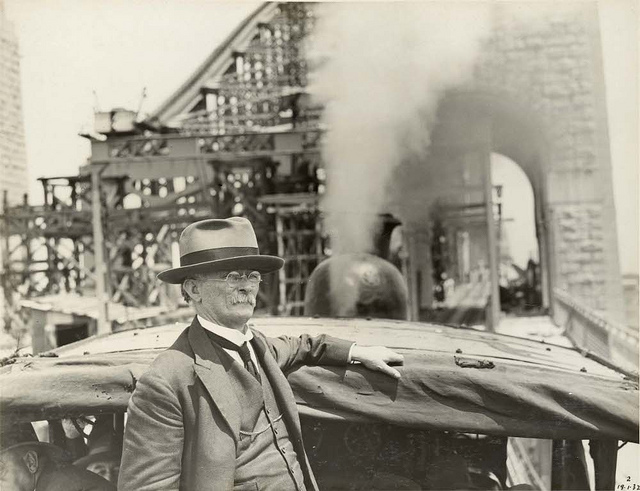
    Doctor John Bradfield shaped modern Sydney. His program of public works, such as building the Sydney Harbour Bridge and the city’s railway network served the city for nearly a century.

    The picture of him from the NSW State Records archives riding the first train across the Harbour Bridge shows him swelling with pride. And so it should.

    What we need to ask ourselves is whether our works could survive a century of massive change and become an international icon as the Sydney Harbour Bridge did.

    If we can just strive toward that – even though most of us will fail – we can be proud of our works as Dr Bradfield was when he rode that train across the Harbour Bridge.

    Similar posts:

  • When disruption meets regulation

    When disruption meets regulation

    Taxi booking applications have been one of the big areas for smartphone developers. Around the world apps for hailing cabs have popped up following the lead of San Francisco’s Uber.

    One of the opportunities for copycat developers is that in most places taxis are regulated by the local city or state government, so an app for New York will struggle in Los Angeles, Paris or Tokyo and savvy entrepreneurs can create their own Uber knock off suited to their own location.

    The problem is in most places taxis are regulated as a cartel, not a public service. Sometimes that cartel is to protect drivers, sometimes the companies that run the networks and often taxi license holders.

    Sydney, Australia, is a good example of the latter two. The New South Wales state government’s rules are designed to protect the interests of the greedy ‘investors’ who’ve bought taxi license plates and the networks who run the booking systems and management of the cabs.

    The result is Sydney cab drivers are treated like serf in what can only described as a feudal system while customers have to put up with lost bookings, poorly kept vehicles and high taxi fares.

    It’s a lousy deal all round and is a great example of where disruption can change things for the better.

    The problem is the incumbents will fight innovation that threatens their cosy and profitable arrangements and the regulators are part of that comfortable alliance.

    In New York it looks like the Taxi and Limousine Commissioner does have some of the consumer interests at heart, pointing out that the metered fare is what passengers have to be charged by law. In most cities though, particularly Sydney, protecting the passenger is just another smokescreen for protecting vested interests.

    Something that many innovators don’t realise is the power of those vested interests.

    In the case of the taxi app developers many of them are about to get a nasty taste of just how vicious incumbent and their tame regulators can be when confronted with a threat to their cosy business arrangements.

    Similar posts:

  • Creating a service mindset

    Creating a service mindset

    In the Foreign Correspondent report that inspired yesterday’s post about the start up community angel Investor Raval Navikant said  “you don’t need customer service anymore, you have Twitter.”

    While it’s refreshing to hear that Twitter is now rightly seen as a customer service channel rather than a marketing tool, it’s worrying that startup businesses still have such a low opinion of supporting their users.

    This is the mindset for the web2.0, social and cloud computing communities – that user support can be done though Frequently Asked Questions (FAQs), user forums or an anonymous email address that might get read once in a while. It’s the self-help model of helping your users and it’s the biggest weakness of online services.

    A worry for these businesses is that big organisations now beginning to remember the importance of customers. What has traditionally been small business’ advantage is  being eroded.

    At an Australian Computer Society Foundation lunch in Sydney yesterday Testra Corporation’s diector of Products and IT Enablement, Jenny Woods described how her company is moving to a more service centric culture.

    While this isn’t simple in a company the size of Telstra, a task made harder by the telco industry’s customer hostility, it’s certainly a process that’s underway.

    There’s a long way to go for Telstra. Along with that traditional telco antipathy towards their customers, they are big company with plenty of silos and aligning management KPIs so the temptation isn’t simply to gouge customers for short term profit is a big change.

    Changing that ‘soak the customer’ mindset is the biggest challenge in making companies like Telstra service centric and that means management at all levels have to buy into the process.

    Without that senior and middle management commitment, customer support will just be seen as the poor relation to other divisions and will be outsourced to the lowest cost provider at the first opportunity.

    Part of that change to a service mindset is in trusting your staff. Jenny described how Telstra abandoned scripts for their home Internet customers and told the support agents they could use their initiative – as a result customer satisfaction went up, problems were solved faster and the number of modem returns slumped.

    “The people who do the work, know how to do the work” says Jenny and it’s good that Telstra’s management is recognising the skills in their workforce.

    Much of that anti-service culture we see in large organisations is because management don’t respect the skills, experience and knowledge of their workers. Instead they’re treated as naughty children who can be slapped into line with a stern memo.

    Today’s economy doesn’t favour businesses and managements who think like that, the organisations that will do well this Century those who are flexible, value their staffs’ skills and have managers who see their role as more than micro-managing their silos.

    It also means delivering a product you’re proud to support. If you won’t support your products, then your customers will go to a competitor who looks after their clients.

    We fell into a trap into thinking customer service didn’t matter during the late Twentieth Century, it was always a myth and now we have to deliver.

    Similar posts: