Category: government

  • Knowledge and power

    Knowledge and power

    In the 16th Century English courtier Sir Francis Bacon declared “Knowledge is Power”, something certainly true during the conspiracy prone reign of Elizabeth I.

    Today the data available about ourselves and our communities is exploding along with the computer power to process that information to turn it into knowledge.

    We see that knowledge being used in interesting ways – US shopping chain Target recently described how they used data mining to determine, with 87% accuracy, to figure out if a shopper is pregnant.

    That 87% is important, it says the algorithm isn’t perfect and bombarding a false positive with baby wear advertising could prove embarrassing, or in some families and societies even fatal.

    A good example of data misuse are the two unfortunate Brummies (alright, one’s from Coventry) who were deported from the US for tweeting they were “going to destroy America and dig up Marilyn Monroe

    For the US immigration and homeland security agents, they ready the jokey tweets by the Birmingham bar manager through their own filter and came to the wrong conclusion, although it’s likely their performance indicators rewarded them for doing this.
    This is the Achilles heel in big data – used selectively, information can be used to confirm our own prejudices, ideologies and biases.
    In 2003 we saw this in the run up to the US invasion of Iraq with cherry picking of information used to build the false case that the ruling regime had weapons of mass destruction that could attack Europe in 45 minutes.
    For businesses, we can be sure data showing the CEO is wrong or the big advisory firm has made the wrong recommendations will be overlooked in most cases.

    Despite the Pollyanna view of a world of transparency and openness driven by social media and online publishing tools, the information is asymmetric; governments and big business know more about individuals or those without power than the other way round.

    In a world where politicians, business people and journalists trade on their insider knowledge rather than competing in the open, free market we have to understand that filtering this data is essential to retaining  powers and privileges.

    Usually when the data threatens the existing power structures it is repressed in the same way a dissenting taxpayer, citizen, employee or shareholder is discredited and isolated.

    At present there’s lots of data threatening existing commercial duopolies, political parties and cosy ways of doing business.

    The fact many of those in power don’t want to see what their own systems are telling them is where the real opportunities lie.

    Entrepreneurs, community groups and activists have access to much of this data being ignored by incumbents, it will be interesting to see how it’s used.

    Similar posts:

  • Finance by the masses

    Finance by the masses

    “Crowd” is one of the hot terms of the moment – the idea that groups of connected, motivated people with the right incentives can deliver great value when their skills and talents are bought together.

    One of application of this idea is crowdfunding where businesses, artists, writer and movie producers can call  on the community to donate or invest small sums into a project in return for a benefit like a copy of the book or being an extra in the movie.

    The biggest success in this space is the New York based Kickstarter which was founded in 2008. Pozible, an Australian equivalent, that provides local creatives with the opportunity to raise funds without dealing with the hassles of US bank accounts or social security numbers.

    Both of these services make money from taking a commission on the money raised, for Pozible users this fee ranges from 5 to 7.5%.

    While the focus of Pozible and Kickstarter is on creative projects like books, music and movies, it’s interesting to consider how this model can work for other businesses.

    Perhaps an IT business can offer a free year of support or food delivery service free shipping in return for a donation. The possibilities are endless.

    It’s not without risks – there’s no doubt the regulators will at best be suspicious of fund raising through these services and anyone participating has to accept the risk of not getting any sort of return.

    Since the 2008 banking crisis, funding for small business has dried up around the world. Many viable enterprises found their lines of credit being withdrawn and some even went under as a result.

    With banks rationing small business credit, there’s a need – we could even argue an economic necessity – for alternative sources of capital. Crowdsourcing could be an option.

    Now the days of easy credit are over; businesses, banks, investors and governments have to adapt. Believing models and regulations that were designed when capital was cheap and abundant won’t work in a very changed economy.

    Crowdsourcing will be one of the issues confronting regulators, it’s going to be interesting to see how they deal with it.

    Similar posts:

  • ABC Nightlife: Explaining the National Broadband Network

    ABC Nightlife: Explaining the National Broadband Network

    For the February 2012 Nightlife technology spot Tony and Paul looked at Australia’s National Broadband Network, exploring the pros and cons of the project designed to connect all Australians to high speed broadband.

    So what is the NBN and what does it do? Here’s some of the points we discussed along with some of the answers to listeners’ questions.

    What is the NBN?

    The National Broadband Network is intended replace the existing copper wire telephone network that was rolled out across the nation over the Twentieth century.

    Eventually the network will provide fast data access across the country replacing the older network that was designed for telephone calls rather than computer communications.

    Most of the country will be connected to fibre optic cables and areas where this is too expensive then wireless or satellite services will be used.

    Why do we need a government run national network?

    The NBN is the culmination of three decades of bad policy out of Canberra. We should remember that the Howard government struggled with how to provide high speed broadband access to the bush.

    For coalition things became particularly bad once they privatised Telstra and no longer had any power over the company’s policies.

    We’ve had a mix of ideological beliefs and rubbery figures from both sides of politics which have left Australia in the situation where the core telecoms network has had to be re-nationalised.

    What are these different ways of connecting up?

    The biggest part of the network will be fibre optic cable where the connection will run along the street like the existing telephone wires and will connect to a box outside your home or office.

    This box – know as an NTD (Network Terminating Device) is then connected into either the existing household telephone system or into a computer network.

    In areas receiving wireless and satellite subscribers will get dishes or receivers that plug into their existing home telephone or computer network.

    There are different types of wireless

    The different types of wireless networks cause confusion. The NBN is going to use 4G or LTE telephone wireless, which is what Telstra have started to roll out and Optus will be starting in the Hunter Valley around Easter 2012.

    Most of us are using 3G networks on our phones which is what the bulk of the mobile phone networks are.

    Another type of wireless is the Wireless Local Area Network. These are what we connect our home or office computers to. These plug into the existing services like the existing ADSL internet connections or the NBN’s fibre network.

    We shouldn’t confuse Wireless LANs with the mobile phone technologies being used by the NBN or phone companies.

    Who is running the NBN?

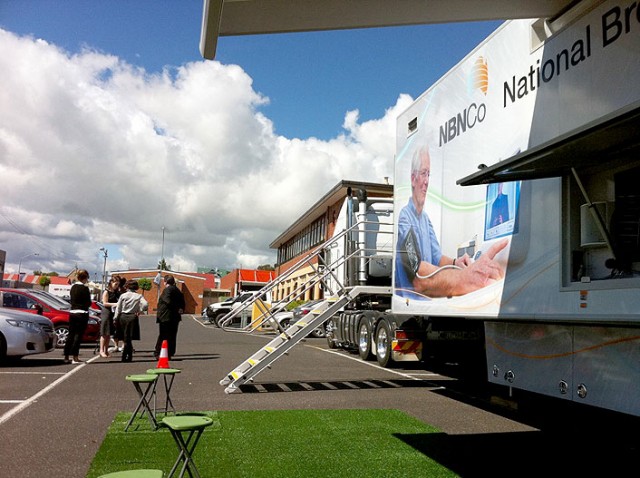
    The organisation set up to build the NBN is NBNCo. They are setting the standards, negotiating access to existing infrastructure and building the network. Their head office is in North Sydney but major operations are also based in Melbourne.

    In turn they are hiring contractors around the country to build the network, run the cables and connect buildings to the new services. Most of us will deal with those contractors and the companies selling NBNCo’s services.

    How is National Broadband Network going to work?

    We won’t talk to NBNCo directly, instead companies like Telstra, Optus, Vodafone and iiNet will buy services from them and then onsell them to us.

    Telstra are playing an interesting game on competing. They are already offering 4G services in regional areas where NBNCo hasn’t announced rollouts and they are planning to upgrade their cable TV network to the DOCSIS 3.0 standard that can sometimes deliver speeds similar to the NBNs proposed service.

    What happens if you don’t let them connect you

    If you don’t let NBNCo’s contractors connect you to the new network then you’ll have a problem a year or so later.

    The copper telephone network is going to be turned off in areas where fibre optic cables are installed so if you aren’t connected to the new system, you won’t have access.

    Anyone who’s done some building or landscaping work knows it isn’t cheap and that’s what building owners who don’t allow access will have to pay for access later.

    In Tasmania a few property owners who were just outside the NBN area asked about getting connected up and apparently the costs were prohibitive.

    One of the things to watch out for is uncooperative building managers preventing NBN contractors from accessing their premises leaving all the residents disconnected when the phone network is turned off.

    Will it really cost $14,000 to wire up your house?

    No but there will be a cost to connect the building’s existing phone lines and power supply to the NBN’s Network Terminal Device (NTD) that will be bolted to the outside of the building.

    The NTDs are designed to plug into existing phone systems and data networks so it shouldn’t be necessary to spend a fortune on connections or upgrades.

    One area where there might be problems is in buildings that have substandard wiring. Licensed electricians and cablers will refuse to work on systems that don’t comply with standards so building owners may find they are faced with big bills to bring their systems up to standard.

    Does the system work if the power goes out?

    Yes, the basic cabling doesn’t need power, although the repeaters and local exchanges will – just like the phone network. Where the system does need power is at the NTDs which will come with a battery providing two to three hours power.

    If the NBN gets hit by lightning, does it stop working?

    Lightning is an incredibly powerful force. It doesn’t matter whether we’re talking about telephones, power or fibre optic networks – anything that is hit by lightning is going to be damaged.

    We should keep in mind that the wireless alternative to fibre is more prone to lightening strikes as base stations are at high points.

    Electrical storms, and other natural forces, are a fact of life that we have to work around. The existing systems are just as prone to interruptions.

    Is it running behind schedule?

    Yes, as of the beginning of 2012 the project seems to be about six months behind. With only 4,000 connections at the end of last year instead of the 30,000 expected by the middle of last year.

    NBNCo are putting this down to delays in finalising negotiations with Telstra and other existing fibre providers.

    How much is it really going to cost?

    There’s still the $43 billion dollar number on the table, which comes from a KPMG study in 2010 although the government claims their investment is going to $27 billion.

    Of that 27 billion, the government expects to recoup it by 2034 based on a 7% return.

    In contrast the opposition are claiming the real cost is $50 billion as they are including the cost of buying Telstra’s infrastructure back.

    The real number is anyone’s guess. The track record of both political parties and Canberra’s bureaucrats on estimating costs on projects like this is less than impressive.

    Is it really worth the money?

    We should keep in mind a lot of this money was going to be spent by Telstra or the other providers anyway over the next two decades as the copper telephone reached the end of its life.

    The risk was we would see something like the cable TV rollout where the big players fought over the most lucrative parts of the country and ignored the rest. The NBN avoids that.

    There are real concerns though as the NBN is running behind schedule, the procurement processes – particularly the construction contracts – appear to have been poorly handled and there has been little discussion about the technology options.

    Overall though, this is an opportunity to get the 21st Century infrastructure right. Where Australia failed with the roads in the 20th Century and the trains in the 19th, we can get this one right.

    Similar posts:

  • The battle between the old and the new

    The battle between the old and the new

    “We will build an America where ‘hope’ is a new job with a paycheck, not a faded word on an old bumper sticker” – Mitt Romney, US Republican Presidential candidate

    “What immediate measures can be taken to protect jobs?”French President Nicolas Sarkozy

    “We want to be countries that made cars” – Kim Carr, Australian Minister for Manufacturing

    Around the world the forces of protectionism are stirring to shield fading industries, businesses and fortunes from economic reality.

    The most immediate target in this battle are the new industries that threaten the old.

    It’s no coincidence US lawmakers want to introduce laws that will cripple the Internet in order to favour music distributors, that the US and New Zealand governments work together to shut down a cloud sharing service or that failing Australian retailers call on their government to change tax rules in order to prop up their fading sales.

    The old industries appear to have the advantage; they are rich, they have political power and – most importantly for politicians – they employ lots of voters.

    We shouldn’t under estimate just how far the managers and owners of the challenged industries will go to protect their failing business models, unwanted product lines and outdated work methods, which isn’t surprising as their wealth and status is built upon them.

    Eventually they will lose, just as the luddites fighting the loom mills and the lords fighting the railway lines did.

    The question for society and individuals is do we want to be part of yesterday’s fading industries or part of tomorrow’s economy.

    We need to let our political leaders know where we’d our societies to go before they make the wrong choices.

    Similar posts:

  • Is Twitter’s censorship a good thing?

    Is Twitter’s censorship a good thing?

    Since Twitter announced they were going to start blocking messages on a country by country basis if required by the laws of that land they have received a lot of criticism.

    Most of this criticism of Twitter revolves around the belief that every message should only edited or deleted by the person who posted the tweet.

    Anything else a breach of free speech and a threat to the underlying principles of the internet.

    That utopian view of the Internet doesn’t translate into real life; the online world is as subject to laws as any other part of life and social media companies have to comply with the same laws as newspaper organisations or fast food chains.

    Regardless of what you think of those laws – and in many countries they certainly are unreasonable and oppressive – they do matter.

    Were Twitter not to comply then the entire service would be at least blocked in those countries and, should an action be enforced in a US court, then the tweet removed anyway for every user around the world.

    By introducing country specific blocking, the service can let the rest of the world see a tweet that would otherwise be lost and in countries with restrictive or authoritarian laws, local people can still use the service.

    A particularly clever way of dealing with removal requests is to note that the specific message has been blocked in a country. This adds a level of transparency and accountability to the actions of courts and governments that want to close the service.

    We can see that being particularly effective in jurisdictions like the UK where British judges have been quick to apply “superinjunctions” preventing the merest mention of something by anybody.

    Should Britain’s overeager judges start demanding Twitter block tweets, those in the UK will quickly realise something is amiss. The effect will probably be to increase the interest in the blocked tweets that can be seen anywhere around the world.

    Despite the utopian view that transparency and openess will solve the world’s problems, we don’t live in that world right now and people can – rightly or wrongly – ask that false, defamatory and damaging posts on the Internet can be removed.

    Interestingly Google this morning announced they will be introducing a similar system to deal with country specific problems on their blogger platform.

    Twitter’s handled this in the best way possible, in many ways this could be a step forward for social media and the Internet in general.

    Similar posts: