
Category: Innovation

  • Closed data doors

    Closed data doors

    “Sydney now joins global cities including London, New York and Hong Kong that also have public transport on Google Maps” boasted Gladys Berejiklian, New South Wales minister for transport, last week that Sydney’s complex and confusing public transport system will now appear Google’s mapping service.

    The minister neglected to mention the other 400 cities that already offer this service including Perth, Adelaide and Canberra in Australia. What’s more concerning is the attitude of public servants and governments towards access to what should be freely available data.

    It’s difficult to think of anything less innocuous than public transport timetables yet access to the data is carefully guarded by most Australian governments under the claim of ‘Crown Copyright’.

    Underlying the idea of Crown Copyright is all the information held by governments is the property of the state – or the monarch in Australia – rather than belonging to the people. This is a great example of governments and the law living in the 18th Century which gives a modern perspective of what the US founding fathers were thinking of when they wrote their constitution in 1787.

    This refusal to make data available is not the attitude of any single government, the Victorian government notoriously refused access to fire information during the tragic 2009 bushfires and Google are still negotiating to add Melbourne’s public transport information to the Maps service.

    ‘Open Data’ is a concept that many agencies pay lip service to, as do many politicians while they aren’t in government, but in practice information is a precious resource which should be hoarded and hidden.

    In the public service itself, information is power – your position and status with an agency is directly proportional to the knowledge you possess and the contacts you can hoard. This attitude spills over into the way services are delivered, or not as the case may be.

    For startup businesses, this hoarding of data hurts local industry – with transport timetables application developers have to negotiate on a case by case basis for data access meaning that only big companies with plenty of resources are able to get hold of the information.

    The tragedy is government are trying to encourage smaller developers and startups. New South Wales had its Mobile Concierge program but these well meaning initiatives fall down when agencies won’t open their data.

    It’s time to scrap the idea of Crown Copyright and the philosophy that all government data is the property of the public service, or the monarch of the day. Certainly there are plenty of areas where it isn’t in the public interest to release confidential information but bus timetables are not one of those areas and there are plenty of laws already in place to protect that sensitive data.

    Like many things in our political and legal sectors, thinking is stuck not in the 1980s but in the 1780s. Maybe it’s time to grab our politicians and their learned lawyer friends and drag them by their horse haired wigs into the 21st Century.

    Similar posts:

  • Eating the Old Man’s lunch

    Eating the Old Man’s lunch

    Optus today announced the purchase of restaurant review site Eatability for $6 million.

    Eatability is one of the services that’s destroyed the business models of both the phone directory business and that of newspapers.

    Thirty years ago the Sydney Morning Herald launched its Good Living section and it became the way people went found where the good places were to eat.

    Diners wanting to make a reservation at the hip eating places being reviewed in Good Living picked up the phone book.

    Now they do neither, they go to web sites like Eatabilty or Yelp where they get reviews, contact details and everything else they need about the venue.

    Which killed the advertising revenues that newspapers and phone directories depended upon.

    The sad thing is both the newspapers and Yellow Pages could have owned this space. Citysearch was setup by Fairfax to address the online market and it was sold to Telstra when the newspaper chain struggled to make it work.

    Citysearch today languishes neglected and nearly forgotten under the Sensis umbrella. Optus now owning Citysearch’s biggest local competitor which must bring a hollow laugh to those involved in the early days of Fairfax’s digital experiment.

    Whether Eatability thrives under Optus remains to be seen, but it illustrates just how incumbent strengths like telephone directories are being eroded in the online world.

    Old men have to start moving quickly if they don’t want upstarts eating their lunch.

    Similar posts:

  • Creating a fresh view for online commerce

    Creating a fresh view for online commerce

    When you’re running a part time business and holding down a full time job, selling is difficult and its hard to find the time to setup websites.

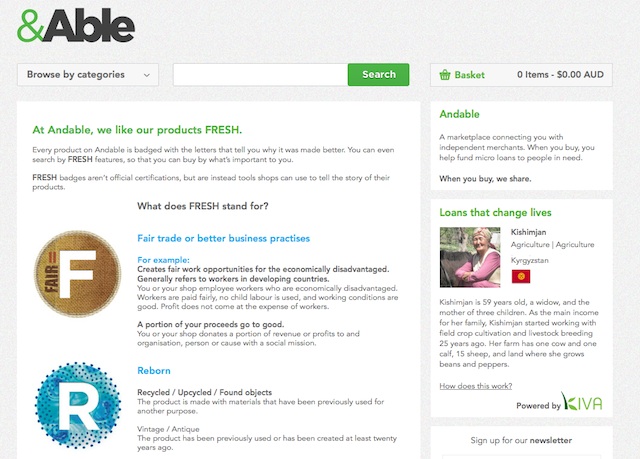
    Online marketplace Andable provides an outlet for creatives and those entrepreneurs juggling full time jobs. The site’s mission is to be “an online marketplace where you can discover extraordinary things to buy and sell.”

    The problem for those passionate entrepreneurs busy making things is they don’t have time – and often lack the skills – to sell their works. Co-founders Rupal Simian and Melissa Dean decided they would set up an online marketplace to help those businesses.

    Central to Andable’s service is the ability for these small businesses to tell their stories. Most of the service’s merchants are part time businesspeople who hold down full time jobs.

    Andable’s name comes from compressing “willing and able” and the site lets micro businesses list their products for free with a 5% commission from sales. Payments are handled through PayPal who they work closely with.

    For sellers to qualify for a listing, they have to meet at least one of Annabel’s FRESH criteria; Fairtrade, Reused, Eco-friendly, Supporting local business or Handmade.

    An interesting thing about Andable is how 10% of the sale goes into a Kiva microfinancing project. After six months that loan is repaid – Kiva boasts a 99% repayment rate – the 10% is rebated to the merchant.

    Since the service’s launch in July, two investments have been made with Mel and Rupal looking at completing 600 loans by the end of their first year’s trading.

    A month into operation, Andable has close to 200 shops including ranging from hand crafted jewellery, vintage lightboxes and hipster homewares. Sellers are based around the world from Germany and Indonesia through to Byron Bay and Fremantle.

    What’s interesting about Andable is how we’re seeing different online marketplaces appearing to cater for different markets. For businesses, this means it’s becoming easier to get your products to market.

    The challenge is to get attention in a marketplace that’s saturated with advertising and information. Platforms like Pinterest, eBay and Andable are ways motivated customers can find businesses.

    Similar posts:

  • Writedowns and triumphalism

    Writedowns and triumphalism

    The contrast between Microsoft’s and Google’s results released on Thursday attracted a lot of interest – for the first time in twenty years Microsoft posted a quarterly loss with Google’s profits continue to grow.

    While there’s no doubt Microsoft are challenged by the effects of their lost decade and bad decisions made in that time, but the business itself is still extremely profitable.

    Microsoft’s posted loss is due writing down 6 billion dollars in their aQuantive investment, an attempt to compete with Google in the online ad placement space.

    Despite a six billion dollar writedown, Microsoft only posted a 500 million dollar loss showing the business is still making over 5 billion dollars profit each quarter.

    Google on the other hand posted a profit of 2.8 billion, up 11% from the same period last year.

    But Google also has some nasty writedowns coming in the future – the purchase of Motorola will see some substantial write downs of that 12 billion dollar deal. It’s conceivable that a very big portion of that investment will have to be written off as well.

    Right now, Google’s seeing some benefit from the Motorola acquisition as the phone company’s cashflow is covering a decline in online advertising revenue, a threat to Google’s core business.

    It’s easy to be triumphant when the headlines proclaim you’re a winner, but it’s often worthwhile looking at the fine print to see the real story.


    Similar posts:

  • Outsourcing’s changing face

    Outsourcing’s changing face

    Outsourcing company freelancer.com regularly releases the fifty fastest moving job descriptions requested by their customers.

    This year’s list shows how the online industry is changing – content creation, social media and SEO job requests are all down substantially as users and gatekeepers like Google adapt to the information flood we all have to deal with.

    Keeping in mind the market that Freelancer.com caters to small businesses and many of the jobs posted are for fairly small – some would say laughingly tiny and insulting – amounts, it’s probably safe to say we’re looking at the low value end of the market.

    Article writing (down 15%), proofreading (5%), blogging (13%) and submission (4%) jobs are probably the cheap and nasty “Demand Media” style of low quality content designed for SEO purposes.

    SEO itself is in trouble with jobs in that sector down 7% indicating Google’s Panda and Penguin search engine changes have achieved their objectives of improving search results and knocking out those gaming the system with low quality content.

    A similar thing has happened with social media. Facebook is too hard for many businesses and they’re not seeing a return on their substantial time investment.

    “Companies in industries from consumer electronics to financial services tell us they’re no longer sure Facebook is the best place to dedicate their social marketing budget—a shocking fact given the site’s dominance among users,” Freelancer quotes Nate Elliott, an analyst at market research firm Forrester.

    A bright part in Freelancer’s list is the rise is in open standards as HTML5 starts moving up the list with 20% growth.

    “The Internet is becoming more interactive, and the technologies that are winning and will continue to win are open standards like HTML5 and jQuery- to the detriment of the incumbents proprietary technology providers like Adobe and Microsoft,” says Freelancer’s CEO Matt Barrie.

    Open standards aren’t winning everywhere though as Apple’s iOS is clearly winning the developer war as iPhone grows by 30% and iPad by 26% compared to Android’s 20%.

    Freelancer’s list is an interesting snapshot at where industry demand is right now, what’s we’re starting to see are some of the transition effects working their way through the system. The rise and fall of the social media and SEO specialists being one of those.

    The full Freelancer list is below;

    Similar posts: