Category: Internet of Things

Posts relating to the internet of things, IoT and M2M technologies

  • Silos and security in the internet of things

    Silos and security in the internet of things

    Last week Deloitte launched its list of  500 fastest growing Asia-Pacific Technology companies.

    At the Australian media briefing on the list and the company’s predictions for the telecommunications market in 2014 Deloitte’s Jolyn Barker and Eric Openshaw discussed the some of the implications of the report.

    During the briefing Openshaw was asked about the risks of vendors creating their own Internet of Things standards to lock customters into proprietary platforms.

    Openshaw isn’t convinced, “over time when technologies develop out of significant players in an attempt to create or extend a vertical stack, over time the market tends to revolt against that.”

    “There’s usually one or two forces working against that, either the market revolts against it and insists on a new standard or the stack is too successful and regulators will come in and say ‘we don’t like your stack, dismantle it’ .”

    His view is that in the long term issues of vendor lock-in and proprietary platforms fix themselves. “One way or another, these things can be problematic in the short run but typically over time they are resolved.”

    Where Openshaw does see risks with  lying in the security of machine to machine technologies.

    “The security aspect just can’t be overstated in terms of how important it is,” says Openshaw. “When we have demonstrations now of being able to hack a pacemaker, that’s a problem.”

    “So the security issues on these networks is important.”

    The interplay between the software, network protocols and security is going to be complex and may well be what makes or breaks some vendors products.

    It’s still early days to fully appreciate all the risks with the internet of machines, but securing networks and devices will be one of the most important tasks ahead for the industry.

    Similar posts:

    • No Related Posts
  • Discussing Cryptolocker and Internet of Things security on ABC Radio

    Discussing Cryptolocker and Internet of Things security on ABC Radio

    If you missed the program, you can listen to the segments through Soundcloud.

    Tuesday morning with Linda Mottram on ABC 702 I’ll be discussing Cryptolocker ransomware, the security of the Internet of Machines and the tech industry’s call for less internet surveillance.

    It’s only a short spot from 10.15am and I’m not sure we’ll have time for callers, but one of the big takeaways I’ll have for listeners is the importance of securing your systems against malware, there’s also some security ideas for business users as well.

    We’ll probably get to mention the ACCC’s warnings on smartphone apps and the current TIFF bug in Windows as well.

    If you’re in the Sydney area, we’ll be live on 702 from 10.15, otherwise you can stream it through the internet.

    Similar posts:

    • No Related Posts
  • Where will the jobs come from in the internet of things?

    Where will the jobs come from in the internet of things?

    One of the common worries about the internet of things and the automation of business processes is that many jobs are going to be lost as a consequence.

    This is a fair concern however we need to keep in perspective just how radically employment has changed in the last century.

    Concerns about technology displacing occupations is nothing new; in the eighteenth century the Luddite movement was a reaction to skilled workers being displaced by new innovations.

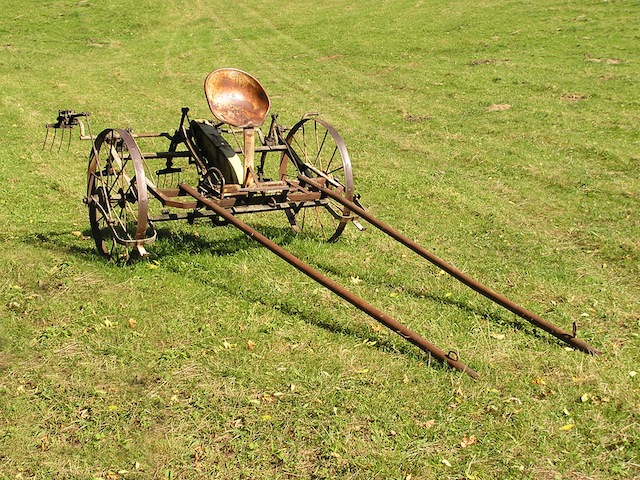
    In an interview with GE’s Chief Economist Marco Annunziata, published in Business Spectator, we covered this topic and Marco had a valid point that the bulk of the Western world’s workforce was employed in agriculture a hundred years ago.

    Today it’s less than two percent in most developed country as agriculture became heavily automated, yet most of those workers who would once have worked in the fields have productive jobs. “As an economist I look at this over a long term perspective and I’ve heard this concern about technology displacing jobs over and over again.”

    Annunziata sees new roles being created, among them what he calls ‘mechanical-digital engineers’ who understand both how the actual machines work as well as the data and the software used to run and monitor them.

    This isn’t to say there won’t be massive disruption – John Steinbeck’s Grapes of Wrath described the massive dislocation that happened in the United States with the first wave of agricultural mechanisation in the 1920s and the decline in rural communities is due directly to modern farms not needing the large workforces that sustained many country towns.

    We can’t see where the jobs of the future will be and just roles like as Search Engine Optimisation and ecommerce experts where unheard of twenty years ago, our kids will be working in occupations we haven’t contemplated.

    It’s up to us to give our kids the skills and flexibility of thinking that will let them find opportunities in a very different workplace.

    Similar posts:

  • Abolishing the service visit

    Abolishing the service visit

    “Service used to be an act of damage control,” said Salesforce’s Peter Coffee at the recent Dreamforce conference. “You are bleeding brand equity until that problem is fixed.”

    Coffee’s view is that the internet of things is an opportunity to delight the customer with proactive service that allows companies to fix customers’ problems before they happen.

    Zero planned maintenance

    Taking this idea further is GE’s Chief Economist, Marco Annunziata, who sees the internet of things as an opportunity to introduce the concept of Zero Planned Downtime where there is no need to stop machines for scheduled repairs and maintenance.

    “A lot of the maintenance work is done on a fixed schedule,” Annunziata. “You end up wasting time and money servicing machines that are perfectly fine.”

    “On the other hand you might miss that something is about to go wrong between two maintenance periods.”

    “The idea of the industrial internet is that by gathering so much data from these machines themselves – plus having the software to analyse this data – you will have information that flags to you when intervention is needed.”

    Annunziata’s view is that connected machines won’t need to have regular service intervals, instead of insisting a car has  an inspection every ten thousand kilometers where the tyres are replaced and the oil changed, often unnecessarily, the vehicle need only be called in for maintenance when its sensors flag that a part or consumable needs attention.

    Finding the benefits

    While that can mean big savings for car owners, it’s in fields such as aviation, mining and logistics where the greatest benefits of Zero Planned Downtime would be found.

    For businesses it’s another example of how they will fall behind if they don’t invest in modern technology as those who invest in newer, connected equipment will be able to reduce downtime and maintenance cost.

    How achievable Zero Planned Downtime is in many fields remains to be seen, not least because of regulatory hurdles in sectors like aviation, however the idea does promise to change the business model of companies that depend upon service revenue.

    Similar posts:

    • No Related Posts
  • Delighting the customer – the new business normal

    Delighting the customer – the new business normal

    Salesforce’s Executive Vice President of Strategic Reserach, Peter Coffee joined the Decoding The New Economy channel at last week’s Dreamforce conference to discuss the new normal — delighting the customer.

    Coffee’s role at Salesforce is to help the company’s potential clients understand the new normals of business life. “It’s a lot of listening,” he says.

    In describing the new normal, Coffee is in tune with Salesforce’s CEO Marc Benioff in seeing mobile services as being one of the key parts of how business will look in the near future.

    “The fundamental statement is your mobile device is no longer an accessory,” says Coffee. “It’s the first thing you reach for in the morning and it’s the last thing you touch at night.”

    “Fundamentally people are mobile centric so we need to rethink our operations.”

    Continuing the social journey

    It’s not just mobile services that are changing the way we do, social media continues to be companies’ weak points in Coffee’s opinion.

    “There’s research that’s come out of places like MIT that shows traditional print and broadcast media are still valuable for creating awareness of your brand but the final step of turning someone from knowing who you are into deciding to do business with you is now made today only when a trusted network confirms it.”

    “People don’t make that final step of buying from you until they’ve consulted their trusted advisors.”

    “Another fundamental change that’s happened is that the connectivity of the customer is such that if you have a customer that’s unhappy with you for even five or ten minutes there’s a tweet or a Facebook post or a LinkedIn update just begging to leak out and damage your brand,” says Coffee.

    “The closer you can get to instantaneous resolution to the issue, the better.”

    Internet of machines

    With the internet of machines, the ability to resolve customers’ problems instantaneously becomes more more achievable in Coffee’s opinion.

    “Connecting devices is an extraordinary thing,” says Coffee. “It takes things that we used to think we understood and turns them inside out.”

    “If you are working with connected products you can identify behaviours across the entire population of those productslong before they become gross enough to bother the customer.”

    “You can proactively reach out to a customer and say ‘you probably haven’t noticed anything but we’d like to come around and do a little calibration on your device any time in the next three days at your convenience.’”

    “Wow! That’s not service, that’s customer care. That’s positive brand equity creation.”

    Delighting the customers

    All of these mobile, social and internet of things technologies will give businesses the tools to delight their customers and Coffee sees that as the great challenge in the new business normal.

    While many businesses will meet the challenges presented by mobile customers and their connected machines Coffee warns those who don’t are in for a painful time.

    “If you do not have delighted customers you have no market.” States Coffee, “the way that you delight customers is by making sure every interaction with you leaves them happier than they were before.”

    “Traditional silos of sales, service, support and marketing must be dissolved into one new entity which is proactive customer connection.”

    “Companies that neglect to adopt it will discover they have customers who are sensitive to nothing but price,” warns Coffee.

    Paul travelled to Dreamforce in San Francisco as a guest of Salesforce.

    Similar posts:

    • No Related Posts