Category: Internet of Things

Posts relating to the internet of things, IoT and M2M technologies

  • The real thing behind the internet of things

    The real thing behind the internet of things

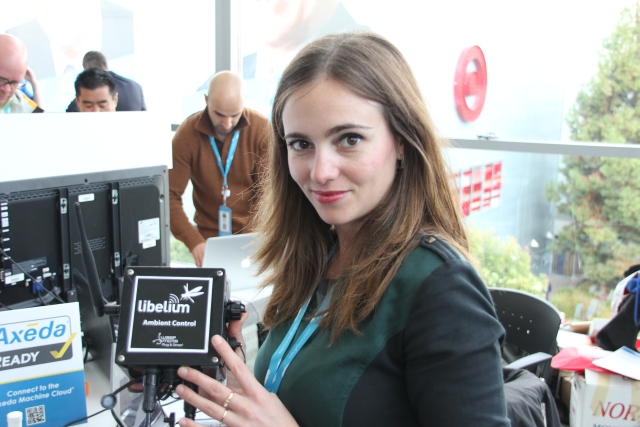
    We need to think beyond technology to get value the real value from the internet of things says Alicia Asin, the CEO and co-founder of Spanish sensor company Libelium.

    Libelium and its CEO Alicia Asin has been covered previously on this blog and we had the opportunity to record an interview with Alicia at the 2013 Dreamforce conference.

    Alicia told us about her vision for how she sees cities and governments evolving in an era of real time accessible information, in many ways it’s similar to where the Deputy Lord Mayor of Barcelona sees his city being at the end of this decade.

    “I would say the biggest legacy the internet of things can bring is transparency,” says Alicia. “In the smart cities movement the IoT gives an opportunity for have a dashboard for cities.”

    “You can see the investment made for reducing traffic investment downtown, the carbon footprint reduced and the return on investment,” says Alicia. “You can have very objective facts to supply to the citizens and they can make better decisions.”

    For this vision to become true, it means government data has to open to the community which is something that challenges many administrations, however Alicia also told the story of how her company supplied Geiger counters to volunteers monitoring the radiation fallout around the damaged Fukushima nuclear reactor in Japan.

    “We made a project in Fukushima when the nuclear accident happened where we sent some Geiger counters to the hacker space,” says Alicia. “Suddenly all the people with the Geiger counters started to publish the data onto the internet.”

    “They were keeping a totally independent radiation map made by the activist citizens.”

    Alicia raises an important point of how citizens can be using technology independently of governments. This was most notable in the Occupy movements across the United States that sprung up in late 2011 where hackers set up independent communications networks and recorded events outside the control of mainstream media and government agencies.

    While citizens can use these tools to get around official restrictions, governments play an important role in developing new industries around these technologies, Alicia sees the smart city investments made by Spanish cities as creating the start of a Spanish Silicon Valley.

    “Despite the economy, we are seeing a number of projects in Spain around smart cities,” Alicia observes. “In fact, I’m saying Spain is becoming the Silicon Valley for smart cities.”

    “In terms of attracting big companies to look at what’s going on in Spain and to build a bigger brand around the Internet of Things, I think that really helps.”

    With government and citizens working together, Alicia sees the Internet of Things delivering great changes to society as it enables citizens and makes governments more accountable.

    “It’s the real thing, it’s beyond technology.”

    Similar posts:

  • Have we over-consumerised IT?

    Have we over-consumerised IT?

    One of the phenomenons of the modern technology industry is the ‘consumerisation of IT’, but have we taken that trend too far?

    I’ve spent today at the opening of the 2013 Dreamforce conference in San Francisco talking to various people about where the IT industry is going.

    The dominant thing at this year’s conference is the “internet of things” or, as Salesforce are marketing it, “the internet of customers.”

    What’s notable in this view is the marketing and consumer centric view of the IT world, something not surprising given Salesforce’s roots as a sales and marketing service, despite last year showing off the social media connected jet engine at last year’s conference.

    Salesforce aren’t alone in this view, most conversations about the tech industry revolve around marketing and advertising. Last week’s Telstra’s Digital Summit was notable for focusing almost exclusively on brands and social media while missing the point that digital business is far more than just adopting online marketing channels.

    For most industries, the marketing and direct consumer connection is only a small part of how technology, not least the internet of machines, is transforming business with manufacturing and supply chain management two areas that are being totally changed with high stakes and big money involved.

    Cracking the enterprise market is hard, which is why most startup tech businesses focus on the customer market and the relatively easy, albeit cash poor, advertising and premium revenue streams.

    While the focus is often on the consumer and mass-market side of the web and internet of machines, the real money, and change is in the business sector. This is exactly how most of today’s tech giants — Microsoft, IBM, Oracle and Salesforce to name a few — came to be where they are today.

    There’s no doubt the consumerisation of IT was a real phenomenon, but it may be that it’s currently being overplayed. We need to think beyond marketing when considering how technology is changing our businesses.

    Similar posts:

    • No Related Posts
  • The ghost in the internet of machines

    The ghost in the internet of machines

    A funny thing happened two hours out of Auckland, the cabin crew on the Air New Zealand flight to San Francisco announced the inflight entertainment system had to be rebooted.

    In the thirty minutes it took for the system to reset and reload, various in-seat functions such as the cabin call button and light switch froze, it was a basic example of how complex systems interact with each other.

    The benefits of a connected egg tray involve the device telling us when more eggs are needed, but what happens when the thing tries to tell your online shopping service that you need 200 dozen?

    As the internet of things develops and business systems become more automated, complexity is going to become greater and more subtle. Understanding and managing the risks that extend from that is going to be essential for both public safety and the economy.

    “The Internet of Things creates a whole new range of attack surfaces” Cisco Systems’ Enterprise Group Vice President Rod Soderbery told the Internet of Things conference in Barcelona last month.

    One of those many ‘attack surfaces’ identified by Fraser Howard, Principle Researcher of Sophos Labs are the dozens of household devices from smart TVs to internet connected egg holders that are beginning to appear in homes.

    Almost all these devices will have flaws in their firmware and yet almost no vendor has an interest in maintaining or patching the firmware of this equipment.

    “Consumers have no way of managing this problem” says Fraser as it’s almost impossible for householders to upgrade their systems and consumer electronics manufacturers have a poor track security track record.

    “There’s a long history of companies with mass market items which deal with things like important items like credentials where they have not had a single thought about security,” says Fraser.

    Security is one the many challenges facing the internet of things along with to manage rogue devices in grid networks. There’s a lot of work to be done in ensuring systems aren’t disrupted by an outlier sensor or critical information disclosed by a poorly secured or out of date smart device.

    As connected egg trays start talking to the supermarket, we have to be confident that we aren’t going to come home to find our connected device hasn’t delivered a pallet load of fresh eggs or that it hasn’t given away our banking details to an organised crime ring.

    Similar posts:

    • No Related Posts
  • Will the internet’s insecurities damage economic growth?

    Will the internet’s insecurities damage economic growth?

    “No country is cyber-ready” warns Melissa Hathaway, author the Cyber-Readiness Report.

    Hathaway’s warning is that the economic benefits of the internet are being lost to the various vulnerabilities in our information infrastructure.

    Dutch research company TNO claims that the Netherlands lost up to 2% of their GDP to cybercrime in 2010 and Hathaway claims similar losses are being incurred in other developed countries.

    Supporting Hathaway’s views at a function in Sydney today, Cisco System’s Senior Vice President and Chief Security Officer, John Stewart, made a frightening observation about corporate networks.

    “Every single customer we have checked with, and these are the Fortune 2000, has high threat malware operating in their environment – every single one of them.”

    So the bad guys are in our networks and causing real economic damage. The question for businesses and governments is how do we manage this threat and mitigate any losses?

    On our more intimate level, how do we manage our own systems and online behaviour to limit our personal or business losses?

    Hathaway makes the point that the internet was never intended to do the job we now expect it to do and as consequence security was never built into the net’s design.

    Today, we rely upon the internet regardless of its lack of inbuilt security. With everyone from governments through to organised crime and petty scammers wanting to peek at our data, we have to start taking security far more seriously.

    Similar posts:

    • No Related Posts
  • ABC Nightlife Computers – explaining the internet of things

    ABC Nightlife Computers – explaining the internet of things

    Paul Wallbank joins Tony Delroy to discuss how technology affects your business and life. For the November 2013 Nightlife spot we’ll be looking at the internet of everything.

    If you missed the show, you can listen to the recording at the Nightlife website.

    The internet of everything is the next big thing in the tech industry, but what how is it any different from the web we know today that’s given us cute pictures of cats, Twitter and the end of newspapers? Some of the questions we’ll cover include;

    • what exactly is the internet of things?
    • how is it different from today’s internet?
    • is this just another tech industry slogan like big data or social media?
    • things like aircraft have been connected to the net for years, why is this suddenly news?
    • what sort of machines are we talking about connecting?
    • some industry pundits are saying this business could be worth $14 trillion dollars, where do they get this number from?
    • how are governments looking at using these technologies?
    • During the week it was reported Google have patented a tattoo with an embedded microphone.
    • so what happens when viruses get into our wearable technologies and connected fridge?

    Part of the show will cover the geek’s tour of Barcelona and the interview with Antoni Vires, Deputy Mayor of the city on how the Spanish industrial centre sees it’s role as a connected city.

    We’d love to hear your views so join the conversation with your on-air questions, ideas or comments; phone in on the night on 1300 800 222 within Australia or +61 2 8333 1000 from outside Australia.

    Tune in on your local ABC radio station from 10pm Eastern Summer time or listen online at www.abc.net.au/nightlife.

    You can SMS Nightlife’s talkback on 19922702, or through twitter to @paulwallbank using the #abcnightlife hashtag or visit the Nightlife Facebook page.

    Similar posts:

    • No Related Posts