Category: software

  • ABC Nightlife – Virtual Reality and Apple encryption

    ABC Nightlife – Virtual Reality and Apple encryption

    Pundits are saying 2016 will be the year Virtual Reality comes to the home, with Silicon Valley investors pouring money into the technology, the long awaited Oculus Rift due to be released this year and the heavily hyped Meta launching soon.

    If you missed the show, you can hear it podcast through the Nightlife website.

    Tonight on ABC Nightlife we’ll look at what VR, and its cousin Augmented Reality, are and what they mean to us ordinary people.  Some of the questions we’ll be looking at include;
    • Exactly what are Augmented and Virtual Reality?
    • Why all the hype now?
    • Why are investors putting so much money into the space?
    • Apart from games what can this tech be used for?
    • Do you always have to wear the funny glasses?
    • Does the headsets always need to be connected to a computer?
    • What are the devices and brands we should be watching out for?
    • Is it likely consumers will be able to afford this technology in the near future?
    • Will 2016 really be the year of virtual or augmented reality?

    If we get time, we’ll also look at Apple’s fight with the FBI over encryption (security researcher Troy Hunt has an excellent run down of the issues at stake) and what happens if you change the date on your iPhone to 1970.

    Join us

    Tune in on your local ABC radio station from 10pm Australian Eastern Summer time or listen online at www.abc.net.au/nightlife.

    We’d love to hear your views so join the conversation with your on-air questions, ideas or comments; phone in on 1300 800 222 within Australia or +61 2 8333 1000 from outside Australia.

    You can SMS Nightlife’s talkback on 19922702, or through twitter to @paulwallbank using the #abcnightlife hashtag or visit the Nightlife Facebook page.

    Similar posts:

    • No Related Posts
  • The limitations of algorithms

    The limitations of algorithms

    Are algorithms getting too complex asks Forbes Magazine’s Kalev Leetaru in an examination of how the formulas that are increasingly governing our lives have grown beyond the understanding of their creators.

    With computer code now controlling most of the devices and processes we rely on in daily life, understanding the assumptions and limitations of  those programs and formulas becomes essential for designers, managers and users.

    Leetaru cites the Apollo 13 malfunction and Volvo’s recent embarrassment where a self driving car nearly ran over a group of journalists however there’s no shortage of more tragic mistakes from the consequences of software design decisions, the crash of Air France 447 over the Atlantic Ocean with the loss of 228 lives where two pilots who stalled their plane due to misunderstanding the characteristics of their cockpit  is one recent sad example.

    As business and government becomes more dependent on software, more risks will arise from managers not understanding the limitations of the algorithms they use in their business.

    Similarly a range of industries to exploit the quirks of algorithm driven markets are developing, the Search Engine Optimisation business designed to exploit quirks in Google’s search algorithm is an established example but more will come to the fore as people find ways to profit by anticipating price movements.

    However algorithms have a way to go before they fully take over, as Salon’s examination of Facebook’s news feed reveals a key part of the social media service’s deciding what appears on users screens are the decisions of around thousand ‘power users’.

    The news feed algorithm had blind spots that Facebook’s data scientists couldn’t have identified on their own. It took a different kind of data—qualitative human feedback—to begin to fill them in.

    While Facebook falls back on large focus groups to fill in the algorithm’s gaps, Uber has found a different problem in estimating driver arrival times where it’s currently not possible to accurately calculate estimated times of arrival in real time.

    “The best way to minimise time differential issue is to communicate statistically expected time, which will result in almost always being different than actual (i.e. wrong), but will be less different/wrong on average,” says Uber CEO Travis Kalanick.

    Uber and Facebook’s challenges with their algorithms illustrate there’s some way to go before all critical business functions can be handed over to software but as automation becomes standard in many areas, not least autonomous vehicles, the limitations of programs and the assumptions of programmers will become apparent.

    Similar posts:

    • No Related Posts
  • Open sourcing artificial intelligence

    Open sourcing artificial intelligence

    Yesterday Google open sourced many of the features in its Tensorflow artificial intelligence service.

    Making the services available to the community will mean many more opportunities to develop the technology. It could well prove to be a turning point for Artificial Intelligence in making it more accessible to the general public and business community.

    Similar posts:

  • Rethinking business IT

    Rethinking business IT

    Last week at the AWS:Reinvent conference in Las Vegas, I had the opportunity to interview the company’s Global Head of Enterprise Strategy, Stephen Orban about where he and Amazon see the direction of the cloud computing market and how business practices are being reinvented.

    Among the things we discussed was Orban’s seven best practices for a company’s journey to the cloud, gleaned from his own experiences in his AWS role of advising clients on adopting and his previous experiences as a technology officer at Dow Jones and Bloomberg.

    Orban laid out what he thinks are the keys to success in a company heading to the cloud in his own blog post and during our conversation he expanded on his ideas which also very much reflect the changing role of the CIO or IT manager.

    Supporting the C-suite

    The first point is the IT department has to understand the business and align technology with the organisation’s objectives.

    “Somebody who understands technology who can merge technology with the business needs” will be better able to win the confidence of management says Orban.

    Doing that is the key to winning support from the executive suite Orban believes. Once CIOs have that trust from senior management it gives their teams the space to experiment with new ways of delivering value to their companies.

    Education 

    “The second thing is to provide training and education,” Orban says. “People tend to get a bit anxious of what they don’t know, particularly when it affects their jobs.”

    In Orban’s experience, having informed staff makes them more open to change within the business, “with the transformation I went through at Dow Jones, most of what we accomplished was because of the people who’d been there a long term. They had the institutional memory but they were very open minded.”

    Foster a Culture of Experimentation

    One of the great benefits of cloud computing is how it lowers the costs of experimentation and development, “gone are the days when it cost hundreds of thousands of dollars, even millions, to try something.” Orban says.

    Learning what works and fails is essential, he believes. But as long as there is executive support then a tolerance towards unsuccessful experiments will develop in the organisation.

    Working with partners

    Outside parties are essential to most organisation’s IT systems and Orban believes partner ecosystems have changed with the advent of cloud computing. “There’s a whole new breed of partners that have been going through this,” he says in citing ‘born in the cloud’ software developers and systems integrators who are changing how projects are being delivered.

    Build a Center of Excellence

    “Creating a center of excellence is, I think, one of the key practices any organisation should invest in. You want a body of people who can institutionalise best practice within an organisation,” observes Orban.

    As cloud services take away the complexity of computer systems it becomes an opportunity for organizations to rethink boundaries between the IT department and business operations.

    Move to the cloud

    Given Orban’s employer it’s not surprising he sees cloud computing as key to a company’s transformation however he admits that few organisations will make the jump straight into cloud services.

    “Hybrid will be a part of every enterprise’s journey. Any company who’s been doing IT for any period of time will have existing investments,” he says. “Our view is that we will make it as easy as possible to create that bridge.”

    “We do believe in the long run that enterprises will find they become so much more effective over here (in the cloud) they will move in that direction.

    A Cloud-First Policy

    Once an organisation has its cloud strategy and experimentation culture in place then having a ‘cloud first’ policy, “it reverses the burden of proof away from ‘why would you use the cloud?’ to ‘why wouldn’t you?’”

    While Orban is emphasising the Amazon Web Services view of the world where ultimately all business computing will be done on the cloud – preferably their cloud – his views illustrates the change facing businesses as they implement online technologies.

    For most, the availability of easily accessible cloud computing services is an opportunity to rethink their business processes and how organisations can deliver the best products quickly to their customers.

    Similar posts:

  • Reinventing Microsoft in the age of cloud computing

    Reinventing Microsoft in the age of cloud computing

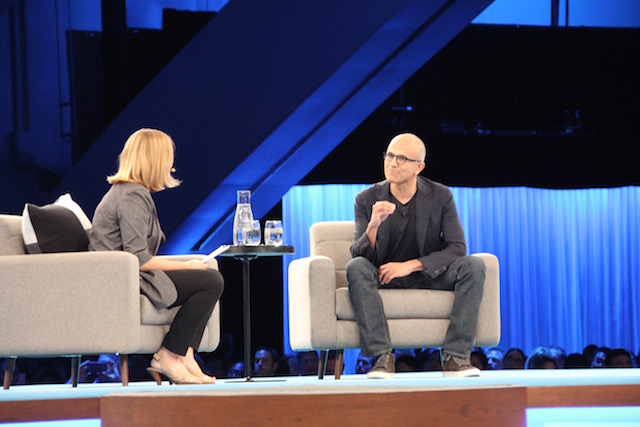
    “Why does Microsoft exist?” Asked the company’s founder Satya Nadella at the Dreamforce 2015 conference.

    Nadella has asked this question before and his answer at the San Francisco event was that Microsoft exists to empower people through technology, something that Bill Gates and Paul Allen envisaged in the mid 1970s when they founded new startup.

    To show how he sees Microsoft’s position in the modern workplace, Nadella gave a not completely flawless demonstration of Microsoft’s integration with Salesforce.

    The products Nadella pushed were Windows Phone and Windows 10, which he claims to be part of a major change in businesses with data transforming the way we work.

    Interestingly, he framed the Windows 10 IoT strategy around endpoint security. While there are millions of vulnerable devices, it’s not clear shipping them with Microsoft’s firmware will resolve the problem.

    “What’s the big technology shift? It’s how we use the data.” Nadella proclaimed in laying out how he sees a data culture transforming the places we work.

    A Grand Pivot

    Microsoft itself is dealing with a cultural transformation with the company shifting across to cloud based subscription services. “The thing that it’s done for us is it’s not a one-for-one move. It’s not like we’re just moving Exchange on premise to Exchange as a Service, it changes the value proposition for the customers.”

    Nadella sees those cloud services as an opportunity to sell more products – and add more value – to customers, particularly small businesses.

    The CEO’s role

    A business’ success relies upon its culture and Nadella sees the role of the CEO as being about curating that culture, “I always ask what it is that defines us.”

    Part of that culture is about becoming customer focused which involves thinking outside of one company’s products or silos, “how is our industry going to succeed? It’s going to succeed if we can add value our customers. Our customers are going to make choices that aren’t homogenous.”

    Those varied choices are what’s driving Microsoft’s current push into alliances.  “If we are going to realise the power of technology, then these partnerships will amplify that,” says Nadella.

    While there were nuggets of truth in Nadella’s presentation, there was also a lot of truisms and somewhat meaningless slogans. While Microsoft’s push onto the cloud and into alliances that were once considered unholy might be genuine, it’s hard not to think there’s still a lot of marketing speak wrapped around it.

    Similar posts:

    • No Related Posts