Category: telcos

  • Opening Telstra in a life and death market

    Opening Telstra in a life and death market

    “Communications are a life and death issue”, says Vish Nandlall the chief technology officer of Telstra. “You realise that when that pipe gets shut off people can die in the field.”

    Nandlall’s experience in weapons technology led him to a life in the telecoms industry which bought him to Australia as he believes Telstra is one of the most innovative companies in the industry. How much this is due to Telstra dominating its domestic market is a discussion for another post.

    Nandlall was speaking last week at a lunch for journalists and bloggers hosted by Telstra in Sydney. It was an opportunity for the company to introduce their CTO to the media following his joining the company last August and to publicise their push into health care services.

    One of the areas Nandlall was particularly keen to push was how Telstra was looking at opening their platforms to third party developers as he sees the nine to ten million strong community as offering opportunities that even the best resourced telecoms company can’t access.

    “How can I get telecom services into places where developers can access the information?” Nandlall asks.

    His answer is to open the services through the Telstra Developer Site which at present is fairly Spartan although one expects it will become more impressive ahead of the I love APIs conference the company is sponsoring in Sydney this June.

    Down the track Nandall sees the open systems assisting the company moving into the key growth areas for all telcos such as the Internet of Things, smart cities and the productivity growth applications in industry verticals.

    The big opportunity the company sees is in health care where a fragmented industry struggles to corral disparate sources of information that touch almost every person. It though just one of the growth telcos are looking at in a dramatically changing marketplace.

    For Nandlall the challenge is to grow Telstra beyond the domestic Australian telco market that it increasingly dominates as its competitors lose interest in the market and the nation’s ambitious but failed national broadband network slowly fades into irrelevance.

    While Telstra is by no means facing any life or death issues, many of its customers could be. Nandlall and his fellow executives are hoping they can help them.

    Similar posts:

  • How Google could be about to disrupt the telco industry

    How Google could be about to disrupt the telco industry

    Google are in talks with Hutchison Whampoa for the Hong Kong based conglomerate to provide global roaming for Google’s proposed mobile phone network reports the London Telegraph.

    Hutchison, who recently agreed to buy UK operator O2 for £10.2 billion from Spain’s Telefonica, are one of the quiet global telecommunications players with services in East Asia, Europe and Australia. An international roaming agreement with Hutchison would give Google a substantial global headstart.

    While the mobile phone angle is the obvious service for a global cellular network, another attraction for both Google and Hutchison is the Internet of Things. Being able to offer a worldwide machine to machine (M2M) data service fits very well into Google’s aspirations with products like Nest.

    For the mobile phone operators, the prospect of Google entering their market can’t be comforting with the search engine giant having three times the stock market capitalisation of the world’s biggest telco, China Mobile.

    It may well be however communications companies have little choice as the software companies start to take the telcos’ profits just as they have done with many other industries.

    Should the story be true about Hutchison and Google being in talks it will probably be the start of a massive shift in the global communications industry and one that will see many national champions threatened.

    Google’s global network ambitions could change the future of the Internet of Things industry.

    Similar posts:

    • No Related Posts
  • Clawing back our data – Telstra makes metadata available to customers

    Clawing back our data – Telstra makes metadata available to customers

    Today Australian incumbent telco announced a scheme to give customers access to their personal metadata being stored by the company.

    In a post on the company’s Telstra Exchange blog the company’s Chief Risk Officer, Kate Hughes described how the service will work with a standard enquiry being free through the web portal with more complex queries attracting of fee of $25 or more.

    The program is a response to the Australian Parliament’s controversial intention to introduce a mandatory data retention regime which will force telcos and ISPs to retain a record of customer’s connection information.

    We believe that if the police can ask for information relating to you, you should be able to as well.

    At present the scheme is quite labor intensive, a request for information involves a great deal of manual processing under the company’s current systems however Hughes is optimistic they will be able to deal with the workload.

    “We haven’t yet built the system that will enable us to quickly get that data,” Hughes told this website in an interview after the announcement. “If you came to us today and asked for that dataset it wouldn’t be a simple request.”

    The metadata opportunity

    In some respects the metadata proposal is an opportunity for the company to comply with the requirement of the Australian Privacy Principles that were introduced last year where companies are obliged to disclose to their customers any personally identifiable information they hold.

    For large organisations like Telstra this presents a problem as it’s difficult to know exactly what information every arm of the business has been collecting. Putting the data into a centralised web portal makes it easier to manage the requirements of various acts.

    That Telstra is struggling with this task illustrates the problems the data retention proposals present to smaller companies with far fewer resources to gather, store and manage the information.

    Unclear requirements

    Another problem facing Hughes, Telstra and the entire Australian communications industry is no-one is quite clear exactly what data will be required under the act, the legislation proposed the minister can declare what information should be retained while the industry believes this should be hard coded into the act which will make it harder for governments to expand their powers.

    What is clear is that regardless of what’s passed into law, technology is going to stay ahead of the legislators, “I do think though this will be very much a ‘point in time’ debate,” Hughes said. “Metadata will evolve more quickly than this legislation can probably keep pace with so I think we will find ourselves back here in two years.”

    In many ways Australia’s metadata proposals illustrates the problems facing governments and businesses in managing data during an era where its growing exponentially, it may well turn out for telcos, consumers and government agencies that ultimately less is more.

    Similar posts:

  • Software ate the demonstration centre

    Software ate the demonstration centre

    Yesterday Australian incumbent telco Telstra took the media on a tour of its showpiece  Customer Insights Centre in downtown Sydney.

    The company is justifiably proud of the facility that includes  a 300 person auditorium, broadcast quality TV studio, a restaurant, workshop and collaboration spaces.

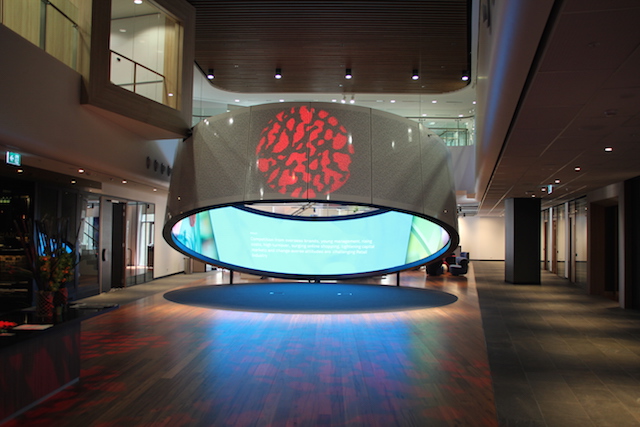
    Welcoming visitors is the centre’s Insight Ring, a nine metre circle-shaped platform that surrounds guests with digital insights mined from Telstra’s information services. Leading off the reception area are a range of displays showcasing the company’s products and capabilities including wearable technologies, 3D printing and Ged The Robot.

    Marking the centre as a modern facility the display spaces where Telstra and its partners can show off technologies to industry bodies and prospective clients.

    Ged, the Telstra robot
    Ged, the Telstra robot

    The previous space two floors higher in the building was beginning to show its age after seven years and the fixed displays of technology in the older facility dated the centre, something that’s a disadvantage in an industry changing as quickly as telecommunications.

    In the new centre, the demonstration facility is largely screen based so displays can quickly be adapted to show off the technologies aimed at whichever industry they are pitching.

    The fast moving technology world
    The software driven demonstration centre


    Andy Bateman, Director of Segment Marketing at Telstra, who lead the tour was proud to show off the current display that had been set up to showcase the company’s banking products.

    telstra_client_demonstration_consumer_insights_centre

    Bateman described how the facility can be quickly altered to suit the needs of specific demonstrations, this was a degree of flexibility missing in the PayPal innovation center in San Jose, which is more comprehensive in its displays but requires a major fit out to change anything.

    Venture capital investor Marc Andreessen stated that software will eat the world, Telstra’s Customer Insights Centre illustrates this starkly.

    However software doesn’t always have the upper hand, just opposite the Telstra centre is the Sydney City Apple Store. In some ways, the two facilities opposite each other illustrate one of the big technological and market battles of this decade.

    View of the Apple Store from the Telstra Centre
    View of the Apple Store from the Telstra Centre

    For most businesses, software will define the future way of working but for the smart hardware vendors will still be making good money.

    Similar posts:

  • Preparing for the mobile data explosion

    Preparing for the mobile data explosion

    Late last month Cisco Systems released its annual Visual Networking Index that tracks the company’s predictions for the growth of global network traffic over the upcoming five years.

    It’s no surprise this year’s report predicts global data traffic will grow at over fifty percent compounded each year with Cisco expecting 24.3 exabytes to be pushed around the world’s networks each month by 2019.

    Most of that network traffic will come from tablet and smartphones with Cisco predicting data use will grow by up to a factor of five on those devices with devices like wearables growing fourfold.

    This growth creates a challenge for telcos as they invest in capacity to deal with the increased traffic and Cisco sees half of all smartphone connections will be handed off to WiFi networks by the decade’s end.

    Summary of Per-Device Usage Growth, MB per Month

    Device Type

    2014

    2019

    Nonsmartphone

    22 MB/month

    105 MB/month

    M2M Module

    70 MB/month

    366 MB/month

    Wearable Device

    141 MB/month

    479 MB/month

    Smartphone

    819 MB/month

    3,981 MB/month

    4G Smartphone

    2,000 MB/month

    5,458 MB/month

    Tablet

    2,076 MB/month

    10,767 MB/month

    4G Tablet

    2,913 MB/month

    12,314 MB/month

    Laptop

    2,641 MB/month

    5,589 MB/month

    Source: Cisco VNI Mobile, 2015

    Handing half the growth in mobile traffic over to Wi-Fi connections, most of which will be connected to fiber or ADSL services will provide challenges for fixed line operators as well who will see the demand for capacity also explode over the rest of the decade.

    Much of this explains the moves by companies like Telstra to roll out public Wi-Fi services to start locking users into their services. It also gives them, and consumers, an opportunity to understand how networks that mix both cellular and Wi-Fi behave.

    Cisco_M2M_connections_to_2019

    Another aspect of the Cisco VNI survey is the Internet of Things which is going to see exponential growth as industrial and household devices start being connected either directly through the telco networks, across unlicensed radio spectrum or over private Wi-Fi systems.

    While Cisco predicts the bulk of that traffic as being generated by smartphones, the company sees connected devices as growing by 45% per year over the next five years with 3.2 billion sensors connected to the internet by the end of the decade.

    Cisco-2015-VNI-M2M-connections

    Notable in the prediction that Low Powered Wide Area (LPWA) networks – non cellular systems mostly operating in the unlicensed spectrum used by Wi-Fi networks – will provide nearly a third of the connections by 2019. At the same time we can expect many M2M deployments to consolidate traffic locally with much of the data processing down locally before the residual information being passed up the network.

    As usual the Cisco VNI report underscores, and possibly understates, the growth in mobile data usage we’re going to see over the rest of the decade. For businesses, it’s time to plan for managing both the flow and application that smart devices are going to generate in our daily operations.

    Similar posts:

    • No Related Posts