Tag: 3D printing

  • Reverse financing a manufacturing revolution

    Reverse financing a manufacturing revolution

    Nano Dimensions may not have shipped a product since it was founded in 2012 but is worth $49 million dollars and was Israel’s best performing tech stock last year reports Bloomberg Business.

    It’s not surprising that Nano Dimensions has caught the imagination of investors, the company was founded in 2012 to develop advanced 3D printed electronics, including printers for multilayer PCBs (printed circuit boards) and the nanotechnology-based inks those machines rely upon.

    Should the technology prove successful, the application of those printers in fields like rapid prototyping is immense. The company speculates their devices may even get RFID tags down to the magical one cent figure which opens may opportunities in industries like logistics and retail.

    In a GeekMe profile of the company last June, the writer even speculated Nano Dimensions could be heralding a disruption to the electronics industry similar to that the music industry faced when home users could burn their own CDs and stream music.

    While that – and the speculation that 3D printing of electronic devices will kill Chinese manufacturing – may be some way off, it isn’t hard to see the potential of this technology.

    The Israeli aspect of the Nano Dimensions story is interesting as well, with the company receiving a $1.25 million investment from the country’s office of the chief scientist after it was reverse listed onto the local stock market by taking over a moribund company.

    For countries like Australia, Canada and the United States which are likely to have many moribund small mining and energy on their stock markets in coming years, such reverse listings may be an opportunity to spark their tech sectors with fresh capital and talent.


    While Nano Dimensions is still very a speculative venture, the company illustrates a number of possibilities for 3D printing, electronics, the Israeli tech industry and the future of fund raising at a time when the Silicon Valley venture capital model seems to be under stress.

    Another fascinating aspect of Nano Dimensions is that it’s one of the new breed of hardware startups, a field that until recently was dismissed as ‘too hard’ by most tech investors. Overall, the Israeli businesses an interesting company to watch for many of the aspects it touches upon.
    Similar posts:

    • No Related Posts
  • The limits of today’s technologies – day two of Autodesk University

    The limits of today’s technologies – day two of Autodesk University

    The second day of Autodesk University 2015 in Las Vegas continued the focus on innovation and changing industries, the afternoon innovation session was particularly focused on some of the opportunities being realised in drones, pre-fabricated buildings and lampshades made out of fungus.

    Brooklyn based designer Danielle Trofe gave a great demonstration of how she’s using fungus to create a range of sustainable light shades. Interestingly in a conversation earlier in the day with Autodesk CTO Jeff Kowalski the topic of growing products out of Mycelium, the vegetative part of a fungus that Trofe uses, was discussed in terms of smart packaging and biodegradable products.

    Growing products out of organic material is one of the themes explored in Mercedes Benz’s Biome concept car which proposes to grow the chassis out of seeds. While realising that concept is some way off, Trofe’s Mush-Lume idea shows some products are already at that stage.

    Rethinking prefab buildings

    Following Trofe was Jos Mulkens, the CEO of Dutch building company Voorbij Prefab, who described how by using sophisticated design tools and 3D printing to make prefabricated building panels they had reduced to the time to fabricate elements from days to hours.

    Mulkens gave a good insight into how design and production workflows are being accelerated with modern technology, particularly in replacing manual form makers to make the moulds for the precast panels. Voobij Prefab are flagging a lot of disruption heading for the building industry.

    At one the media breakout sessions a group of senior Autodesk managers discussed the trends in design and materials engineering. This turned out to be an interesting session on the limits of current technologies.

    Composite technologies

    Max Moruzzi, Autodesk’s Principal Research Scientist, is a passionate believer in composite materials and the benefits they promise. However he conceded when challenged by his colleague Steve Hobbs, who joined Autodesk last year with the acquisition of  UK based Computer Aided Manufacturing company Delcam, about the structural properties of composites that we still have a lot to understand about how they behave and fail.

    Bringing a touch of English scepticism to the panel, Hobbs pointed out almost all metallic components made by 3D printing require some sort of mechanical, subtractive finishing such as milling or polishing.

    Hobbs went onto warn that we risk introducing a “hairball of complexity” into the design and manufacturing industries as people experiment with developing products with materials and techniques they don’t fully understand.

    All the panel, which also included Carl White – Autodesk’s senior director of marketing for advanced manufacturing – and Benjamin Schrauwen who leads the company’s Spark 3D printing division, agreed that applying current design and manufacturing methods need to be rethought in the light of new methods being developed.

    The limits of 3D printing

    It was notable in the panel Q&A around the revelation that 70% of 3D printing projects fail, the panel put this down to the relative immaturity of software and machinery along with the technologies currently being poorly understood. Hobbs observed that for GE to 3D print their jet engine parts they rebuild and reprogram the printers they buy to their own higher specifications.

    For the final session CEO Carl Bass and CTO Jeff Kowalski faced a Q&A from analysts and the media, that session was interesting in exploring some of the directions Autodesk sees industry and business heading and I’ll write more about that tomorrow.

    Overall, the Autodesk University has been an interesting insight into the future of design and manufacturing along with the effects this has on other industries. With these technologies at an early stage, it’s a field that is going to evolve rapidly.

    Paul Wallbank travelled to Autodesk University in Las Vegas as a guest of Autodesk.

    Similar posts:

    • No Related Posts
  • Touring the Autodesk demonstration gallery

    Touring the Autodesk demonstration gallery

    What is the future of design and manufacturing in an age of 3D printing and powerful software? Computer Aided Design company Autodesk gives us some clues at how the world of design is changing.

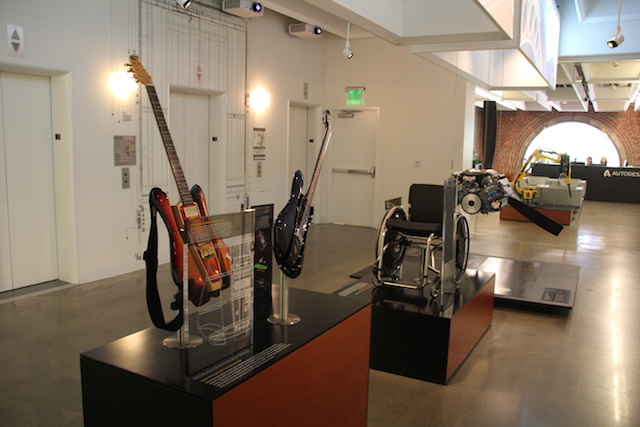
    Sitting in what was once the Southern Pacific Railway’s headquarters at the beginning of San Francisco’s Market Street is design software company Autodesk’s demonstration gallery showcases how design and manufacturing are going to radically change in coming years.

    The first exhibit in the exhibition, which is open to the public three days a week with guided tours on Wednesdays, is a scale model of the Shanghai Tower that illustrates the power of simulations and the value computers add to the building and architecture industries.

    Shanghai_tower_scale_model_autodesk_gallery

    Currently China’s tallest skyscraper and the second highest in the world, one of the notable features of the Shanghai Tower is how the designers were able to extensively model the shape of the building to reduce the loads on the structure. The cost and weight savings enabled the developers to create a far more lightweight building with a reduced environmental footprint.

    For architects, builders and designers the Shanghai tower is an example of how desktop prototyping can be used to experiment with competing schemes to see what designs meet the needs of those using the building or product.

    The biggest exhibit in the hall is the Mercedes Biome concept car chassis. First unveiled at the 2010 Los Angeles Car Show, the idea behind the vehicle’s design is an organic form similar to an animal’s skull to create a strong but lightweight structure.

    Mercedes_biome_concept_car_chassis

    Adding to the Biome’s exotic design is the proposal to ‘grow’ the car’s chassis out of genetically modified seeds. Essentially the vehicle’s structure wouldn’t be manufactured in our current understanding of the word at all.

    Mercedes_Benz_Biome_Concept_Car_model

    While the Biome or similar vehicles won’t be seen on the roads in the near future – Mercedes predict the vehicle is at least 60 years away – the idea behind ‘growing’ industrial items is one that may well become commonplace in the near future for smaller items.

    lego_dinosaur_autodesk_demonstration_gallery

    The other big exhibit in the gallery is the Lego dinosaur. Made up of 62,000 custom designed pieces, the dinosaur was assembled in at the company’s Czech Republic facility before being shipped to California.

    One disappointing aspect of the dinosaur for some of the attendees is that these models aren’t made of solid Lego. Instead an internal brace is made that supports the structure. Again this is a feature of the design software that allows the creators to accurately calculate the weight and build a model that won’t collapse under its own mass.

    At the other end of the size range, but no less important, is the display of 3D printed prosthetic limbs. It’s now possible to scan the remaining limb and create a device that closely replicated the lost limb.

    3D_printed_prosthetic_leg_autodesk_gallery

    Again, using 3D printing allows those limbs to be quickly made to the custom specifications, the design also allows weight saving features to be incorporated into the prosthetic. This exhibit shows just how life changing modern technologies can be.

    Finally, one of the most intriguing devices is the The SOCCKET power generating soccer ball designed to promote physical activity and help children in developing nations access light to study by.

    Uncharted Play Sokket ball

    The SOCCKET charges up as kids play with the ball, in the evening an energy efficient LED lamp can be plugged into the ball. The Soccket retails for 99 US Dollars and for ball sold one is donated to a third world community.

    Products like the Soccket, the prosthetic limbs and many of the other displays in the Autodesk Demonstration Gallery show the potential of a world where new ways of manufacturing join with modern design tools. It’s worth a visit to appreciate some of the ways our world is going to change in coming years.

    The gallery is open to the public every Monday, Wednesday, Friday from 10 a.m. to 5 p.m., with a guided tour at 12:30 p.m. every Wednesday. Admission is free.

    Similar posts:

    • No Related Posts
  • Management in an age of information abundance

    Management in an age of information abundance

    The Twentieth Century was defined by abundant and cheap energy while this century will be shaped by our access to massive amounts of data.

    How do managers deal with the information age along with the changes bought about by technologies like the Internet of Things, 3D printing, automation and social media?

    Management in the Data Age looks at some of the opportunities and risks that face those running businesses. It was originally prepared for a private corporate briefing in June 2015.

    Some further background reading on the topic include the following links.


    Similar posts:

    • No Related Posts
  • The not so smooth rise of 3D printing

    The not so smooth rise of 3D printing

    Vice’s Motherboard details the remaking of MakerBot, the rescue of an early leader of 3D printing industry.

    The story is great long read for any business owner or want to be startup founder and a reminder that the development of new industries is never smooth sailing.

    Similar posts: