Tag: android

  • Comparing Management costs

    Comparing Management costs

    Telecoms analyst site Asymco has a look at how much Samsung spends on marketing compared to other tech companies, particularly Apple, with Coca-Cola added as a sanity check from outside the bubble.

    While the results are stunning with Samsung dwarfing the others, the Asymco story also touches on the total cost of sales and general administration expenses with the observation that, as a proportion of revenue, Sumsung’s are soaring while Apple’s are declining.

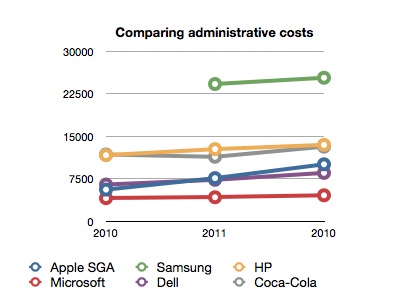
    Teasing those figures out a bit more is interesting, when we track the sales and general administration costs of all the business we see that with the exception of Apple they’ve been remarkable flat in straight dollar terms over the last three years.

    Of course this comparison is a little unfair as this is an absolute number, not as a proportion of revenue and as Horace Dediu points out in the Asymco posts Apple’s expenses as a ratio to sales has fallen.

    For companies like HP, Dell and Microsoft where sales have been stagnant or falling it might be that the ratio is rising while spending is flat.

    We’ll tease these figures out over the next few days.

    In the meantime, the fact that Samsung is spending such an awesome amount on marketing should cause us to treat Android sales figures with caution as that spend in undoubtedly inflating their sales figures. More on that in the future as well.

    Similar posts:

  • Enter the Dragon

    Enter the Dragon

    Once up a time our parents laughed at the tinny little Japanese cars – in the 1960s companies with silly names like Toyota and Mazda could never threaten world giants like Chrysler, Ford and General Motors.

    Within two decades the Japanese had moved their products up the value chain leaving their American and European competitors running scared while governments in western countries offered the new leaders of the manufacturing industries bribes to set up plants in their towns and states.

    It was always obvious China would follow the same course as the Japanese, particularly given the country’s position as the world’s cheap labor supplier had a time limit thanks to the demographic effects of the 1970s One Child Policy.

    So it’s no surprise that Alibaba, China’s biggest e-commerce service, has built its own mobile operating system to compete with Google’s Android.

    If Aliyun follows the Japanese development path, the first version is terrible but within five years – the development cycle of software is a lot quicker than that of cars – Alibaba will be a viable competitor to Google and Android.

    Chinese developers moving into the mobile market is terrible news for the also rans like Microsoft and Blackberry. As Apple dominate the premium mobile sector and Android the mass market, it’s very hard for those running third or lower to achieve the critical mass needed to be competitive. Aliyun makes it much harder for them to gain any traction in high growth developing markets.

    An interesting aspect of the Wall Street Journal’s story is how Aliyun is aimed at the domestic Chinese market for the moment. This is part of China’s economy moving away from being overly reliant on exports, having locally made products that meet the needs and aspirations of a growing domestic economy is an important part of this process.

    Exports though will remain an important part of the Chinese economy for most of this century and value added products like Aliyun will be important for China as the cheap labour advantage erodes over the next two decades.

    Businesses who think their markets are protected because their quality is better than their Chinese competitors may be in for a nasty shock, just like the 20th Century auto makers who dismissed the Japanese were in the 1970s.

    Whether Aliyun is successful or not, we’re once again seeing many of the facile assumptions about Chinese growth being tested as the country’s economy and society evolves.

    Similar posts:

  • Android’s corporate wins

    Android’s corporate wins

    Telstra’s launch of the second iteration of their T-Hub device and the Commonwealth Bank’s Albert tablet Point of Sale device are notable in their choice of operating system.

    For the T-Hub, the first version was a bug plagued and slow proprietary system that which one of the reasons for the device’s market failure. Telstra’s second attempt runs on the Google Android system.

    The Commonwealth Bank didn’t make Telstra’s mistake with the Albert device, instead choosing  the open source system from the beginning.

    Choosing an open platform like Android makes it easier for the developers and company to support the device and develop new products. There’s also the advantage of thousands manufacturers supplying hardware that runs on Android.

    If we compare the costs of developing a proprietary system and sourcing hardware for it to run on, the choice of an open system is almost irresistible.

    For Microsoft, this adoption of Google Android by corporations is another blow to Windows’ dominance of the market, a few years ago all of these devices would have been running a version of Windows but Android is a cheaper, more flexible and better suited to most of the tasks required.

    It could be worse for Microsoft – Apple could be dominating this market. Apple though have had their own victory on consumer devices and increasingly companies have to cater for their customers and staff wanting an iPhone or iPad app.

    Like on smartphones, the battle is now between Android and Apple.

    Similar posts:

  • The high stakes of Lumia

    The high stakes of Lumia

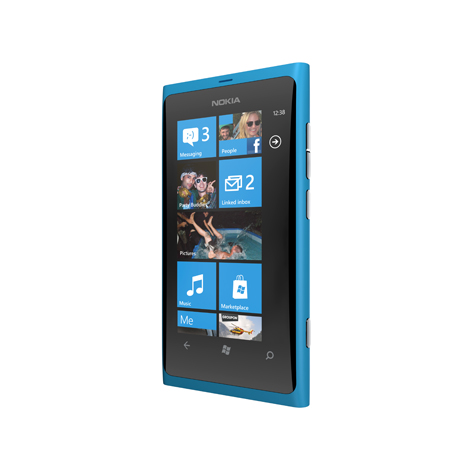
    Yesterday Nokia and Microsoft gave a preview of their upcoming Lumia 710 and 800 phones for the Australian market. It’s make or break time for both companies in the mobile space.

    The phone itself is quite nice – Windows Phone 7.5 runs quite fast with some nice features such as integrated messaging and coupled with good hardware it’s a nice experience. Those I know who use Windows Phones are quite happy with them (I’m an iPhone user myself).

    Whether its enough to displace the iPhone and the dozens of Android based handsets on a market where both Nokia and Microsoft have missed opportunities remains to be seen.

    The battle is going to be on a number of fronts – at the telco level, in the retail stores and, most importantly, with the perceptions of customers.

    Probably the biggest barrier with consumers is the perceived lack of apps, to overcome this Nokia have bundled in their Maps and Drive applications while Microsoft include their Mixed Radio streaming features along with Microsoft Office and XBox integration.

    As well the built in services, both parties are playing up their application partners with services like Pizza Hut, Fox Sports and cab service GoCatch. Although all of these are available on the other platforms.

    While application matter, the real battle for Nokia and Microsoft is going to be in the retail stores where the challenge shouldn’t be underestimated.

    Apple dominate the upper end of the smart phone market and Android is swamping the mid to low end. How Windows Phone devices fit remains to be seen.

    In Australia, if they going to find salvation it will be at the tender hands of the telco companies.

    The iPhone is constant source of irritation for the telcos as not only do Apple grab most of the profit, but they also “own” the customer.

    On the other hand, Android devices are irritating customers who are bewildered by the range of choices and frustrated by inconsistent updates that can leave them stranded with an outdated system.

    So the Windows Phone does have an opportunity in the marketplace although one suspects commissions and rebates will be the big driver in getting sales people at the retail coal face to recommend the Microsoft and Nokia alternatives.

    Overall though, it’s good to see a viable alternative on the market. For both Microsoft and Nokia the stakes are high with the Lumia range – it could be Nokia’s last shot – so they have plenty of incentives to get the product right.

    Microsoft has consistently missed the boat on mobile computing since Windows CE was launched in 1996 while Nokia were blind-sided by the launch of the iPhone in 2007 and have never really recovered.

    To make things worse for Nokia, the market for basic mobile phones where they still dominate is under threat from cheap Android based devices. So even the low margin, high volume market isn’t safe.

    For both, the Lumia range is critical. 2012 is going to be an interesting year in mobile.

    Similar posts:

  • The business of baffling choices

    The business of baffling choices

    In his Daring Fireball blog, John Gruber’s takes to task the view that Apple suffers through not having a wide product range.

    John makes the valid point that Samsung seems to stealing market share from HTC rather than Apple but the whole theory of offering too many choices strikes to the heart of two industry’s business models.

    Those two industries are the mobile telco business and the Windows personal computer sector.

    In the PC world, the wide range of models has been both an advantage and a weakness; it’s allowed Dell and others to create custom machines to meet customer needs but also leaves consumers – both corporate and home buyers – confused and suspicious they many have been taken advantage of.

    All too often customer were being had; frequently buyers found they’d bought an underpowered system stuffed with software that either was irrelevant to their needs or an upgrade was necessary to get the features they hoped for.

    The entire PC industry was guilty of this and Microsoft were the most obvious – the confusing range of operating systems and associated software like the dozen version of Microsoft Office was deliberately designed to confuse customers and increase revenue.

    For the PC industry, the “baffle the customer” model reached its zenith, or nadir, with Windows Vista where Microsoft deliberately put out an underspecced ‘Home’ edition designed to push sales up the value chain.

    Compounding the problem, most of the manufacturers followed Microsoft’s lead and put out horribly underpowered systems in the hope that customers would upgrade with more memory, better graphics card and bigger, faster hard drives.

    Most customers didn’t upgrade and as a result the Vista operating system – which was horrible anyway – enhanced its well deserved reputation for poor performance.

    In the telco sector, consumer confusion lies at the heart of their profitable business model; a bewildering range of phones and plans often leaves the customer spending too much, either through an overpriced plan or paying punative charges for ‘excess’ use.

    Having a hundred different types of Android phone adds to the confusion and, by restricting updates, they can cajole customers into ‘upgrading’ to a new phone and another restrictive plan every year or so. This is why you get phone calls from your mobile phone company offering a new handset deal 18 months into a two year plan.

    Apple’s model has been different; in their computer range there has never been a wide choice, just a few configurations that meet certain price points. The same model has used for their phones and iPads.

    For Apple, this means a predictable business model and a loyal customer base. They don’t have to compete on price and they don’t have to fight resellers and telcos who want to ‘own’ the customer. It’s one of the reasons mobile phone companies desperately want an alternative to the iPhone.

    Companies using the baffling choices business model – Microsoft, HP, Dell and your local mobile telco – may well continue to do okay, but that business model is coming under challenge as new entrants are finding new niches.

    For all of us as consumers all we can do is make the choices that are simple are reject complexity. Warren Buffett has always maintained he doesn’t invest in businesses he doesn’t understand, perhaps we should have the same philosophy with the purchases we make.

    Similar posts: