Tag: apps

  • The revenge of the open web

    The revenge of the open web

    Ben Terrett, the former head of design at the UK Government’s Digital Service, tells GovInsider why the agency banned mobile phone apps with the British taxpayers saving £4.1bn over the following four years.

    Instead the GDS insisted agencies built responsive web sites so pages would adapt to the devices they were being read upon, saving time and money being devoted to developing and maintaining individual apps for different platforms.

    Apps are “very expensive to produce, and they’re very very expensive to maintain because you have to keep updating them when there are software changes,” GovInsider quotes Terrett.

    For those of us who worry about the increasingly siloed and proprietary nature of the internet, Terret’s story is very good news. Apps are particularly problematic as they stunt innovation, lock users into platforms and give those who control the App stores – mainly Apple and Google – massive market power.

    It’s no co-incidence Facebook are currently in the process of restricting web access to their messenger service. Locking users into their app gives them far more power over users and much more control over their data.

    On the other hand, the open web means sites are more accessible and not subject to the corporate whims of whoever controls a given silo. It also means that any data collected is far more likely to be commoditised, something Facebook hates.

    That government agencies and large corporations are realising the costs, risks and value they are handing over the gatekeepers by developing apps is encouraging. It would be good if they considered the other downsides of giving the web over to a small clique of companies.


     

    Similar posts:

  • Dealing with an app driven world

    Dealing with an app driven world

    “It isn’t easy to create apps for the real world,” is the opening line of this morning’s VM World conference in San Francisco.

    That line encapsulates the challenge facing almost every company, not just tech companies like VMWare, in the face of shifting marketplaces and technologies.

    One of the biggest business shifts is the move to mobile technologies. This isn’t just changing marketing and user experiences but also changing companies’ operations as staff increasingly use their own smartphones and tablets to work.

    Managing a shifting market

    That shift though is not simple, as ZD Net reports Facebook’s move to ‘mobile first’ was a tough path in the words of the company’s senior engineer Adam Wolff.

    “I think everyone would say it was worth it, but it was extremely painful,” Wolff admitted, explaining each sub-team was building in their own ways because there was no one to crossover with necessary knowledge.

    Facebook has probably been the most successful company is dealing with the mobile shift and their difficulties despite their massive resources show just how difficult it is for companies to change not just their technology, but their business processes and in many cases the entire mindset of the organisation.

    Those pain points in transitioning between ways of doing business is where opportunities lie, for VMWare they are seeing IT departments struggling with the development and deployment of apps along with the security risks of staff bringing their own mobile devices.

    Happy coincidences

    For VMWare, this is a happy coincidence in that their main business of computer virtualisation is as much at risk from the shift to cloud computing and mobile applications as any other business. By offering the tools for companies to manage that shift, they can retain their place in the market.

    The threat though is this space has many other contenders – not least Facebook itself with its open source React platform the company developed out of its experiences in developing its mobile product.

    One of the strengths VMWare has is being an incumbent, which is why they are pushing their ‘hybrid cloud’ offerings where companies use both their own data centres along with the public cloud providers such as Amazon and Microsoft.

    Stuck with sunk costs

    For large corporates with huge sunk costs in their own infrastructure and those with security or operational reasons for keeping some of their functions in house that hybrid strategy makes sense as it’s unlikely any board or CIO is going to happily burn their existing systems and process down and go to a ‘pure cloud’ or mobile strategy.

    While catering to that market is lucrative for the moment, the longer term risk is that the next wave of large corporations – and today’s high growth businesses – are pure cloud companies.

    For the companies catering to the old ways of doing business, for the short term there’s profits to be made in the pain points from an evolving marketplace but in the long term it’s how well businesses are placed for the world the end of that transition that will guarantee their survival.

    The process facing software companies like VMWin dealing with as business shifts is a challenge faced by almost all industries, the question is how to adapt to a very changed way of working.

    Similar posts:

    • No Related Posts
  • Adapting to a new economy

    Adapting to a new economy

    Taxis have gotten their ass kicked” says Hansu Kim, owner of San Francisco’s oldest taxi company.

    Kim’s company, DeSoto, is changing the name it has held since the 1930s to Flywheel in an agreement with the taxi hailing app of the same name. The San Francisco Chronical describes how DeSoto and the city’s other taxi companies are finding times tough now Uber and other services have moved into what was a safe, regulated business.

    DeSoto’s move is a sign of the times as older business models evolve; moving to an app based hailing service improves the experience for everybody in the cab industry and radically changes the economics of getting a ride across town.

    The main reason for Uber’s success is being able to identify both drivers and passengers which improved confidence in the system. In turn, this changes riders expectations and taxi’s fare structures.

    For companies competing with Flywheel the question will be do they participate in this service or do they create their own app. For the industry in general it makes sense to share the infrastructure but for uses it may well be in their interest to have competing apps with different levels of service.

    As the levels of car ownership continue to fall, how taxi hailing and car hire apps evolve will drive the development of our cities through this century. DeSoto and Flywheel’s experiment is the start of many as older businesses adapt to a changing economy.

    Similar posts:

  • Don’t be at the wrong end of the long tail

    Don’t be at the wrong end of the long tail

    One of the most important characteristics of the technology industry is  you have to be first or second in your market to guarantee profitability.

    As more of the world become digitized this is becoming true in other sectors, as Tomi Ahonen’s survey of the app industry shows. This also demolishes the long tail theory of online economics.

    The long tail idea was put out by writer Chris Anderson during the first dot com boom.

    Anderson’s view was the long tail of older material would be a useful income source for creatives and businesses. For many, small payments on a ‘long tail’ of older work would add up to reasonable revenues.

    I’ve always skeptical of that view as the internet tends reward the ‘one percenters’ — a tiny number with the most traffic or revenue make the money while the bulk of players fight over the few crumbs that drop from the table.

    A sheer disaster industry

    A good example of how digital markets favour a tiny group of leaders  is in Tomi Ahonen’s survey of the 2014 mobile apps market that shows the vast majority of developers struggle for pennies.

    Ahonen pulls no punches, describing the apps industry as a “sheer disaster industry with only one sector making money” and goes on to describe just how dire the predicament is for most developers.

    The first point is where the money is being made; the first answer is by Google and Apple who skim five billion of the industry’s $21 billion in revenues. Just that stat alone shows where the real money is in the sector.

    Of the remaining $15 billion the top 1.3% of the industry — around 27,000 developers — take $11 billion, or 73% of the revenue and leave four billion to be shared among the other 98%.

    Slaves and huddled masses

    At the other end of the scale those who Ahonen calls the ‘slaves’ and the ‘huddled masses’ there’s only 400 million dollars to be shared around two million developers. Implying 87% of the industry barely make a few hundred dollars a year.

    On Ahonene’s figures two out of five developer make nothing.

    HUDDLED MASSES IN APPS ECONOMY 2013
    Revenues left . . . . . . . . . .  0 million dollars
    Bottom 39% developers . . 819,000 developers
    Bottom 39% earn . . . . . . .  0 million dollars
    Bottom 39% earn . . . . . . .  0% of all revenues
    Bottom 39% earn . . . . . . .  0% of developer revenues
    Average per dev . . . . . . . .  0 dollars
    In above numbers:
    Beggars failed to earn . . . . 400,000
    Hobbyists don’t care . . . . . 250,000
    Branded utility app devs . . 170,000
    Source: TomiAhonen Consulting analysis on Vision Mobile survey Aug 2014

    The Apps industry is a stark indicator of just how brutal the economics of digital distribution are. The long tail is real, it’s just that it describes a massive imbalance in income within markets.

    For all of us trying to make a dollar in the digital world, we need to find the niche where we fit into the profitable part of the curve.

    Being on the wrong end of the long tail is a recipe for poverty.

    Similar posts:

    • No Related Posts
  • Splitting apps

    Splitting apps

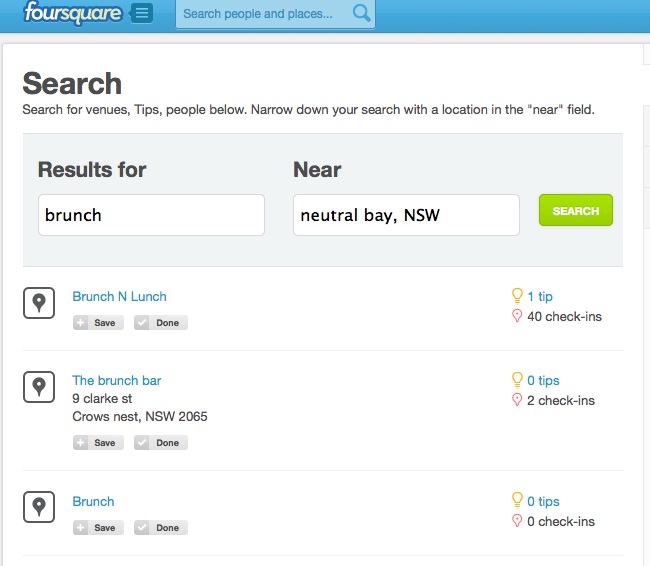
    Much to the irritation of many users both Foursquare and Facebook have split their apps into separate tools.

    Fred Wilson of Union Square Ventures, one of the investors in Foursquare, explains the reason for this are that different patterns meant the service had to cater for privacy models which threatened to confuse users.

    The risk for both Facebook and Foursquare is that irritated users might give up on the service, it’s a tough balancing act.

    Similar posts:

    • No Related Posts