
Tag: business

  • A quick Christmas checklist for hospitality businesses

    A quick Christmas checklist for hospitality businesses

    For listeners of my regular spot on ABC Riverland, here’s a quick checklist for regional business owners to make sure their online presence is ready for the Christmas holidays.

    Prospective customers are using the web to find businesses and attractions, so taking advantage of the free listing services by the major search engines and directories is the first step.

    Google Plus Local

    The search engine giant’s local service gives a free business listing that feeds into their results and those of many GPS devices and social media services.

    Fill in as many fields as possible, making sure you don’t forget opening hours and payment methods you accept.

    You can also upload photos and menus to your Google Local listing, all of these will help you come up higher in the search engine results.

    True Local

    News Limited’s True Local offers a similar service to Google and this also feeds into various services along with the local news sites run by the newspaper chain.

    Again, fill in as many fields as possible and make sure all your essential business details are listed.

    Sensis

    While the Yellow and White Pages may be dying, a free listing with their site will help come up on the various Telstra sites and companies that partner with them.

    Review sites

    Eatability, Yelp and Tripadvisor are all popular sites and applications used by customers to research accommodation and venues. You need to grab your listing and check what previous customers have said about you.

    Social media

    Along with having your own listing on Facebook, LinkedIn, Twitter and possibly sites like Pinterest; you should be doing regular searches to check what people are saying about you and your district.

    One of the great things about social media is it’s a great market intelligence tool. For instance if there’s lots of people coming to your town to go fishing and there’s nobody catering for them, then this is an opportunity. Google Alerts can help you with this.

    Your own website

    Most important of all is your own website. Check that it works on smartphones and tablet computers, if necessary borrow a friend’s Android or Apple device and see what your site looks like on it.

    When you review this with your web developer also check your keywords are working and make sure yourmeta-tagsall reflect what you have to offer your customers.

    The Christmas-New Year rush is too important a period for hospitality business to miss out on customers. A few small thing might get you the visitors who might have kept on driving to the next town.

    Similar posts:

  • Google for entrepreneurs

    Google for entrepreneurs

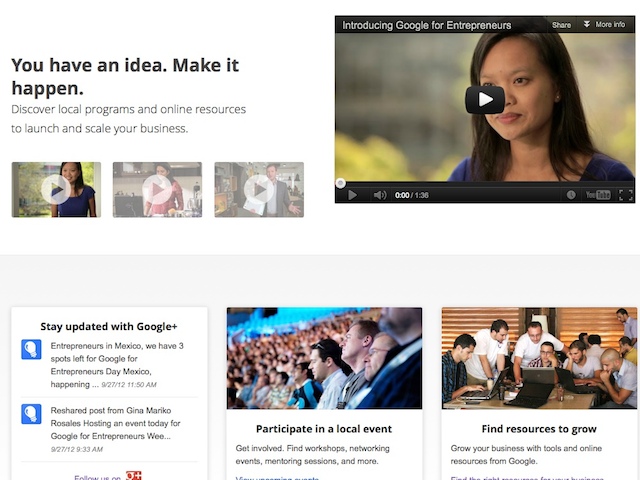
    This is an interesting project – Google have pulled together all their entrepreneurial resources into one page at Google For Entrepreneurs.

    As well as being a handy resource for anyone building a business, it’s a great overview of the various programs Google and their partners are running around the world.

    If you are looking at setting up a business or have a fast growing enterprise it might be worthwhile having a look at the resources Google have pulled together.

    Similar posts:

  • Your customers are smarter than you

    Your customers are smarter than you

    “I’m a serial entrepreneur which means I failed with one company at a time” says Steve Blank in a terrific interview with Mark Suster.

    Both Steve and Mark are experienced entrepreneurs conversation is one of these raps between two experienced and intelligent individuals where the questions are as smart as the answers.

    One of the key take aways from the interview is that our customers are smarter than us. If they aren’t buying from us, they know something we don’t.

    Whether we’re talking about startups or big business, listening to the customer is the core thing we have to be doing and everything else is noise.

    Similar posts:

  • Gift giving in China

    Gift giving in China

    A terrific little infographic from cross cultural PR firm Illuminant shows the right and wrong ways of giving gifts in China.

    The first faux pas listed is giving clocks and the advice “if you happen to receive a clock from any Chinese source, get your butt to airport pronto” is marvellous.

    Giving gifts in sets of six or eight is also a great little gem.

    One of the cultural differences between East Asia and the west is the habit of giving small gifts of appreciation and it’s easy to get this wrong. What is acceptable in the People’s Republic of China might be a grave mistake in Korea or Thailand.

    A handy little app for dealing with cross cultural misunderstandings is Hooked In Motion’s World Customs and Cultures that lets you dial up the basic protocols like not touching heads or hand gestures which should be avoided. Sadly it doesn’t cover gift giving.

    Illuminant’s infographic and Hooked In Motion’s app remind us that the whole world isn’t being homogenised by the web and global communications as each culture takes today’s tools and adapts them to their own worlds.

    Similar posts:

  • Squandering a reprieve

    Squandering a reprieve

    ABC Radio National’s Background Briefing has a terrific story on the struggles of the Fairfax newspaper empire during the early days of the Internet.

    One of the major themes that jumps out is how Fairfax, like many media and retail organisations, squandered the opportunity presented by the tech wreck.

    The tech wreck was an opportunity for incumbents to claim their spaces in the online world, instead they saw the failure of many of the dot com boom’s over-hyped online businesses as vindication of their view the Internet was all hype.

    As former Sydney Morning Herald editor Peter Fray said “In florid moments you could even think this internet webby thing would go away”.

    For Fairfax the profits from the traditional print based business were compelling. According to Greg Hywood the current CEO, for every dollar earned by the company, 70c were profits – a profit margin of 233%.

    The Internet threatened those “rivers of gold” and media companies, understandably, did nothing to jeopardise those returns.

    Another problem for Fairfax was the massive investment in digital printing presses in the 1990s. These behemoths revolutionised the way newspapers were printed as pages could be laid out on computer screens and sent directly from the newsroom to the press itself which printed out pages in glorious colour rather than with smudgy black and white images.

    Moreover these machines were fantastic for printing glossy coloured supplements and the advertising revenue from those high end inserts kept the dollars rolling in.

    When the tech wreck happened, the massive investments in printing presses were vindicated as the rivers of gold continued to flow while the smart Internet kids went broke.

    Fairfax’s management weren’t alone in this hubris – most media companies around the world made the same missteps while retail companies continued to build stores catering for the last echos of the 20th Century consumer boom.

    In 2008, the hubris caught up with the retailers and newspapers. As the great credit boom came to an end, the wheels fell off the established business models and the cost of not experimenting with online models is costing them dearly.

    Value still lies in those mastheads though as more people are reading Fairfax’s publications than ever before.

    Readers still want to read these publications, one loyal reader is quoted in the story that Sydney Morning Herald should aspire to “being a serious international paper.”

    That isn’t going to happen while management is focused on cutting costs to their core business instead of focusing on new revenue streams.

    Somebody will find that model, had the incumbent retail and media organisations explored and invested in online businesses a decade ago they may well have found that secret sauce.

    Now many of them won’t survive with their horse and buggy ways of doing business.

    Similar posts: