Tag: china

  • Australia and the Chinese Mexican stand off

    Australia and the Chinese Mexican stand off

    Twenty years ago visitors to Sanya on the south coast of China’s Hainan Island could find themselves staying at the town’s infectious diseases clinic, converted into a backpackers hostel by a group of enterprising doctors.

    The Prime Ministers and Presidents attending of Boao Asia Forum this week won’t get the privilege of staying at the infectious diseases hospital as Sanya’s hotel industry has boomed, bust and boomed again following the island being declared a tourism zone in 1999.

    Instead, their focus is on the pecking order of nations and for the Australians the news is not good. As the Australian Financial Review reports, the Aussies have been seated well below the salt by their Chinese hosts.

    On the Boao list, Australia is outranked by Brunei, Kazakhstan, Myanmar, Zambia, Mexico, and Cambodia – even New Zealand Prime Minister John Key gets higher billing.

    Central and South East Asian countries make sense as countries like Myanmar and Kazakhstan are China’s  neighbours with strong trade ties.

    That the Kiwis have been given priority over the Aussies by the Chinese government is not surprising in light of this.

    An unspoken aspect for the Australian attendees to the Baoa conference is how long Canberra’s political classes can continue their forelock tugging fealty to the US without offending the nation’s most important trading partner.

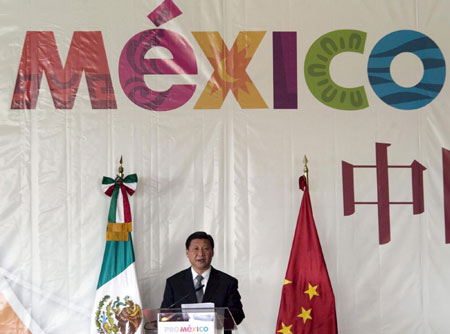
    Mexico’s entry on that list could be one of the most important with consequences for Australia and the world.

    During the 1992 US Presidential campaign candidate Ross Perot coined the phrase “the great sucking sound” in his opposition to the North American Free Trade Agreement and the risk of losing jobs to lower cost Mexico.

    As it turned out, the giant sucking sound was China – it turned out China’s admission into the World Trade Organisation had far greater consequences for the United States and Mexico than NAFTA.

    Mexican manufacturing was one of the greatest victims of China’s rise as US companies found it easier to subcontract work to Chinese factories rather than setup their own plants in Mexico.

    Now China is finding its own costs creeping up and labor shortages developing and Mexico is attractive once again. The Chinese and Mexican governments have been working on their relationships for some time.

    As manufacturing moves out of China, the shifts in world trade we’ve seen in the last two decades are going to be repeated, this time with Chinese moving up the value chain the lower level work moving to Mexico and other nations.

    The leaders at the Baoa conference have their work cut out for them in dealing with another decade of global change.


    Similar posts:

  • Microsoft’s China crisis

    Microsoft’s China crisis

    That the Chinese Public Security Bureau is blocking your messages – and may even be reading them – would make anyone pause before they used a service.

    Bloomberg Businessweek reports Microsoft Skype is doing exactly this with its Chinese customers. Anything deemed inappropriate is censored and referred to servers belonging to TOM Online, the company that runs the Skype service on behalf on Microsoft in China.

    The Bloomberg story goes onto detail how one Canadian researcher is reverse engineering the Chinese blacklists, giving us a wonderful insight into the petty and touchy minds of China’s censors and political leaders.

    What raises eyebrows about this story is how nonchalant Microsoft is about this issue, in a wonderful piece of corporate speak the software giant answered Bloomberg’s question with the following bland statement;

    “Skype’s mission is to break down barriers to communications and enable conversations worldwide,” the statement said. “Skype is committed to continued improvement of end user transparency wherever our software is used.”

    Microsoft’s statement also said that “in China, the Skype software is made available through a joint venture with TOM Online. As majority partner in the joint venture, TOM has established procedures to meet its obligations under local laws.”

    Microsoft have to fix this problem quickly, glibly saying the Chinese government eavesdropping on conversations is a matter for partners is not going to be accepted by most customers.

    It would be a shame should Microsoft’s Skype investment fail – Skype is a very good fit for Microsoft, particularly when the technology is coupled with the Linc corporate messaging platform, so squandering goodwill over protecting users’ conversation seems counterproductive.

    One of the great business issues of this decade is the battle to protect users’ privacy. Those who don’t do this, or don’t understand the imperatives of doing so, are going to lose the trust of the marketplace.

    Twenty years ago, Microsoft could have risked this. Today they can’t as they struggle with a poor response to their Windows 8 operating system and their mobile phone product.

    Losing the trust of their customers may be the final straw.

    Similar posts:

  • Revolution and disconnected leaders

    Revolution and disconnected leaders

    China expert Patrick Chovanec has a provocative blog post on What Causes Revolutions, building upon the Financial Times’ description of how the Chinese Communist Party is struggling with corruption.

    In his article Chovanec quotes Richard Pipes’ Three “Whys” of the Russian Revolution which looked at how the fall of the Tsarist government was largely unexpected.

    This is true with the fall of all great regimes, in the late 1980s the idea that the Soviet Union would cease to exist within a decade was unthinkable.

    Chavonec quotes a key part of Pipes’ book;

    In 1982 [Pipes writes], when I worked in the National Security Council, I was asked to contribute ideas to a major speech that President Reagan was scheduled to deliver in London.  My contribution consisted of a reference to Marx’s dictum that, when there develops a significant disparity between the political form and the socio-economic context, the prospect is revolution.

    “A significant disparity between the political form and social-economic context” could be just as applicable to Western democracies.

    The Economist article makes a point about the French revolution “the widely accepted theory now is that the French Revolution was one of rising expectations that eventually could not be met.”

    As Stratfor’s George Freedman pointed out last week, a generation of Americans have expectations that are not going to be met. The same is true in Europe.

    While there’s no doubt the China’s political structures – like those in all totalitarian nations – are more brittle than those in established democracies, it might not be a good idea for those of us in the West to be smug and complacent about our own systems.

    Zapata image is courtesy of Ferferfer through SXC.

    Similar posts:

  • Proudly designed in Gyeonggi

    Proudly designed in Gyeonggi

    “Designed by Apple in California ” is the boast on the box of every new iPad or Macbook. That the slogan says ‘designed’ rather than ‘made’ says everything about how manufacturing has fled the United States.

    Last year the New York Times looked at Apple’s overseas manufacturing operations, pointing out that even if Apple wanted to make their product in the the US many of the necessary skills and infrastructure have been lost.

    Now the US is facing the problem that Asian countries are looking at moving up the intellectual property food chain and doing their own designs.

    In some ways this is expected as it’s exactly what Japan did with both the consumer electronics and car industries during the 1960s and 70s.

    The big difference is that Japanese manufacturers travelled to the US and Europe to study the design and manufacturing methods of the world’s leading companies. In the 1990s and 2000s, the world’s leading companies gave their future competitors the skills through outsourcing and offshoring.

    In the next decade we’ll see the latest consumer products coming with labels reading “Designed by Lenovo in Fujian” or “Developed by Samsung in Gyeonggi”.

    For western countries, the question is what do we want to be proudly be putting our names to?

    Image from Kristajo via SXC.HU

    Similar posts:

  • Bringing manufacturing home

    Bringing manufacturing home

    In the 1980s General Electric, like most US companies, sent most of its appliance manufacturing offshore.

    Now its coming home.

    The Atlantic Magazine looks at how General Electric is resuscitating manufacturing at Kentucky’s Appliance Park as management finds US workers are more skilled and productive than their equivalents in Mexico or China.

    An important part of the article is how critcal supply chains are; manufacturing hubs rely upon having a community of skilled service providers and suppliers around the factories while being close to customers improves and simplifies logistics.

    In the latter case, it now take hours or days to deliver products to customers’ stores or warehouses rather than the five weeks it takes from China.

    The cost of those goods is lower too, the Kansas made GeoSpring heater sells for $1299 while the Chinese product sells for $1599.

    What is most notable though is how designers and managers now have a better understanding of the manufacturing process; where under the oustourced model the difficulties in assembly were none of their business, now they are far more deeper and directly involved.

    This really goes to the core of what an organisation does – in the 1980s it was fashionable to talk of the “virtual corportation” where everything the business did was outsourced except for the managers who were employed solely to pocket their bonuses.

    In the 1990s and early 2000s that “virtual corporation” became a reality as manufacturing and customer support were offshored and logistics was outsourced.

    One of the best examples was customer support where looking after the needs of those who buy the company’s products were secondary to the need to cut costs.

    This focus on cost cutting over customer service hurt Dell badly in the 2000s and it continues to hurt many organisations – particularly telcos and banks – today.

    The weakness in the “virtual corporation” model was the company ended up adding little more value than the brand name and eventually those offshored manufacturers and call centres took control of the business’ goodwill and intellectual property.

    Eventually the hidden costs of offshoring became too obvious for even the most craven, KPI driven manager to ignore and suddenly manufacturing in the Western world became competitive again.

    Sadly, the fixation on dirt cheap labour has damaged many industries beyond the point where they can be salvaged with too many skilled workers lost and the ecosystem of capable suppliers destroyed. These are costs where tomorrow’s managers will rue the short sighted actions of yesterday’s corporate leaders.

    Similar posts: