Tag: demographics

  • Managing unemployment perceptions

    Managing unemployment perceptions

    Stephen Koukoulas has a look at the changing composition of the Australian economy in Business Spectator today where he looks at how things have evolved over the last 50 years.

    One of the notable things is unemployment and how our perception of what an acceptable level is;

    Australia’s unemployment rate is 5.4 per cent at present, it was 0.9 per cent in August 1970 while in August 1951 it was a staggering 0.3 per cent.

    In the 1961 Federal election the Menzies government hung on by one seat, having been punished for allowing the unemployment rate to reach the dizzying heights of 3.5 per cent.

    Through the Twentieth Century, Australia’s unemployment rate averaged around 5% as shown in this Treasury graph.

    Australia's unemployment through the twentieth century

    What’s notable in that graph is how high unemployment became the norm in the last quarter of the century. When it became obvious politicians and economists couldn’t move the needle below 5%, the process of convincing us that five percent was ‘good’ began.

    One wonders what the acceptable level of unemployment will be for the next generation. Will they consider us the failures that our grandparents would?

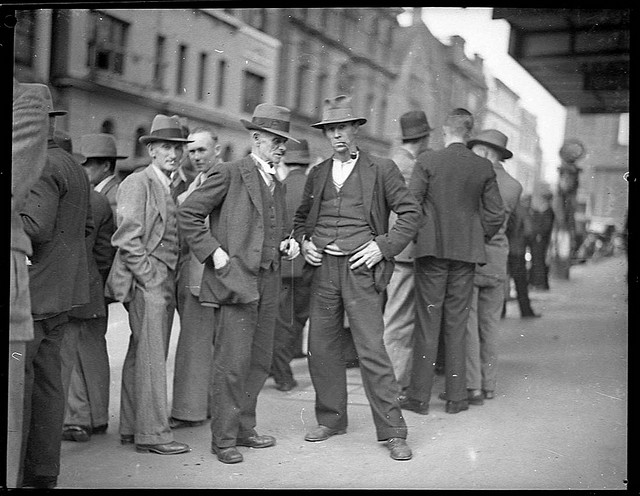
    Image of unemployed carpenters in 1935 courtesy of the NSW State Library via Flickr

    Similar posts:

  • Why you won’t retire

    Why you won’t retire

    Outliving Our Super is the headline of an Australian Financial Review story on the problems of an aging population.

    Jacqui Hayes cites a billboard in San Francisco declaring that life expectancy will soon be 150 and we have to plan for longer retirements.

    The flaw in this discussion is the idea of retiring in our 60s. When the age pension was introduced in 1910, a new-born boy could expect to live 55 years and a girl, 59 years. The odds were against the average person every receiving the pension which was an effective, if ruthless, way of ensuring the solvency of social security programs.

    A hundred years later, a new born can expect to live well into their eighties. Meaning the average person will spend two decades in retirement.

    Making matters worse is the nature of that Millennial’s work pattern – when great, great grandpa entered the workforce in the 1920s,  he was almost certainly in his early teens and worked a solid fifty years paying his taxes before prospect of retirement arrived.

    Today, that child won’t enter the workforce until at least their late teens and more likely until their early twenties. A modern child is also going to have a much more fragmented work career and will likely have periods of unemployment or low earnings as a casual or contract worker.

    For today’s child to retire at 65 it would mean he or she will have had to saved enough over a forty year working life to sustain them for fifteen years of retirement, those numbers are tough and to achieve it most won’t be living the millionaire lifestyle during their golden years.

    With a life expectancy of 150, the early twentieth century model of retiring at 60 or 65 means today’s child would spend less than 30% of their lives in the workforce. Put simply, the numbers don’t add up.

    The reality is most of us won’t be retiring at 65, the baby boomers reaching retirement age now are learning this and it’s a lesson that’s going to get harder for the Gen X’s and Y’s following them.

    As a society, or an electorate, we can pretend there’s no problem and policy makers and politicians will pander to our refusal to face the truth by keeping structures that reflect early Twentieth Century aspirations rather than Twenty-First Century realities.

    We have to face the reality that the retiring at 65 is unaffordable dream for most of us. Once we accept this, we can get on with building longer lasting careers.

    Picture of pensioners courtesy of andreyutzu on SXC.HU

    Similar posts:
  • Desperate Ken and market realities

    Desperate Ken and market realities

    Ken Slamet has a problem, his in-laws are trying to sell the family house and no-one will give them the price they want.

    The house at 228 Warrimoo Ave has been on the market through an agent for more than 100 days, pulling in ridiculously low offers, Mr Slamet said.

    Depending on the deposit, Mr Slamet is seeking between $1.5 million and $1.6 million for the house his wife grew up in.

    One would argue that those “ridiculously low offers” are actually Mr Market giving Ken and his in-laws a slap of reality. They are simply asking for too much money.

    St Ives, a suburb on Sydney’s Upper North Shore, is going through demographic change. In 1960s and 70s St Ives was the suburb for successful stock brokers and bankers, however in the 1980s and 90s that demographic decided they wanted to live closer to the city and Harbour and suburbs like Mosman and Clontarf became their areas of choice.

    For Ken’s in-laws and their neighbours, this is bad news as few other people can afford 1970s mansions on large blocks within 30km of Sydney. Those who do manage to sell often find the buyers are developers who sub-divide to build townhouses or apartment blocks, madness in a congested, car-dependent suburb with poor public transport links.

    Adam Smith’s invisible hand of the market is giving those holding properties that were attractive to stockbrokers in 1972 a nasty slap over the head in 2012.

    Ken though has a solution for his problem – he’s offering a rent to buy scheme at a mere snip of $2297 per week. An amount 70% higher than the average Sydneysider’s gross income and a whopping four and half times the city’s average rent of $500.

    Good luck with that.

    The real problem is that Ken’s in-laws are stuck with expectations higher than the market reality. Like many of us in the Western world, they believe their assets are worth more than they really are.

    As the global economy deleverages there will be many more people like Ken’s family. For many the transition to a less wealthy lifestyle is going to be tough.

    Similar posts:

  • Could Australia follow the Greek path?

    Could Australia follow the Greek path?

    Business Spectator’s Robert Gottliebsen today describes how Australia has caught the Greek disease of low productivity and an overvalued currency.

    This is interesting as just last week Robert was bleating on behalf of Australia’s middle class welfare state.

    Australia’s productivity has stagnated over the last 15 years, but unlike Greece the ten years before that was a period of massive reform to both employment practices and government spending.

    The structure of the Australian economy is very different, not least in its openness, to that of Greece.

    What’s more Australia has a floating currency which will eventually correct itself unlike the Euro that Greece finds itself trapped in.

    That’s not to say Australians won’t be hurt when that currency correction happens. The failure of the nation’s political, business and media elites in failing to recognise and plan for this is an indictment on all of them – including Robert Gottliebsen.

    Australia’s real similarity with Greece is the entitlement culture that both nations have developed.

    Over those last 15 years of poor productivity growth, Australia has seen a massive explosion of middle class welfare under the Howard Liberal government which has been institutionalised by the subsequent Rudd and Gillard Labor governments.

    Today middle class Australians believe they have a right to generous government benefits subsidising their superannuation, school fees and self funded retirements.

    For all the sneering of Australian triumphalists about Greek hairdressers getting lavish government benefits, Australia isn’t far behind Greece in believing these entitlements are a birthright.

    A middle class entitlement culture is the real similarity between Australia and Greece. It’s unsustainable in every country that harbours these illusions.

    Unlike Greece, Australia doesn’t have sugar daddies in Brussels, Paris and Berlin desperate to prop up the illusion of the European Union. Australia is own its own when the consequences of magic pudding economics become apparent.

    Australia’s day of reckoning may arrive much quicker than that of Greece. Then we’ll see the test of how Australians and their politicians are different from our Greek friends.

    Similar posts:

  • No exit

    No exit

    The men’s hairdresser down the road from me has hung up his scissors after twenty-four years.

    The sign on his shop window apologizes and the shop itself is up for lease. Shortly there won’t be any evidence a long standing local business was once there.

    Roy had no exit from his business and he sell the operation as a going concern.

    For Roy his retirement will be funded solely out of his savings. If he’s lucky he’ll have saved enough of his income from the business for a comfortable retirement – unfortunately many small business owners they’ll eke out the rest of their lives on the pension.

    Even for those who have planned for an exit, many of their plans have fallen over in the aftermath of the 2008 financial crisis.

    It’s always been questionable whether Gen X and Y entrepreneurs could afford to pay the sums for the affluent retirement of Baby Boomer business owners but now the post 2008 contraction in lending means it’s even less likely retiring business owners like Roy will find someone to buy their businesses.

    While the focus is on twenty something app developers selling their businesses for a billion dollars, the truth is that wealth for most business owners lies in the local newsagent, hairdresser or coffee shop owner being able to sell their operation for a reasonable return.

    For many baby boomer business owners it’s going to mean working more years than they intended and sharply reduced retirement expectations.

    Property values too are difficult. Many boomer businesses had the sensible model of buying the property their business occupies as a retirement nest egg.

    Again those properties are too expensive for the new generation and the deleveraging economy means the outlook for property values isn’t good.

    On every level, things are going to be tough for those wanting to sell businesses over the next decade.

    Those who do get good prices for their businesses are going to be those doing something exceptional to gain attention with income and profits that make them stand out from the cloud.

    Just being the best hairdresser in the neighbourhood or having a popular cafe isn’t going to be enough.

    Hopefully Roy The Barber managed to stash away enough for a well deserved comfortable retirement.

    Similar posts: