Tag: disruption

  • Business in an age of data abundance

    Business in an age of data abundance

    I’m preparing a corporate talk for next week on the changing economy and one theme that sticks out is how the Twentieth Century was defined by cheap energy and physical mobility as mains electricity and the internal combustion engine became ubiquitous and affordable.

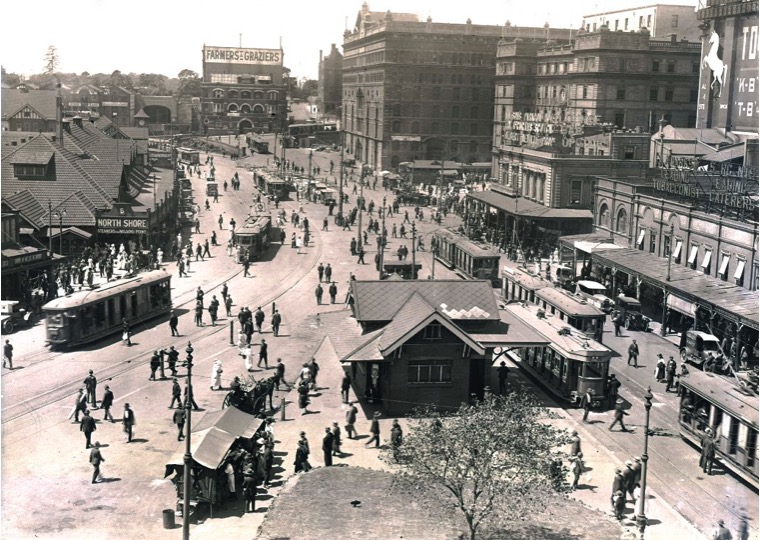
    The picture accompanying this post illustrates that shift, Sydney’s Circular Quay a hundred years ago was just at the beginning of the automobile era. The previous fifty years had bought trams, the telegraph and reliable shipping but the great strides of the Twentieth Century were still to happen.

    At that stage the steam engine and advances in electrical transmission had bought reliable power to the masses, although it was still expensive. What was to come over the next fifty years was that energy was about to become cheap and abundant. That drove the suburbanisation of western societies and the development of industries around the availability of cheap power and a mobile workforce.

    At the time though information was still expensive, the control of broadcast networks by a few license holders and print operations by those who could afford the massive costs of producing and distributing magazines or newspapers made data difficult to get and worth paying for.

    Today we’re at the start of a similar shift in information; it’s no longer expensive or difficult to obtain.

    What that means for the next thirty years is what industries will develop in an economy where information is basically free and ubiquitous. Just as cheap energy created the consumerist economy, we’re going to see a very different environment in an age of cheap data.

    Similar posts:

  • Is your job really safe?

    Is your job really safe?

    Yesterday we looked at the PwC report on the value of science and engineering education to the economy.

    The survey wasn’t good news for the workforce with the survey predicting over two in five workers’ jobs were at risk as digital technologies changed industry.

    Notable in the list were the industries PwC believed to be safe over the next twenty years; largely being the medical, health and ‘people’ businesses like public relations.

    jobs-least-at-risk-from-tech-change

    While the industries themselves might be safe, specific jobs in those sectors may not be so with roles ranging from hospital porters being replaced by robots to surgeons carrying out remote operations.

    Looking at the list of relatively unaffected industries, it’s hard not to see how digital technologies aren’t going to disrupt those occupations.

    Redefining public relations

    PR for instance is undergoing a radical change as the media industry is being totally disrupted requiring today’s public relations professionals to have a very different set of skills to those of twenty years ago.

    Those skills include a much more adept use of technology itself and having to deal with a faster, more fragmented industry.

    Public relations professionals brought up in the days of boozy lunches and far off deadlines struggle in a time of bloggers, social media and data journalism.

    Evolving medicine

    Similarly medical practitioners, the top position on the list, have seen their jobs dramatically transformed over the past twenty years by computers and those changes are far from over as medical equipment gets smarter, personal fitness devices become pervasive and the amount of data being collected on patients grows.

    Across the medical industry the roles of almost every occupation is being redefined as technology changes the tools they have, along with the nature of ailments their patients present with.

    Big Data and analytics

    Some professions will grow but automation in those fields will grow exponentially faster, a good example being the fifth role on the list – database administrators and ICT security professionals.

    Ensuring the reliability and security of servers and networks is going to become even more essential as the economy increasingly depends upon these systems however security and IT professionals are going to rely on algorithms and Big Data to manage the massive task they have – these are the opportunities for companies like Splunk and Microsoft Dynamics.

    In all of these comparatively safe industries the jobs of tomorrow are going to need different skill sets to what they require today.

    For workers in these ‘safe industries’ this means further education, training and reskilling to stay employed. Just being employed in a sector that’s expected to stay static or grow isn’t enough to keep your job.

    Employers in these ‘safe industries’ also face a challenge in making sure their staff have the right skill sets to use the new technologies.

    The airline analogy

    If you were running an airline in 1965 it would be cold comfort to look at the explosive growth ahead for the industry in the jet airline era when all your staff are trained to keep propellor aircraft in the air.

    So when we talk about digital disruption, it’s not just about industries being shut down and jobs being lost but about radically changing occupations.

    It would be a brave person to assume that just because their industry is safe, their own job or business is secure.

    Similar posts:
  • Microsoft in Middle Age

    Microsoft in Middle Age

    One of the great business stories of today is how Microsoft is reinventing itself in the face of a totally changed industry. With the company turning 40, The Economist has a look at the business in its middle age.

    The Economist concludes CEO Satya Nadella is making the important changes to the business that founder Bill Gates couldn’t make because he was too protective of the company’s core products and that Steve Ballmer, Nadella’s predecessor, wasn’t interested in making as he sweated the existing assets.

    As this blog has pointed out before, The Economist notes the profit margins of the cloud and mobile services Nadella is focusing on are far slimmer than those Microsoft are used to from their server and desktop products.

    Those fat profit margins were the reason why Nadella’s predecessors had little reason to refocus the company but towards the end of Ballmer’s leadership it was clear Microsoft couldn’t resist the shift for much longer.

    Microsoft’s dilemma was clear to the stock market as well with The Economist having a chart showing the relative performance of IBM, Microsoft and Apple over the last 35 years.

    share-price-value-of-tech-stocks-ibm-microsoft-apple

    When Microsoft peaked in the late 1990s, the company was worth over twenty percent of the total tech sector’s valuation – today Apple has stolen most of that value.

    A particularly jarring from The Economist’s graph is just how much IBM dominated the tech sector a generation ago and its steep decline following the introduction of desktop computers.

    IBM’s decline in its dotage is exactly the fate Nadella is trying to avoid for Microsoft, with companies like Google, Apple and Amazon as competitors he has a tough task ahead of him.

    Similar posts:

  • Artificial meat and disruption of the cattle market

    Artificial meat and disruption of the cattle market

    In thirty years ‘cultured meat’ will be commonplace and it will disrupt the cattle market Professor Mark Post warned the Northern Territory Cattlemen’s Association earlier this week.

    Artificial, or ‘cultured’, meat is a dramatic change for the food industries and it promises, or threatens, to radically transform the cattle grazing business.

    This is another example of an industry that wasn’t expected to be affected by change facing a radical transformation. It shows again few of us are immune from change.

    Similar posts:

  • Software eats the sports cameraman

    Software eats the sports cameraman

    Since the beginning of industry technology has changed occupations in unexpected ways the demise of the sports TV cameraman is a good modern example of a highly skilled, specialised trade that may soon be redundant.

    Years ago television studios largely replaced cameramen with remote controlled cameras but sports grounds needed skilled operators with excellent attention spans to video action at sports grounds.

    At a lunch today in Sydney Michael Tomkins, Chief Technology Office of Fox Sports Australia, explained how a combination of high definition cameras and advanced software is changing the way sports are broadcast and recorded.

    “Last year we put two 4k cameras in to cover the length of the ground,” Tomkins said. “Two 4k cameras can see the length of the whole ground so I get rid of four cameramen and replace them with one joystick bunny.”

    “He moves a box around the screen and those become a virtual camera. The resolution of a 4k camera is four times that of our HD broadcasts. It’s quite cost effective and I don’t have to roll a crew out.”

    A demonstration of how the technology works is in a YouTube clip of an Australian Rules football match from last year. While the ‘joystick bunny’ and the software is somewhat clumsy in the segment, the clip shows the power of the technology.

    With abolishing most of the camera, the opportunity to rationalise the production suite also becomes possible; at present most sports events have a producer instructing a group of assistants to cut between cameras, prepare replays and all the other effects expected by viewers. With a software based system most of that labor and its skills become redundant.

    Over time as higher resolution cameras become available this application is going to become common, in fact most junior and amateur sports will be able to afford static hi-res cameras for their ground that allows them to record their games.

    While the demise of the sports cameraman and producers is a shame in the same way loom weavers and hansom cab drivers disappeared, it is a reflection of  changing technologies creating then destroying occupations.

    TV camera image through wikipedia

    Similar posts: