Tag: economy

  • Cheap coffee and the changing service sector

    Cheap coffee and the changing service sector

    I noticed the queues one morning when calling into the local service station to grab a carton of milk at 5am.

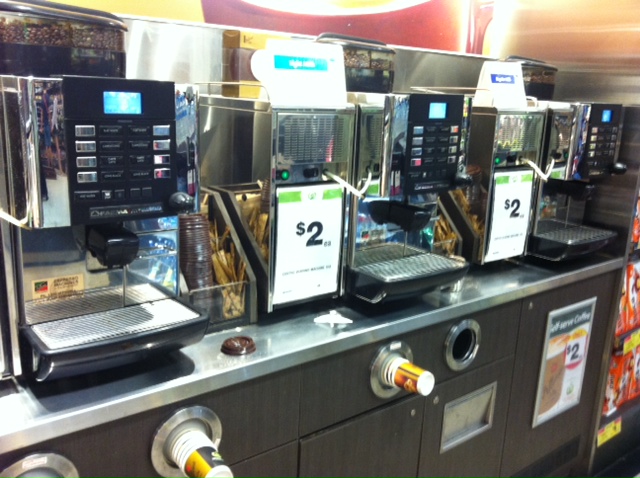
    There was a line of tradesmen out the door waiting to buy a $1 self serve coffee. Freshly ground with your choice of espresso, latte or cappuccino.

    No messing around, no being patronised by snobby barista – just a cheap, decent quality cup of coffee.

    For the last few years these machines have been popping up in convenience stores and service stations, freshly grinding beans to order and delivering a reasonable cup of coffee for a dollar or two.

    7-11-cheap-coffee.jpg
    Cheap coffee at the local convenience store

    None of the machine made cups will beat a coffee made by a good barista, but are half or a third of the price being charged by many cafes whose product often isn’t much better (and sometimes worse) than that made by the machines.

    With the rise of the service economy in the 1970s it was assumed employment would move from factories to jobs like baristas and serving in cafes, now we’re seeing automation taking over those jobs as well.

    The 1970s assumption that the service industries would become the mainstay of the economy turned out to be true with over two thirds of the workforces in countries like the US, UK and Australian employed in them them by the end of the Twentieth Century.

    Now industries are restructuring again and the assumptions that worked well for the last fifty years are being challenged by automation and increased outsourcing.

    The idea we could build an economy based upon us all making coffee and waiting tables for each other was always problematic and so it is proving to be.

    It’s worth thinking about the opportunities this presents for your business.

    Similar posts:

  • Australia’s economic Hari-Kari

    Australia’s economic Hari-Kari

    The Golden Era of Credit is Now Over” writes Maximillian Walsh in the Australian Financial Review today.

    Max’s story relies mainly on the April edition of Bill Goss’ monthly newsletter where the founder of investment firm PIMCO writes about the talents of today’s market wizards;

    All of us, even the old guys like Buffett, Soros, Fuss, yeah – me too, have cut our teeth during perhaps a most advantageous period of time, the most attractive epoch, that an investor could experience.

    The credit boom of the last fifty years created many winners – investment bankers, property owners and those who sell things funded by easy finance.

    One of the best examples of a fortune made through easy credit is Australia’s Gerry Harvey. Here’s one of Gerry’s ads from 1979.

    Hurry into Norman Ross. You can use Bankcard or our easy credit system. You can even use cash!

    Three years later Gerry was sacked from the business he founded and he set up Harvey Norman, promising John Walton and Alan Bond “I’m going to beat you.” By the end of the 1980s he had.

    Gerry’s success is built on easy credit and the rise of the consumerist economy. From the hire purchase plans of the 1960s, the introduction of credit cards in the 1970s and the banking deregulations of the 1980s, Gerry was able to sell goods to eager consumers who could worry about paying later.

    In the 1990s and 2000s a happy coincidence of easy credit and cheap Asian manufacturing – note the prices of electrical goods in that 1979 commercial – saw businesses like Harvey Norman grow exponentially.

    Mao promised the Chinese a chicken in every pot, Gerry delivered a plasma TV in every Australian bedroom.

    Today, as Bill Goss says, the credit party is over. Last drinks were called with the failure of Lehman Brothers on September 16th, 2008.

    However this hasn’t stopped the Aussie economy, as the Sydney Morning Herald reports today Sales growth cheers Gerry Harvey.

    In the same edition the SMH reports the government science organisation, the CSIRO, is cutting hundreds of staff. Notable in that article is a comment from the organisation’s CEO;

    Dr Clark said more than 2000 companies collaborated with CSIRO but that industries were reducing the amount spent on research.

    So at a time when the Australian economy is struggling with the effects of a high currency and exhibiting all the symptoms of the Dutch Disease, consumers are spending more on TVs and sofas while business cuts investment in research and development.

    Karl Marx famously predicted that the last capitalist will be hanged with the rope they sold, Australians have a bunch of Harvey Norman branded credit cards for their financial seppuku.

    Similar posts:

  • Driving a horse and cart in a digital economy

    Driving a horse and cart in a digital economy

    “There’s no point in building a highway if no-one can drive” Tasmanian business leader Jane Bennett said about the Australian National Broadband Network during an interview last week.

    Jane was touching on an important point about the digital economy – that most businesses aren’t equipped to deal with it.

    That half of businesses in the US, UK or Australia don’t have a website illustrates that in itself. What’s really worrying is setting up a website is the easy part and has been standard for a decade.

    In many respects this isn’t new, a similar thing happened when mains electricity or the motor car arrived. Many businesses clung desperately to their oil filled lamps and horse drawn carts way past the time these were superseded.

    Well into the 1970s there were hold outs who continued to ply their carts despite the costs of keeping horses on the road being far greater than buying a truck.

    That failure to learn about and invest in new technologies saw all those businesses die, many of them with the owner who’d eked out a living as a milko or rag and bone man for decades.

    On a bigger level, the struggles of the local milkman with his Clydesdale is a worrying reflection of business underinvestment. These folk are stuck with old equipment because they didn’t have the funds to spend on bringing their equipment up to Twentieth Century standards.

    In the 1980s I saw this first hand in some of Australia’s factories. A foreman at a valve manufacturer in Western Sydney boasted to me how he had done his apprenticeship on a particular lathe fifty years earlier.

    That machine still had the belt and pulley assembly from the days when the factory was powered by a steam engine at one end of the plant. It had an electric motor bolted onto it some time in the 1960s but was largely unaltered since.

    It was understandable many Australian factory owners wouldn’t invest after World War II – many industries were protected and property speculation offered, and still does, better returns.

    Another reason for not investing was the sheer cost of buying new equipment, major capital expenditures are risky and for most businesses it wasn’t work taking those risks.

    Today there’s a big difference, hardware and software are far cheaper than they were in the 1960s or 70s with the big investment being in understanding and implementing the new technologies.

    Few businesses don’t have computers or the internet but most of the things we do online are just variations on how our great grandparents worked with documents, filing cabinets and the penny post. We have to rethink how we use technology in business.

    It would be a shame if we find ourselves stuck on the side of the highway wondering what the hell happened in the early years of the 21st Century.

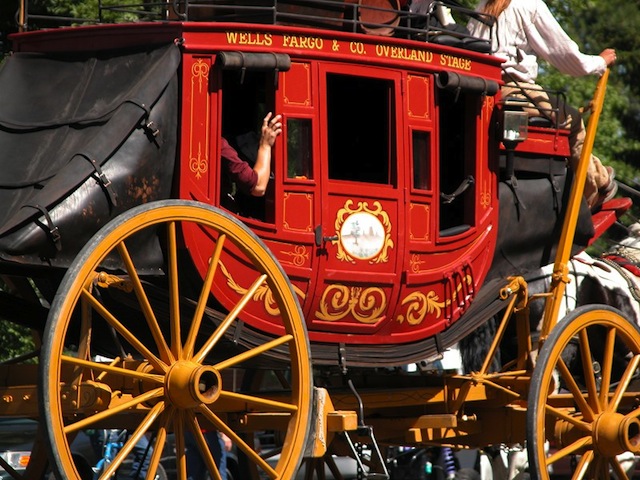
    Stage coach image courtesy of Velda Christensen at http://www.novapages.com/

    Similar posts:

  • Australia welcomes the multi generational mortgage

    Australia welcomes the multi generational mortgage

    At the height of the Japanese property boom in the 1980s, the hundred year mortgage came into being.

    Pushing payments onto children and grand-children was the only way home prices could continue to rise once they hit levels which the average Japanese worker could ever afford with a more traditional twenty or thirty year mortgage.

    Twenty five years later Australia finds itself in a similar position as parents guarantee their childrens’ mortgages.

    Repeating the Japanese mistake

    While the Japanese looked to sticking their mortgages onto their kids and grandkids, Down Under the kids are fighting back and getting mum and dad to underwrite their unaffordable loans.

    This weekend’s Sydney Morning Herald features in its property section the story of how Sharon and Graeme Bruce guaranteed their son’s and his fiance’s mortgage in Sydney’s inner suburbs.

    While the story isn’t clear on the size of the deposit (which isn’t surprising given the SMH’s shoddy editing), it appears the Bruces’ have guaranteed around $300,000 so his son and future daughter-in-law can grab a five bedroom, 1.45 million dollar mansion.

    One wonders what great businesses Matt and Hannah could build if mum and dad were prepared to stump up a similar amount to invest in a start up?

    Australia’s property obsession

    Sadly we’ll never know – in Australia, the smart money gets a job, pays off a mortgage and accumulates wealth through investment properties. What cows are to African tribesmen, negatively geared units are to the Australian middle class.

    The hundred year strategy hasn’t worked too well for Japan, with a declining population those mortgages entered into a boom level 1980s values now don’t look so attractive and are one large reason for the nation’s lost decades.

    In Australia, things aren’t likely to work so well either. The Baby Boomers and Lucky Generationals – those born from 1930 to 1945 – guaranteeing their kids’ and grandkids’ mortgages are relying on ever increasing property prices.

    This is understandable given that few of them have any experience of long term stagnation, let alone decline, of property values but it leaves them incredibly exposed should the Aussie housing market slump.

    Can an Aussie property decline happen?

    Many Australians, particularly those with vested interests, maintain such a decline can’t happen but the prospects aren’t good as the SMH story shows;

    The couple had attempted to buy a small terrace in Newtown but kept getting pipped at the post by other young professional couples. At a higher price point they had no competition.

    Despite his parents’ generosity he said he would still need to rent out a few of the rooms to help pay for the mortgage.

    So Matt can’t afford the mortgage. That’s not good starting point and one that could cost his parents dearly, which they don’t seem to care about much.

    ”Obviously my dad guaranteeing the loan was the only way we were going to purchase this,” Mr Bruce said. ”You need to have a 20 per cent deposit otherwise the banks want you to pay insurance … it’s a bit of a rort really.”

    It’s fair to call mortgage insurance a rort – as it certainly is – but its purpose is to protect the banks should a mortgagee default and the financiers find themselves out of pocket.

    With Matt’s parents getting him out of paying that insurance his bank has much better default protection, equity in his parents’ property.

    Guaranteeing risk and misery

    I’m not privy to the finances of Sharon and Bruce, but most of their contemporaries can ill afford to lose several hundred thousand dollars in home equity in their later years.

    That is where Australia’s multi-generational mortgages could turn very nasty, very quickly as older Australians find themselves having to deliver on the guarantees they gave on behalf of their over committed offspring.

    In Japan, it’s taken a long time for the population to realise their national wealth has been squandered on twenty years of propping up unsustainable property prices and economic policies.

    One wonders how long it will takes Australians to realise the same has happened to them and what the political reaction will be.

    Similar posts:
  • Graphs, damn lies and the middle class

    Graphs, damn lies and the middle class

    Graphs are great for illustrating a story, and also excellent at misleading people.

    A good example of where a graph can give an incorrect impression is the Sydney Morning Herald’s story Whatever Happened to the Middle Class.

    The story is a very good explanation of the predicament Australia’s political classes have put themselves into – exacerbated by their 1950s view of dividing the workforce into poorly paid ‘blue collar’ workers and affluent ‘white collar’ office staff – but it suffers from the selective use of headline graphs.

    Viewing the big picture

    The first graph shows how Australians are identifying themselves as middle class and the trend looks staggering,

    Graph of How Australians see themselves as middle class

    Now if we add those who identify themselves as working class, the picture looks even more dramatic with some pretty volatile swings,

    A graph showing How Australians see themselves as middle or working class

    However if we now add in those who identify themselves as rich, or upper class, we get a better perspective as the entire range is now shown,

    Graph showing How Australians see themselves as upper middle or working class

    Selective choosing the Y, or vertical, axis will always give an exaggerated view of a trend or proportion. Once we take the full range in we see the real extent of things. It also has the benefit of showing the trends aren’t as volatile as first appear.

    Middle class perceptions

    When we look at the graph showing the full picture there’s a number of interesting trends and characteristics about Australian society that come out of it which are worthy of some future blog posts.

    Most notably is the identification of Australians being middle class as their property values increased.

    On this point, it’s worthwhile contrasting the Australian experience with the US, here’s a Gallup poll from last year on how Americans see themselves,

    A graph showing how Americans see themselves as upper middle or working class

    While the definitions are different – that Americans differentiate ‘working class’ and ‘lower class’ is interesting in itself – it’s clear that the same trend happened in the US with more people identifying themselves as being members of middle class when their property values were increasing.

    In 2008 and 9 there’s suddenly a sharp increase in Americans identifying themselves as working class as the property downturn bites. The steady increase in those claiming to be ‘lower class’ from 2006 onwards is worth closer examination.

    What this means for Australia

    The implications of the US trends is that any Australian politician intending to dismantle John Howard’s middle class welfare state will have to wait until the property market falls before trying to win any popular support.

    For this year’s Australian election though, what’s clear is that any attempt to stoke the fires of class warfare is going to fail dismally in the outer suburban marginal seats so coveted by both parties.

    We’re going to see a lot more selective graphs during the course of this year, it’s worthwhile taking time to look at them closely. The stories may be different, and a lot more nuanced, than the headlines tell us.

    Similar posts: