Tag: economy

  • Risk free fallacies

    Risk free fallacies

    One of the conceits of the late Twentieth Century was that we can engineer risk out of our lives.

    Derivatives like Collateral Debt Obligations were thought to overcome financial risks, think contracts would eliminate business risks and wise central banks would massage the economic cycle to banish the risks of economic crises.

    In schoolyards, the kids are banned from doing cartwheels and playing ball games – in response to a recent edict prohibiting physical activity at a local school an education department spokesman said the ban was to prevent, and not in response to, playground injuries.

    So nothing’s happened to provoke a ban, just someone decided there was risk and the first reaction is to eliminate it rather than manage it.

    In a litigious society where a culture of blame has developed this reaction is understandable. If a kid gets hurt in the playground then the parents might blame the teacher and one should be under no illusion that in the NSW state education system, the industrial concerns of teachers will always trump the welfare of students.

    So the cartwheels must stop.

    The strange thing with our culture of blame is that when something goes seriously wrong, such as the implosion of the banking system due to greed and misunderstanding of risk, no-one is held responsible.

    For lawyers, this culture is understandable. After all, their job is to warn clients of legal risks and it’s true that every time we walk down the street or jump in our car we might make a mistake that could see us in court.

    But we learn to manage that risk and we accept the odds every time we choose to drive down to the supermarket.

    The danger in believing we can eliminate risk is that removing one element of risk often results in unexpected consequences – they are even more unexpected when you don’t understand the risks in the first place. CDOs and the shadow banking system are a good example of this.

    Government seek to pass laws eliminating risks and in doing so create new risks, particularly when the Acts they pass are poorly written and badly thought out.

    There is always the question of what risk we are addressing – in the modern corporatist political system, the PR risk to a government always takes priority over a real risk to citizens. Passing a law to protect the minister’s backside might make life more risky for others.

    As helicopter parents, always hovering over our children and blaming teachers, schools, neighbours and other parents when something goes wrong, we’re creating a whole set of risks we don’t understand.

    For politicians, managers and leaders their main responsibility is to manage risk, not pretend it’s been eliminated by the latest memo, law or silly schoolyard ban.

    Similar posts:

  • Economic cholesterol

    Economic cholesterol

    Australia’s productivity isn’t growing and it’s fashionable among business community to blame Australia’s productivity decline on high labour rates.

    While there’s an argument that the cafe worker earning $25 an hour is overpaid – although we don’t hear the same criticism of multimillion dollar packages paid to executives with at best mediocre track records – the argument is far more complex.

    In the McKinsey report linked to above, the mis-investment is put down to the recent resource boom, but is this really true?

    To really understand why Australia hasn’t performed well, we need to look at why the country is so reluctant to invest in assets that will increase our productivity.

    The role of property

    Underlying the recent Australian “economic miracle” is the property industry. The country’s domestic building sector is one of the most efficient job generators in the world. Stimulate the Aussie property market and job growth ripples quickly through the economy.

    This was one the lessons learned in the 1990s recession – successive governments and bureaucrats have learned the mantra “go early, go hard and go residential” when it comes to cutting interest rates and introducing home building incentives like the first home owners grants.

    It was no coincidence that when the Rudd Government was faced by the Global Financial Crisis they launched a wave of initiatives to boost the property industry and shore household wealth. Just as the Howard and Costello governments did in response to the Long Term Capital Bank collapse, Asian economic crisis or the 2001 US recession.

    While those stimulus measures have kept Australia out of recession for two decades, the failure to unwind the measures after the economic shock has passed leaves the nation’s property market remains “hyper stimulated” and over valued. That over investment in property has sucked funds away from other areas which affects the competitiveness of Aussie industry.

    The great property squeeze

    One of the great tragedies of the 1990s was Sydney’s East Circular Quay precinct which could have been one or two of the world’s greatest hotel sites, literally on the steps of the Sydney Opera House.

    Instead, high priced apartments were built on the site and Sydney’s tourism and convention industries are crippled by a shortage of top end hotel rooms.

    Tourism isn’t the only industry affected by the Australia’s obsession with residential property – across the country service stations, sports clubs and convention centres are being demolished to make way for high rise apartment developments. No economic activity seems to trump property speculation when it comes to attracting Australian investors.

    Ideological beliefs

    Adding fuel to the property obsession are the ideologies of the 1980s which are still closely held by the nation’s business and political leaders.

    Capital gains tax concessions introduced by the Howard government in the late 1990s made property and share speculation far more attractive that invention, innovation or entrepreneurship.

    To make matters worse, Australia’s social security policies and taxation laws favour capital gains – any Australian over thirty who has tried to build a business has plenty of mates who did far better out of negatively geared property than those who foolish enough to create new enterprises.

    For those older entrepreneurs facing retirement, they are in for a nasty shock if their businesses don’t sell for what they hope. They would have been far better staying in a safe corporate job and buy a few negatively geared investment properties.

    Again, this ideological belief that capital gains trumps wage or business income means investment is steered away from productive assets and into residential property that can be held for a capital gain.

    The Ticket Clipping Culture

    Australia’s failure to invest in productive assets is not just a feature of the household investor, the corporate sector has a lot to answer for as well.

    While good in theory, the superannuation system has been a failure in providing a capital pool for new and innovative businesses and productive investments.

    The superannuation trustees have largely focused on hugging the index, the ticket clipping funds management culture means that any real investment for productive assets is restricted to funding toll roads where fat management fees and guaranteed commissions mean an easy life for those fund managers.

    In a perverse way, the short term appearance of the ticket clipping might mean increased productivity as costs are cut to improve profits. In the medium and long term, the lack of investment in these assets means in the long term these assets too cease to add productive capacity to the economy.

    Of course there’s more to infrastructure investment than toll roads and airports with crippling parking charges, but the ticket clipping classes of Australia’s investment community don’t see a quick buck in that.

    Increasingly the boards of Australia’s major companies are appointed by those running the superannuation funds and these people have the generational bias away from productive investment. Instead they see slashing IT, training or asset investment as costs to be cut in the quest of boosting bonus delivering profits.

    More fundamentally, three decades of consolidation in most of Australia’s industries has seen a generation of Australian executives whose main expertise is that of maximising their market power at the expense of their competitors. Investing in productive capacity is not a major concern for those corporations.

    Fixing the problem

    Getting Australians – whether mom and dad property speculators or high paid fund managers parking money in the ASX 200 or plonking money in the latest toll road boondoggle – to change attitudes and invest in productive capacity is going to take a generational change.

    As long as the attitude persists that property is a safe investment that doubles in real value every ten years then Australians are going to continue to ply cash into apartments and houses.

    It is possible that a period of Australian Austerity that suppresses property prices may force that change in investment attitudes. An weak property market is one of the unspoken effects of the spending cuts advocated by many right wing commentators,

    The question is whether those commentators, or the political classes who derive their much of their policies from right wing ideologues, view have the stomach for disruption that will come when weaning Australians from the teats of corporate ticket clipping and property speculation.

    Similar posts:

  • Are IT workers the new loom weavers?

    Are IT workers the new loom weavers?

    “There are IT workers who can’t put food on their table,” complained an industry representative at an outsourcing conference.

    It’s true – there are hundreds of once well paid project managers, technicians and support staff staff who can’t get work in their industry as some tasks go offshore and others are supplanted by new technologies.

    None of this is new, we only have to think back to the heady days of the Dot Com boom when any punk with a basic knowledge of HTML could pull down six figures a year.

    Just like the loom weavers of the 17th Century who became the Luddites, the HTML coders of 1998 and the project managers of 2008 have had a short period of affluence before been overtaken by change.

    It’s something that today’s hot shot coders should keep in mind, bubbles burst and technology changes.

    Similar posts:

  • Redefining affluence

    Redefining affluence

    Finance writer Scott Pape always has an interesting perspective in his regular columns.

    This week he talks about Melissa a mother of three who lives in the US state of Georgia who also happens to be Scott’s virtual PA.

    Scott hires Melissa because she’s cheap; far cheaper than her competitors in Australia.

    For the $8 an hour she earns, she gets no sick pay, no health insurance and no retirement benefits. Unless Melissa has a well paid partner and her work for Scott is just a sideline to help pay the bills, she will work until she drops.

    This is the new reality for those in America, Spain, the UK and most of the West. It’s slowly becoming the reality in Australia as well despite the current hubris about the Down Under Economic Miracle.

    Melissa’s job as a secretary or PA was safe and comfortable twenty years ago. Today – just like auto workers, shop assistants, accountants and even lawyers – secretaries are having to trade their secure jobs for precarious, and reduced, incomes in the globalised and casualised marketplace.

    Scott makes perfectly valid points that individual drive and determination will be important in the globalised economy, but nothing changes the fact that Melissa and millions like her – including ourselves – will not have the living standards of her parents.

    While we can talk about billions of Indians and Chinese improving their standard of living the new globalised world, we shouldn’t forget for a moment that living standards are declining for the most of developed world’s middle and working classes.

    This decline isn’t totally due to globalisation and was probably going to happen regardless of the rise of China. The West’s prosperity was built upon the post World War II reconstruction and the credit booms of the 1980s and 2000s. Eventually the money – or the credit – had to run out.

    How we as a society deal with this will define our nations and communities over the next fifty years. Our governments, business leaders and media commentators are ill prepared for the effects even if they recognise the problem.

    Those most deeply affected are the businesses based on the twentieth century model of ever increasing prosperity. As our retailers are finding, this model is running out of steam.

    While some expect the newly affluent Chinese and Indians to save their well padded hides, most will find Asian consumption patterns in the 21st Century will be different to US auto workers of the 1950s or English real estate agents of the 1980s.

    Even financial planners like Scott are going to find things different – many financial planners thought they could get rich just skimming commissions off their clients’ portfolios which grew with the ever climbing stock and property markets. That model dropped dead in September 2008.

    For those of us born and raised during the Western world’s era of great prosperity, we’re going to find we have to work a lot harder and not take affluence for granted.

    Melissa and her eight dollar an hour secretarial service is the future and it’s probably Scott’s, yours and mine as well.

    Some may say that’s a pessimistic view of the world, but a leaner, harder economy may be the best thing could happen for us as individuals and a society.

    Similar posts:

  • Darling Harbour and the peak of consumerism

    Darling Harbour and the peak of consumerism

    Sydney’s Darling Harbour was one the centre of the nation’s mercantile economy, from across the country millions of tons of grain, wheat, sugar and other commodities were loaded onto ships and exported to the empire.

    Eventually Darling Harbour fell into disuse, the docks became containerised, bulk goods moved to specifically designed loaders and the new breed of cargo ships were often too big to fit under the Sydney Harbour Bridge.

    What really sealed Darling Harbour’s fate was Australia moved from being a largely export based agricultural export economy to a service based consumerist economy.

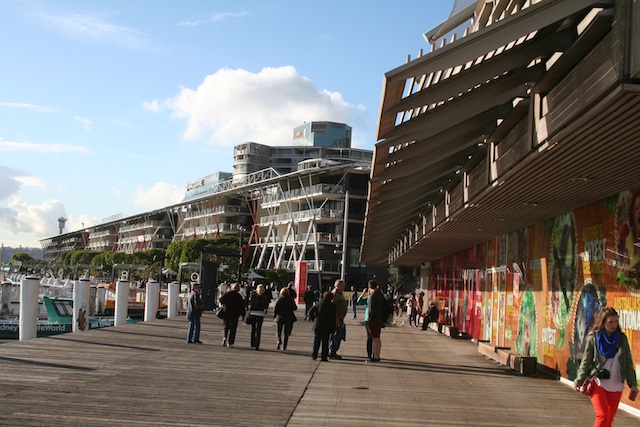
    Today Darling Harbour illustrates that change, the docks have become expensive restaurants, hotels and shopping centres. The notorious “hungry mile” of docks is being converted into “Barangaroo” complex of office blocks, apartments and possibly even a casino for “high roller” Chinese gamblers.

    Even the cruise liners are going. The 1980s vision of Darling Harbour as a temple to consumerism and property speculation is complete. In this way, Darling Harbour has become a picture of the Australian economy.

    Just as Australia’s mercantile era peaked just before The Great Depression of the 1930s – the depression of the 1890s was actually far harder on Australia, particularly Melbourne and Victoria – the consumerist era finished with the Global Financial Crisis of 2008.

    It will be interesting to see how Darling Harbour evolves over the next hundred years.

    For a glimpse of the final days of the old Darling Harbour, Island Shunters an ABC documentary from 1977 showed the working lives of railway workers in the goods yards on the Western side of the docks. Today those railyards are the Australian office of Google and Fairfax’s headquarters.

    Similar posts: