Tag: Facebook

  • Can hyperlocal media work

    Can hyperlocal media work

    One of the hoped for futures of publishing was cheap, hyperlocal websites that report news on individual suburbs or neighbourhoods and get advertising from local businesses.

    Last week US TV network NBC abruptly closed down its Everyblock online service, leaving loyal users angry and bemused. Right now it appears though the hyperlocal concept isn’t working.

    The failure of Everyblock

    Founded five years ago, Everyblock had an interesting model of mashing up local data like Flickr pictures and government information with news so residents and visitors would have an accurate up-to-date picture of what was happening in their neighbourhood.

    Everyblock’s failure follows AOL’s struggle to get their hyperlocal play Patch working, although AOL reported in 2012 that Patch’s revenues have doubled.

    Whether that doubling is enough to save Patch remains to be seen, it’s quite clear that some question the sustainability of AOL’s growth in revenues and page views.

    All of this raises the question of why hyperlocal isn’t working.

    A game for amateurs

    The main reason is that there’s not enough money it –anybody who is going to run a hyperlocal site is going to be doing it for love or because there’s a dumb corporation burning shareholders’ equity on the venture.

    In most communities there simply aren’t enough advertisers interested to pay the bills and you can forget any paywalling.

    Most critically for local publishing ventures, the local advertising market has been suffocated by the web. Twenty years ago, the local plumber or cafe would hit most of their market by spending $2,000 on their Yellow Pages listing and probably double that with a weekly ad in the classified section of the local newspaper.

    Today, a web site with sufficient SEO smarts to come up on their first page of searches for their suburbs is enough, many can get away with a free Facebook or Google Plus for Business page, despite the dangers of using other people’s services to promote your business.

    For the telephone directories this change has been catastrophic while local newspapers only survive thanks to their less than healthy relationship with real estate agents.

    Local market failure

    The interesting thing with the evolving local media market is just how poorly the web giants have performed.

    Two years ago, Google appeared to have the sector sown up with the Google Places service but a combination of poor service, restrictive rules and an obsession with Google Plus have seen the company squander their advantage, leaving their local search service underused and irrelevant.

    Similarly, Facebook looked like they could take that market off Google but they too haven’t executed well.

    Which leaves local businesses reliant on their own websites and a hodge-potch of services like Yelp!, Tripadvisor and Urbanspoon.

    This doesn’t serve the business or the customer well.

    Where to for local news?

    A bigger question though is where do people go to find local news?

    Increasingly it looks like social media sites like Facebook and Twitter are the place as people see what their friends and neighbours post. It’s not great, but it’s better than the local newspapers increasingly stuffed with syndicated content with a few local stories from an overworked part-timer.

    It’s not clear that hyperlocal news has failed, but right now it’s not looking good. Perhaps it needs somebody with a truly disruptive model to find what works in our communities.

    image courtesy of davidlat on sxc.hu

    Similar posts:

  • Can Yahoo! disrupt the disruptors?

    Can Yahoo! disrupt the disruptors?

    Yahoo! CEO Marissa Mayer packed out the room for her interview at the World Economic Forum this week where she spoke about some of the challenges her and the company face.

    One of the areas she sees for Yahoo! is in collaborating with other tech industry giants.

    Mayer also is making a point of collaborating with companies such as Apple Inc., Google and Facebook, instead of competing.

    “It ultimately means there’s really an opportunity for strong partnerships,” she said.

    The problem for Yahoo! is that it doesn’t have a lot to offer companies like Apple, Google or Facebook – they are steaming along on their own and have moved ahead of the areas which Yahoo! dominated a decade ago.

    Generally in the tech industry partnerships are more the result of the sector’s also-ran coming together in the hope that their combined might will overcome the leader’s advantages.

    It’s the same philosophy that thinks tying the third and fourth placed runners legs together will make them faster than the winner.

    A good example of this is Microsoft’s tie up with Nokia over the Windows Phone. If anything, the net effect has put Windows Phone and Nokia even further behind Apple and Google in the handset market.

    Even when two tech companies have united to exploit their individual strengths, the results usually end in tears. Probably the best example of this was the IBM and Microsoft joint venture to develop the OS/2 operating system which eventually sank under IBM’s bureaucrat incompetence and Microsoft’s disingenuous management.

    Those two examples show how partnerships only work when each party has something valuable to contribute and all sides are committed to the venture.

    Marissa Mayer’s task is to find Yahoo!’s strengths and build on them, then she’ll be in a position to enter partnerships on an equal basis.

    Whether its worth entering into partnerships with the big players though is another question. It may well be that Yahoo! has more to offer smaller businesses and disruptive startups.

    Entering into a desperate alliance with Apple or Facebook could possibly be the worst thing Yahoo! could do, the company is no longer a leader and now needs to be a challenger or a disruptor.

    Facebook’s locking competitors out of data feeds is an example of how complacent the big four internet giants are becoming, Yahoo! are in the position to upset that comfortable club.

    The value of partnerships is that we all have weaknesses and strengths, a properly thought out venture builds on the various parties’ strengths and covers their weak spots. Right now Yahoo! has more weaknesses than strengths.

    Similar posts:

  • Tracking the knowledge graph

    Tracking the knowledge graph

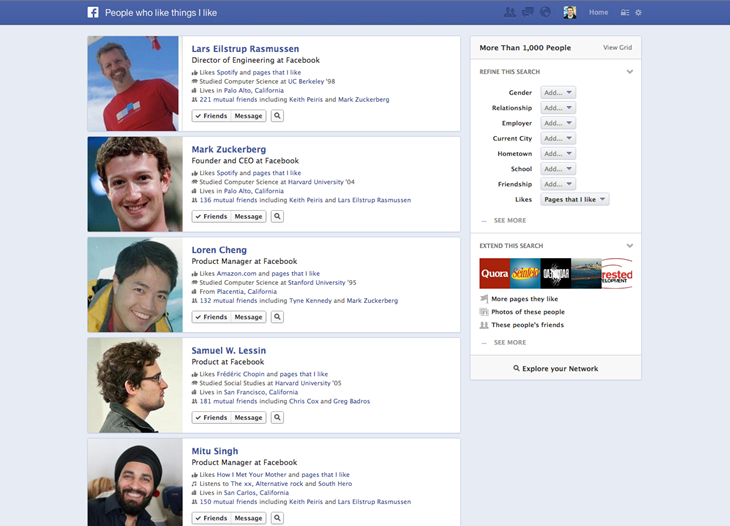
    “Married Men Who Like Prostitutes” is juicy search term and the results can wreck marriages, careers and lives.

    This is one of the Facebook Graph searches UK tech commentator Tom Scott posted on his Actual Searches on Facebook Tumblr site which lists, mercifully anonymised, the results.

    What should worry anybody who uses Facebook is that this data has been in the system all along, advertisers for instance have been able to target their marketing based on exactly this information, Graph Search just makes it quicker and easier to access. This is why you should be careful of what you like and who you friend online.

    Tom Scott has a terrific Ignite London presentation which looks at just how vulnerable an individual is by over sharing online. In I know what you did five minutes ago, Tom finds an individual, discovers his mother’s maiden name and phone number all within two minutes.

    Facebook isn’t the only service we should be careful of, it just happens to be the one we overshare data with the most. When you start stitching together social media services with government and corporate databases then a pretty comprehensive picture can be made of a person’s likes and preferences.

    The best we can hope for in such a society is that picture is accurate, fair and doesn’t cast us in too unfavourable a light.

    In same cases though that data can be dangerous, if not fatal.

    As potential employers, spouses and the media can easily access this information, it might be worthwhile unliking obnoxious, racist and downright stupid stuff. There’s a very good chance you’ll be asked about them.

    Similar posts:

  • Customer lock in as a business asset

    Customer lock in as a business asset

    US booksellers Barnes and Noble has been struggling for years and things aren’t getting better reports the New York Times.

    An important part of the New York Times story is the quote from a Forrester industry analyst,

    “The problem is not whether or not the Nook is good,” said James L. McQuivey, a media analyst for Forrester Research. “What matters is whether you are locked into a Kindle library or an iTunes library or a Nook library. In the end, who holds the content that you value?”

    Locking in customers lies at the heart of the Kindle and iTunes business model. Once users have a substantial investment in their book or music collections on one platform it’s unlikely they will go elsewhere as the costs, and risks, of moving are too great.

    This doesn’t always end well for the customer and it gives online businesses great power which they often misuse.

    Every online business tries to lock their customers into their ecosystem – Google, Amazon, Facebook and Apple are the most successful but every single social media and cloud service tries to make it hard for users take their business elsewhere.

    In some respects this is no different to the phone company or bank which have historically tried to lock customers into their services, but the online social media, cloud computing and e-commerce platforms make a much more ambitious grab for their users’ data and assets like music and book collections.

    The New York Times article illustrates just how critical that user lock in is to the success of online businesses. The question for us as consumers is how much we want to be locked inside the web’s walled gardens.

    Similar posts:

  • Is Facebook the new Microsoft?

    Is Facebook the new Microsoft?

    One of the problems with dominating your field is that to find new growth opportunities involves becoming distracted with your core business and damaging your reputation. This is what hurt Microsoft over the last decade and now threatens the internet’s big four.

    App.net CEO Dalton Caldwell wrote an open letter to Facebook CEO Mark Zuckerberg describing how the social media giant is trying to wipe out competitors through bullying them into being acquired.

    If a business doesn’t succumb to Facebook’s seduction, then they risk being wiped out by the social media giant setting up their own version of the product which they can push out to a billion subscribers.

    Jason Calacanis explores this strategy with Facebook’s launch of Poke, designed to compete with the instant messaging service Snapchat.

    In many ways this is the same model that Microsoft employed in the 1990s as it worked towards dominating the desktop computer market – bully innovators into selling to them and, if that fails, copy the product and crush the opposition.

    It worked for Microsoft because they controlled the distribution channels through their tight relationships with computer manufacturers.

    Microsoft created their own applications, or features in their products, which would be bundled onto Dell, Gateway or Compaq computers. Once users had functionality built into Windows or Microsoft Office then they didn’t have to buy a third party app.

    Bundling network protocols destroyed the business models of LANtastic and Novell, in the browser wars Microsoft killed Netscape by putting Internet Explorer on the desktop and in the office suite predatory pricing killed WordPerfect and Lotus while resulting in acquisitions of companies like Visio.

    This way of business cemented Microsoft’s domination of their desktop, office productivity and server markets at the turn of the century. It was a true river of gold that continues to flow today.

    Unlike the personal computer software markets, bullying or buying your way into market dominance doesn’t work online as the barriers to entry that protected Microsoft from competitors are nonexistent on the web.

    Both AOL and Yahoo! learned this the hard way as their acquisition sprees through the dot com boom didn’t prevent them from sliding into irrelevance.

    A good example of how hard it is for the Internet giants to execute a plan for world domination is the rise and fall of Google’s Knol as described by Seth Godin, who thought his own Squidoo startup would be crushed by the Internet giant. It turned out not to be so.

    For the web incumbents the fundamental problem are, as Jason says, that they are not focusing on their core businesses and they have plenty of Plan Bs as Seth Godin described.

    The manager who fails with Knol or Poke moves onto another division with a pat on the back and a safe claim on their bonus. The startup founders on the other hand are fighting for survival.

    All four of the Internet’s giants have similarities to Microsoft in the 1990s as every single one dominates its niche and wonders how to expand outside their core business – for Google, and possibly the other three, there’s the added problem of managerialism as a large cadre of managers worries more about maintaining privileges over competing in the marketplace.

    Managerialism ended up crippling Microsoft and continues to do so today, whether Facebook and Google can avoid that fate remains to be seen.

    A bigger problem for Facebook is losing trust – Microsoft’s conduct, particularly with WordPerfect and Netscape in the late 1990s made a generation of developers and entrepreneurs cautious about dealing with the company.

    For many that suspicion remains and is one of the barriers the company now has to overcome in the smartphone and cloud computing markets where it is one of the crowd of scrappy challengers.

    In the social and online worlds, collaboration is one of the keys to success. If Facebook, or any of the others, lose the trust of the community then they’ll become irrelevant a lot faster than WordPerfect or LANtastic did.

    Becoming irrelevant is the real worry for Facebook’s tenured managers and their investors.

    Similar posts: