Tag: innovation

  • Running out of luck

    Running out of luck

    Last week I was lucky to get along to Digital Australia and Emergent Asia panel held at PwC’s Sydney office where the panel looked at how Australia’s industries are adapting to the digital economy and evolving Australian markets.

    The outlook from the panel was generally downbeat about the ability of Australia’s business leaders and politicians to adapt to the changes in the global economy although there were some optimistic points about the resilience and flexibility of the nation.

    I did a write up for it on Technology Spectator which is online at It’s Not Good Enough To Be Clever

    The challenge is on for Australia’s business leaders – let’s see if they are up to it.

    Similar posts:

  • Australia in the Asian Century – Chapter Three: Australia in Asia

    Australia in the Asian Century – Chapter Three: Australia in Asia

    This post is one of the series of articles on the Australia in the Asian Century report. An initial overview of the report is at Australian Hubris in the Asian Century.

    The third Chapter of the Australia in the Asian Century report, “Australia in Asia” attempts to define the role the country currently plays in the region. In some ways this is the most constructive part of the paper in that it describes the lost opportunities of the last 25 years.

    Much of the early part of the chapter traces the development of Australia’s engagement with Asia after World War II; Chifley’s post war efforts with the United Nations, Menzies’ engagement with Japan, Whitlam’s going to China, Fraser’s opening to Vietnamese immigration and Hawke’s work on building the APEC agreement are all noted.

    Again are the major wars that also formed Australia’s current position in East Asia – World War II, the Malayan Emergency, the Korean and Vietnamese wars – are barely mentioned. This trivialises some of the major influences in today’s complex tapestry of relationships

    Of Australia’s closest Asian neighbour, the fall of Sukarno gets a brief nod but Suharto’s removal, the rise of Indonesian democracy and East Timor are all removed from the narrative. There is also no mention of other internal dislocations like the Cultural Revolution or the Indian Partition, all which still have echos today.

    In the introduction the Colombo Plan gets a mention and it’s worth reflecting upon its effects.

    When I worked in Bangkok in the early 1990s there were a number of business leaders who had been educated in Australia under Colombo Plan scholarships.

    That investment by Australia paid dividends through the 1980s and 90s as many of those scholarship students were ardent supporters of Australian businesses and government.

    One wonders how today’s students who’ve been treated as milk cows by Australian governments and “seats on bums” to education institutions will feel about the country when they enter business and political leadership positions over the next decade?

    The examples of Australian business engagement in Asia are interesting – Blundstone’s is a straight out manufacturing outsourcing story which doesn’t really describe anything not being done by thousands of other businesses while Tangalooma Island Resort is a light of hope in the distressed Australian tourism industry.

    A notable omission is how digital media, apps developers and service businesses are faring in Asia. There are many good case studies in those sectors but the writers seem to be, once again, fixated on the trade patterns of the 1980s and 90s rather than success stories in new fields and emerging technologies.

    Generally though the description of the Australian economy is again more of the same; a combination of self congratulations on having a government AAA credit rating, hubris over avoiding a GFC induced recession and stating how the services sector has risen to replace the manufacturing that’s been outsourced by companies like Blundstone.

    Overall Chapter Three of the Australia in the Asian Century report illustrates the opportunities missed in the last 25 years. Had this report been written twenty years ago it could have forecast a booming relationship in the services and advanced manufacturing sectors. It almost certainly would have included an observation that the days of the Australian economy depending upon minerals exports is over.

    What a difference a couple of decades make.

    The engagement of Australia with Asia concludes with a look at the changes to the nation’s immigration intakes and demographic composition. This point is, quite rightly, identified as an area of opportunity.

    Having Thai restaurants in every suburb and Indian doctors in most country town isn’t really taking advantage of the opportunities presented by having a diverse population and workforce. Chapter Four attempts to look at how these factors, and others, can help Australia’s engagement with the Asian economies.

    Similar posts:

  • A swelling feeling of pride

    A swelling feeling of pride

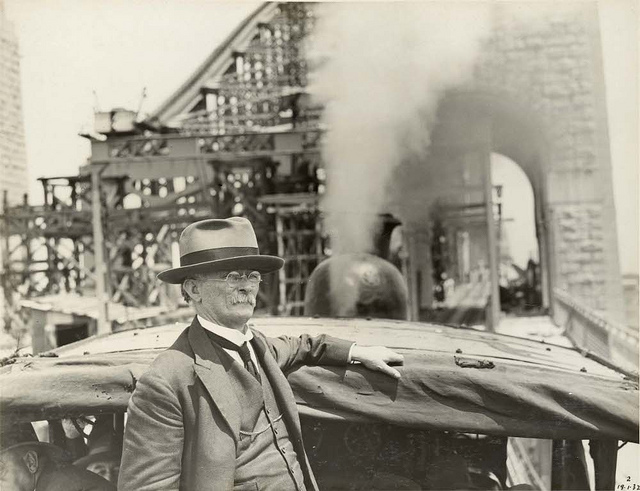
    Doctor John Bradfield shaped modern Sydney. His program of public works, such as building the Sydney Harbour Bridge and the city’s railway network served the city for nearly a century.

    The picture of him from the NSW State Records archives riding the first train across the Harbour Bridge shows him swelling with pride. And so it should.

    What we need to ask ourselves is whether our works could survive a century of massive change and become an international icon as the Sydney Harbour Bridge did.

    If we can just strive toward that – even though most of us will fail – we can be proud of our works as Dr Bradfield was when he rode that train across the Harbour Bridge.

    Similar posts:

  • Shifting to a better return

    Shifting to a better return

    As part of Deloitte’s Building the Lucky Country series, the consulting firm had a briefing last week from John Hagel, co-chairman of Deloitte’s Silicon Valley Centre for the Edge, to discuss how industries are responding to shifts in the workplace and their markets.

    John’s thesis is that businesses can be broadly split into into three groups; infrastructure, product innovation and customer relationship business which he covers in his Shift Index that looks at how industries are being affected by digital technologies.

    Infrastructure businesses are high volume, transactional services like call centres, logistics and utilities companies.

    The product innovators are those who develop new products, get them to market quickly and accelerating adoption of those goods.

    Customer relationship businesses focus on understanding their clients and using that knowledge to add value.

    Each of these business models require different mindsets and because most large companies try to do all three, they manage to do none well.

    One of the results of this is a lousy Return On Assets, which Hagel says have fallen in the United States to one-third of the levels of 1965 and he doesn’t see this improving as the ‘competitive intensity’ of US markets increases.

    A big feature of this decline in overall ROA is how the best performers have travelled compared to the laggards with the ‘winners’ barely maintaining their returns while the ‘losers’ are seeing their results declining dramatically.

    How Hagel sees the solution to this poor performance is through rewarding creative and passionate workers better.

    Firms have untapped opportunities to reverse their declining performance by embracing pull. To accomplish this, firms must develop and encourage passionate workers at every level of the organization.

    Additionally, companies must tap into knowledge flows and expand the use of powerful tools, such as social software to solve operational/product problems more efficiently and effectively as well as to discover emerging opportunities.

    If Hagel is right, it’s the businesses who want to micro-manage their workers while stifling innovation, initiative and creativity in their businesses who will be the great losers in this next decade as we move to the next phase of the ‘Big Shift’ where knowledge flows improve business performance.

    Starting the process of dealing with these shifts involves understand what the DNA of your business really is; if it is a transactional infrastructure business then management needs to acknowledge this and not kid itself about being in customer relationships.

    There are weakness in John Hagel’s proposition – one being that businesses can be easily pigeonholed into three categories.

    Apple is a good example of this where a company that is clearly product focused has also shown it can be customer orientated with the success of the Apple Stores.

    There’s also the question of why are there only three categories? In the breakdown the immediate thought is that there are businesses that don’t fit in any of these boxes. Legacy airlines or struggling motor manufacturers are good examples.

    Despite the criticism, John and the Center For The Edge have some good points about the future of business and it’s something we’ll explore more over the next few weeks.

    Similar posts:

  • Today’s business Neanderthals

    Today’s business Neanderthals

    “Bringing a knife to a gunfight” describes showing up hopelessly ill-equipped for the task at hand.

    Two recent conferences, the massive Dreamforce in San Francisco and the smaller, but still fascinating, Australian Xerocon in Melbourne illustrate just how radically the commercial world is changing and how many business leaders are poorly equipped for today’s times.

    In July, the Melbourne Xero Convention bought together 400 Australian partners of the cloud accounting service which showed how how one New Zealand based company is building it’s business through engaging other suppliers who add features to the basic service.

    Vend, a Point Of Sale cloud service provider, was one of the companies exhibiting at XeroCon. In the past POS systems have been a pain for retail businesses with most suppliers’ business models being about locking customers into expensive contracts.

    With cloud services, the old vendor lock in model dies as stores can use any device they like such as a PC, tablet computer or a smartphone so a business is no longer locked into using an overpriced and often antiquated piece of equipment.

    Making the cloud offering even more attractive is that Vend, and many of their competitors, also take advantage of APIs – Application Program Interfaces – built into other services so they can seamlessly change records.

    So a shop can make a sale in their physical store and inventory levels will automatically change in the online stores and on services like eBay. If an item is now of stock, the websites are automatically updated to reflect this.

    This business automation makes it easier and cheaper to run a business. It’s everything that computer have promised for the last thirty years and is now being delivered through cloud computing services.

    At Dreamforce in San Francisco last week, Salesforce.com CEO Marc Benioff showed the 90,000 attendees how these services work on a corporate level with demonstrations from companies as diverse as General Electricski company Rossignol, and Australia’s own Commonwealth Bank.

    What really stood out with all of these presentations was how each business had made major technology investments that in turn allowed them to deploy modern tools.

    The Virgin America Dreamforce presentation was particularly telling. Having just endured a 13 hour United Airlines flight in a plane that had been barely refurbished since 1988 it was clear that the older airline simply didn’t have the hardware to compete with the upstart even if management and staff wanted to.

    From both Dreamforce and XeroCon the message has been clear, those legacy managers who won’t invest in new technologies or re-organise their businesses to meet the realities of the 21st Century are simply doomed.

    In Australia this sense of doom in the business community is confirmed when MYOB and Google missed their target of giving away 50,000 free business websites as part of their Getting Aussie Business Online program.

    Depending on whose figures you use, between 50 and 65 percent of Australia’s 1.7 million small businesses don’t have a website – and websites are last decade’s technology.

    Business has moved onto mobile and social platforms, those 800,000 businesses who are yet to move into the new century are roadkill – the competition are just going to run over them.

    If you are still struggling with the idea of a website – let alone a mobile site, mobile phone app or social media strategy – then you haven’t bought a knife to a gunfight, you’ve bought a sharpened stick. It’s time to figure out whether you still want to be in business.

    Disclaimer: Paul travelled to XeroCon in Melbourne courtesy of Xero and to Dreamforce in San Francisco as a guest of Salesforce.com

    Similar posts: