Tag: internet

  • Building the Internet’s Frankenstein monsters

    Building the Internet’s Frankenstein monsters

    Apple’s announcement of deep Facebook integration into their iOS6 operating system for the iPhone and iPad is the latest in the weird beasts created as the various online empires jostle for position in a changing marketplace.

    We’re used to failing companies creating alliances – most notably Microsoft and Nokia in the mobile phone sector – and almost all of these ventures fail as they are akin to the two slowest runners in a race tying their legs together believing that will make them faster than the leader.

    In other areas we see the big players buy out hot new businesses as the incumbents figure its easier to buy out the competition rather than try to compete.

    While those purchases form the basis of the Silicon Valley greater fool model, usually the new business gets subsumed into the big corporation, the technology is lost and all but the most cynical founders wander off to do something more interesting.

    Then there’s the merger of equals, and today’s announcement of Apple and Facebook’s deep co-operation is one of these.

    Facebook has been talking about building its own phone – much to the scorn of industry participants – as the company struggles to deal with user moving onto mobile phones.

    Apple is hopeless at social media, which is barely surprising from a company that employs its own secret police.

    So the two coming together make sense although it may not work well as alliances like these can be likened like mating the world’s best golfer with a Grand Slam Tennis champion and expecting the child to be an Olympic swimmer.

    Of course Apple had a successful merger of equals back in the early days of the iPhone – Google. The alliance worked well and, Google’s then CEO Eric Schmidt sat on Apple’s board for some time.

    Than Google decided to develop its own mobile software build its own phones so relationships soured between Steve Jobs and Eric.

    Now Google Maps has been ditched from the iOS phone system and steadily Google are finding their services being dropped from all of Apple’s products.

    Those moveable alliances – not dissimilar to Eurasia, Eastasia and Oceania in George Orwell’s 1984 – are something we should get used to as the Big Four maneuver for position in the changing online world.

    While it’s going to be tough time if you’re a mindless fanboi following the progeny of these strange alliances, for the rest of us it should be fascinating viewing.


    Similar posts:

  • Disrupting the markets

    Disrupting the markets

    Generally it’s not a good idea to have nearly a hundred slides in a presentation, but Mary Meeker’s overviews of the tech industry are so rich in data it’s impossible not to spend a weekend looking over the entire sldieshow.

    Last week Mary gave her presentation at the All Things Digital conference and as usual she identified a range of trends and issues in the technology industries.

    Smartphone upsides

    Still the early days of smartphone adoption, with 6 billion mobile phone subscriptions worldwide but only 954 million smartphones activated.

    This adoption is driving mobile revenues with income growing at 153% per year. Although as she shows later, this is not necessarily good news for everybody.

    Print media’s continued decline

    A constant in Mary’s presentations over recent years the key slide in has been ad spend versus usage across various mediums.

    In this year’s version we still print still vastly over represented with 25% of US advertising while TV remains static, although Henry Blodget at Business Insider thinks the tipping point might be arriving for broadcasters.

    Online’s thin returns

    One of the things that really jumps out is how thin onlie revenues really are. In annual terms services like Pandora and Zynga are making between 6 and 25 dollars per active user over a year.

    These tiny revenues indicate the problem content creators have in making money on the web, after the gatekeepers like Pandora or Spotify have taken their cut, there isn’t much left to go around.

    Facebook and Google are also encountering problems as users move to mobile where revenues are even smaller than those from desktop users. This is constraining both services’ earnings growth.

    Disrupting markets and governments

    Mary’s presentation goes on to look at the disruption web and mobile technologies are bringing to various markets – it’s a good overview of whats changing right now and the products driving the changes.

    It’s not just markets that are being disrupted with Mary also looking the US’s budget position and entitlement culture. This in itself is a massive driver of change which will have a deep effect on our lives regardless of where we live.

    Are we in a bubble?

    Mary finishes up with a look at whether we’re in a tech bubble or not.

    Her view is that we are and we aren’t – there are silly valuations of companies in the private market however the poor performance of tech stocks on the stock market indicate the public aren’t being fooled.

    One telling statistic is the only 2% of companies have accounted for nearly all the wealth creation of the 1,720 US tech IPOs between 1980 and 2002. There’s little to indicate much has changed in the decade since.

    The optimism in funding new businesses is based in the disruption they are bringing to markets and industries – you only need one eBay or Google in your portfolio and you’re a legend, if not filthy rich.

    Both the economic and technological changes are disrupting our own businesses and this is why its worth reading and understanding Mary Meeker’s presentations if only to be prepared for the inevitable changes.

    Similar posts:

  • Is the Paperless Office promise about to come true?

    Is the Paperless Office promise about to come true?

    For as long as personal computers have been around the paperless office one of the holy grails of the IT industry.

    Paper is messy, difficult to file or store and cruel to the environment. So being able to move and save information electronically made sense.

    Despite the promises of the last twenty years, the quest for the paperless office seemed lost.

    While the networked PC gave us the ability to get rid of paper, its advanced word processing functions and graphic capabilities along with the data explosion of email tempted us into generating more paper.

    To compound the problem, over the last thirty years paper manufacturers found cheaper ways to make their product which meant the price of paper dropped dramatically just as we found more ways to use it.

    So rather than delivering on the promise of eliminating paper, computers generated more than ever before.

    Just as it seemed all was lost in IT’s War On Paper, the tablet computer came along. Coupled with cloud computing services and accessible fast wireless Internet, suddenly it appears we might just be on the verge on delivering on those promises of the last twenty years.

    At a suburban football game I saw this first hand as I watched the ground officials electronically filing match information with their league.

    “This used to be a pile of paperwork that used to take until Tuesday to be filed and collated” the ground manager told me, “today it’s done within half an hour of the game ending with almost no paper involved.”

    For amateur sports clubs, money isn’t so much the problem as time. There simply are never enough volunteers to meet the workload of getting a team on field.

    This is true with almost any community based organisation – from volunteer firefighters to community kindergartens organisers struggle with rosters and finding helpers.

    In business the same resource constraints exist except we know we can fix these problems by paying a worker to do it. The problem there is few businesses have unlimited funds to employ filing clerks and form fillers to handle the paperwork.

    By killing paper in the office, we’re making business and the economy more efficient. We’re about to deliver on that promise.

    Bill Gates once wrote that in the short term we overpromise what technology can deliver while in the long term we underestimate its effects.

    This is true of the paperless office – now that promise is being delivered the effects on business and government will be profound.

    Is your business prepared for these changes?

    Similar posts:

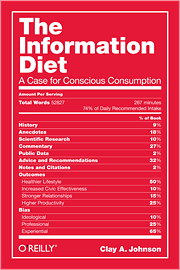
  • Book review: The Information Diet

    Book review: The Information Diet

    We all know a diet of fast food can cause obesity, but can consuming junk information damage our mental fitness and critical faculties?

    In The Information Diet, Clay A. Johnson builds the case for being more selective in what we read, watch and listen to. In it, Clay describes how we have reached the stage of intellectual obesity, what constitutes a poor diet and suggests strategies to improve the quality of the information we consume.

    The Information Diet is based upon a simple premise, that just as balanced food diet is important for physical health so too is a diverse intake of news and information necessary for a healthy understanding of the world.

    Clay A. Johnson came to this view after seeing a protestor holding up a placard reading “Keep your government hands off my Medicare.” Could an unbalanced information diet cause a kind of intellectual obesity that warps otherwise intelligent peoples’ perspectives?

    The analogy is well explored by Clay as he looks at how we can go about creating a form of “infoveganism” that favours selecting information that comes as close from the source as possible

    Just as fast food replaces fibre and nutrients with fat, sugars and salt to appeal to our tastes, media organisations process information to appeal to our own perceived biases and beliefs.

    Clay doesn’t just accuse the right wing of politics in this – he is as scathing of those who consider the DailyKos, Huffington Post or Keith Olbermann as their primary sources as those who do likewise with Fox News or Bill O’Reilly.

    The rise of opinion driven media – something that pre-dates the web – has been because the industrial production of processed information is quicker and more profitable that the higher cost, slower alternatives; which is the same reason for the rise of the fast food industry.

    For society, this has meant our political discourse has become flabbier as voters base decisions and opinions upon information that has had the facts and reality processed out of it in an attempt to attract eyeballs and paying advertisers.

    In many ways, Clay has identified the fundamental problem facing mass media today; as the advertising driven model requires viewers’ and readers’ attention, producers and editors are forced to become more sensationalist and selective. This in turn is damaging the credibility of these outlets.

    Unspoken in Clay’s book is the challenge for traditional media –their processing of information has long since stopped adding value and now strips out the useful data, at best dumbing down the news into a “he said, she said” argument and at worse deliberately distorting events to attract an audience.

    While traditional media is suffering from its own “filter failure”, the new media information empires of Google, Facebook, Apple and Amazon are developing even stronger feedback loops as our own friends on social media filter the news rather than a newsroom editor or producer.

    As our primary sources of information have become more filtered and processed, societal and political structures have themselves become flabby and obese. Clay describes how the skills required to be elected in such a system almost certainly exclude those best suited to lead a diverse democracy and economy.

    Clay’s strategies for improving the quality of the information we consume are basic, obvious and clever. The book is a valuable look at how we can equip ourselves to deal with the flood of data we call have to deal with every day.

    Probably the most important message from The Information Diet is that we need to identify our biases, challenge our beliefs and look outside the boxes we’ve chosen for ourselves. Doing that will help us deal with the opportunities of the 21st Century.

    Clay A. Johnson’s The Information Diet is published by O’Reilly. A complimentary copy was provided as part of the publisher’s blogger review program.

    Similar posts:

  • The death of the short message service

    The death of the short message service

    The New York Times’ Bits Section looks at how in many countries text messaging (SMS) services are declining.

    For telcos, the SMS feature was a happy – and extremely profitable – accident with the Short Message Service feature designed as a control channel for the mobile voice networks.

    The Short Messaging Service cost almost nothing to develop and quickly became a massive profit centre for mobile phone companies.

    Today in markets where smartphones are dominating sales, people are moving many of their communications away from text messages over to Internet based services like email, instant messaging and social media.

    Interestingly, in the United States text messaging still growing although at a slower rate than previously. This makes sense as the US is behind countries that have fully adopted 3G networks and subscribers don’t get the full benefit from a smartphone without a reliable and fast data service.

    For developing countries, we’ll probably see SMS continue to grow as the attractions of a relatively cheap and simple communications channel like text messaging still make sense in markets where data plans are expensive and smartphones scarce.

    As revenues from text messaging drops, we’ll be seeing more telecommunications companies try to replace the lost income with other services. Expect to see more offers for various business and home service bundles and offers to upgrade to the latest phones or packages as providers try to lock profitable customers into cash generating agreements.

    The era of accidental profits for telcos is over, the quest for these companies now is to find how they can maintain profits in an era where data services are commoditising their lucrative product lines.

    For the managers of these companies, the challenge is on to successfully do this – it remains to be seen how well they do in refocusing their businesses.

    Similar posts: