Tag: internet of things

  • A geek’s tour of Barcelona

    A geek’s tour of Barcelona

    Spain and Barcelona have faced challenges in recent years as the economy was hit hard by the 2008 crisis. Now the city is looking to the internet for the next wave of prosperity.

    This quest for reinvention isn’t new for the city, “Barcelona used to be an industrial city, that was badly hit by the economic crisis of the seventies,” said Deputy Mayor Antoni Vives. “There were some guys in the city at the time that decided that we had to keep on being an important city.”

    “There’s a new generation of politicians, civil servants, of thinkers and people committed to the city that ten years ago started to work on a new phase of what the city was to become.”

    Antoni Vives - Deputy Mayor of Barcelona
    Antoni Vives – Deputy Mayor of Barcelona

    “We decided that Barcelona had to become the edgiest city in the world related to the new revolution and the new revolution was this one — the technology related to mobility, devices and mainly the internet.”

    That vision resulted in Barcelona starting to rewire the city which was one of the reasons for Cisco choosing the city as the venue for its inaugural Internet of Things World Forum.

    As part of the event, the City took delegates on tours of some of the connected infrastructure the city has installed. Here’s what we learned on the press tour.

    The digital bus stop

    Digital bus stop
    Digital bus stop

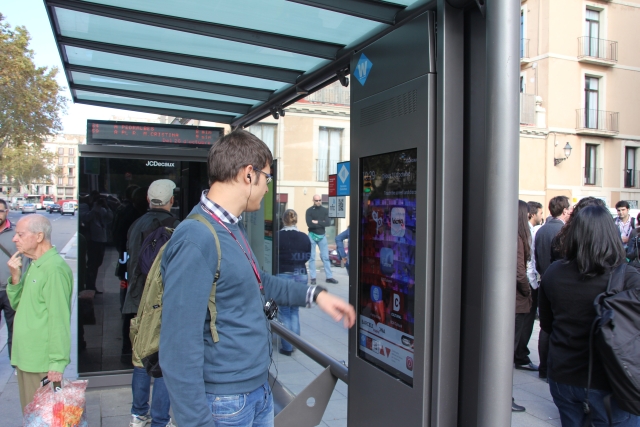
    The digital bus stop is one of the prides of Barcelona, not only does it display digital advertising and real time bus schedules it also offers tourist information, USB charging sockets and acts as a free WiFi base station.

    One of the barriers Barcelona has encountered has been the Spanish telecoms regulators objection to the city providing municipal WiFi so services are restricted to the city’s property, which happens to include bus stops.

    The bus stops themselves are connected to the city’s fibre network that runs most of the backhaul and connects many of the fixed devices.

    Smart parking spots

    Smart parking space
    Smart parking space

    Connected to the city’s WiFi network are these smart parking spaces that detect the presence of cars through a combination of light and metal detectors.

    The city’s plan is that payment and monitoring of the smart parking spots will happen online and with smartphone apps.

    Powering the dot, which is a fairly dumb device, is a battery with an expected five to seven year lifespan. Interestingly, the dots don’t work with motorcycles.

    One of the reporters on the tour questioned the durability of these devices given Barcelona doesn’t get extreme temperatures, the response from the Cisco and city staff indicates that ice or hot weather may shorten the lifespan of these devices.

    Smart lighting and monitoring

    Smart lights and monitors
    Smart lights and monitors

    In the square outside the Born Cultural Centre, the city has installed a row of streetlights with multiple features including CCTV, air monitoring and Wifi. All of these lights are connected to the city’s 500Km long undeground fibre network.

    The fibre network itself is being installed progressively as the city carries out routine maintenance to roads and other underground services. By co-ordinating the work with other trades it reduces the installation cost dramatically.

    Smart censors in the street lights
    Smart censors in the street lights

    Smart rubbish bins


    Smart rubbish bins in Barcelona
    Smart rubbish bins in Barcelona

    The connected garbage bins are one of the showpieces of the city’s services. By monitoring trash levels, the council’s sanitation team can plot the optimal routes for collection services.

    Smart rubbish bins sensor
    Smart rubbish bins sensor

    Again the sensors on the bins are fairly dumb devices that connect wirelessly to a base station, shown on the pole above the bins in the earlier photo, these track rubbish levels and later versions are expected to detect the presence of obnoxious or hazardous materials that might be dumped in the bin.

    Single person operation of the connected garbage truck
    Single person operation of the connected garbage truck

    Operators of the garbage trucks get real time updates to their routes which optimises their productivity. It’s cost savings in the city’s operations which is one of the key drivers for the city’s investment in these technologies.

    Power savings

    Smart lighting systems
    Smart lighting systems

    One of the major cost savings identified by the Barcelona Council is in energy costs. Along with the expense of running garbage trucks unnecessarily are power bills.

    Part of the smart lighting system is that it will dim when there’s no motion detected in the streets and lighten when pedestrians are around. This is intended to save money and help the city meet it’s zero carbon emission targets.

    Barcelona and the future

    Every single one of the technologies being shown today in Barcelona will be commonplace in most developed cities in the near future.

    The problem for adopting these systems is going to be connectivity, in places where there aren’t the fibre optic services or easily deployed WiFi it will be difficult to install smart devices and monitor them.

    Every major city is going to be facing the question of how they deploy these devices over the next decade as their residents expect better and more efficient service. Barcelona has taken the first steps that most others will follow.

    Similar posts:

    • No Related Posts
  • A trillion points of data

    A trillion points of data

    Last night, current Affairs program Four Corners had a look of the risks to families in the age of Big Data.

    Earlier in the day I had the opportunity to speak on ABC 702 Sydney with the program’s reporter, Geoff Thompson, to discuss some of the issues and take listeners’ calls about Big Data and security.

    What stood out from the audience’s comments is how most people don’t understand the extent of how data is being shared. The frightening thing is the Four Corners program itself understated the extent of how information is being distributed around the internet.

    Looking beyond social media

    Social media sites like Facebook are an obvious and legitimate area of concern with most people not understanding the ramifications of the terms and conditions of these services, however Big Data is a far more that what you share on LinkedIn or Instagram.

    A major point of the program was how the New South Wales police force’s Automatic Number Plate Recognition (ANPR) equipment stores photographs of car license plates.

    One of the applications of ANPR shown during the program was how an officer can be warned that a vehicle has owned by someone potentially dangerous or used in a suspicious situation, allowing them to be more cautious if they decide to pull a car over. Probably the greatest application is getting unregistered, uninsured or unlicensed drivers off the road.

    Those sorts of usage is the positive side of Big Data and its role in reducing the road toll, the example also illustrates how data points are coming together with the internet of machines as traffic lights, road signs and cars themselves are communicating with each other and those police databases.

    When that information is put together there’s a lot valuable intelligence and that’s why people are concerned that the NSW Police are storing millions of apparently useless images of car number plates with the time and location of the photographs.

    These technologies aren’t just being used in shopping centres; instore mobile phone tracking combined with the same numberplate recognition the police use watching who is entering the carparks makes it possible to predict buying patterns and target offers to shoppers.

    Couple that information with store loyalty cards and add in rapidly developing facial recognition, retailers have a very powerful way of monitoring how their customers behave.

    “What instore analytics does is it takes the same kind of capablities that e-commerce sites have had for more than a decade and apply them to brick and mortar stores,” says Retail Next’s Tim Callen. Using the store’s CCTV system the company applies facial recognition software to track shoppers’ behaviour.

    Securing the data feeds

    The immediate concern is the security of this data, we’ve covered the hackable baby monitor and the Four Corners program examined Troy Hunt’s exposure of security flaws in Westfield Shopping Centres’ Find My Car App. Similar security concerns surround government databases like the NSW Police’s numberplate store.

    As we’ve seen with the repeated data breaches of 2011, the management of big and small organisations like Sony or Stratfor don’t take security seriously. It’s hard to recall any senior public servant being held accountable for a security breach by their department.

    A billion points of data

    On their own, each of these data points means little but for a motivated marketer, tenacious police officer or determined stalker pulling those separate information sources together can pull together an accurate picture of a person’s private information, habits and beliefs.

    Almost all the collectors of this data claim this information is anonymised or isn’t personal information, unfortunately there’s mismatch between the definition of private data and reality as number plates and mobile phone MAC addresses are not considered private, however they provide enough insight for an individual to be identified.

    That aspect isn’t understood by most people, the final caller to the ABC Radio spot asked why she should be bothered worrying about privacy – it doesn’t matter.

    As French politician Cardinal Richelau said in the Seventeenth Century, If you give me six lines written by the hand of the most honest of men, I will find something in them which will hang him

    Today we each have six million points of data that can hang us, in a decade it could easily be a billion. We need to understand and manage the risks this presents while enjoying the benefits.

    Similar posts:

    • No Related Posts
  • Realising value from the internet of everything

    Realising value from the internet of everything

    How much opportunity does connecting all our machines to the internet really offer businesses and society?

    Cisco’s Internet of Everything index released last week looks at one of the great opportunities facing today’s managers in realising business value in these new technologies .

    On Cisco’s calculations, the internet of everything is worth over $14.4 trillion to the world economy and nearly half the business benefits are going wasted.

    Germany and Japan lead the pack and, as discussed yesterday, Australia wallows between China and Russia.

    Cisco comparison of countries
    Cisco comparison of countries

    Despite German businesses being the leaders, Cisco estimates $33bn, or nearly 40% of the potential gains, isn’t being realised even in that country.

    How different industries are using the internet of machines is notable as well, with Cisco claiming the biggest benefits currently being realised by the IT industry while the greatest potential lies in the service, logistics and manufacturing industries.

    cisco-internet-of-everything-value-index-by-industry
    Internet of everything value by industry

    If anything, these projections could be on the conservative side with Cisco estimating fifty billion devices connected to the net by 2020. Given the rate of smartphone being sold and everything from vending machines to clothing being online, it may well be ten or even a hundred times that number.

    The real challenge for businesses in all these projections is how individual organisations can realise this value in their operations.

    For some businesses, there’s plenty of existing opportunities with well established services in areas like field services and logistics tracking the locations of staff and packages. These are relatively simple to incorporate into existing operations.

    In other applications, businesses will find things more complex as the connected devices will tie into analytics and Big Data plays. These won’t be simple.

    One particularly important area for the workforce as a whole in business process automation where many tasks currently done by humans can be carried out by machines talking to each other.

    This is already happening in fields like fast moving consumer goods and hospitality where stock levels can be automatically monitored and replacement stock ordered in without staff being involved. As the technology becomes more widespread this will threaten the roles of many previously well paid managers.

    Many of those managers though will be challenged anyway unless they’re prepared to deal with the changes that internet of things is bringing to their businesses.

    How do you think the internet of everything will change your business?

    Similar posts:

  • What happens when the power goes out?

    What happens when the power goes out?

    Cisco gave a media and analyst briefing earlier today on the Internet of everything looking at how various technologies can help with tasks ranging from reducing traffic accidents to improving productivity which I’ll write up later.

    One of the analyst’s questions though is worth pondering – “what happens when the power goes out?”

    For most of the industrial processes discussed by Cisco and the panellists, this would be a hassle but most of the systems would, or should, be designed to fall back to a default position should the power fail.

    On a much bigger scale though this is something we don’t really think through.

    In modern Western societyour affluent lifestyle is based upon complex supply chains that get the food to our supermarkets, fuel to our petrol pumps, water to our taps and electricity to our homes.

    Those chains are far more fragile than we think and few of us give any thought to how we’d survive if the power was off for more than a few hours or if the shop didn’t have any milk and bread for days.

    It’s one of the fascinating thing with the end of the world movies. When the meteorite hits or aliens take over then our power and food supplies probably have only 72 hours before they dry up.

    After that, you’ve probably got more to worry about your neighbours trying to steal your hoard than being ripped to pieces by zombies.

    Most of us probably wouldn’t cope without the safe, comfortable certainties which we’ve become used to.

    One thing is for sure — if the power does fail, then most of us will have more to worry about than whether our smartphones are working or whether our geolocating, internet connected fridge is tweeting our wine consumption.

    Similar posts:

  • Connecting the household to the internet of everything

    Connecting the household to the internet of everything

    The development of intelligent household appliances like lights is changing our lives in subtle ways, Australian startup Moore’s Cloud is a good example of how cheap computing, accessible internet and open applications are coming together.

    One of the frontiers of technology right now is the internet of things, where machines connect directly to each other, cutting out the requirement for people to monitor them.

    Good examples of these devices is the internet connected fridge – which was the poster child for pointless connectivity during tech wreck in the early 2000s but is now standard equipment in hotels, restaurants and hospitals where monitoring stock levels has become wholly automated.

    Cheap hardware has driven this trend, as processor prices have tumbled it’s become cost effective to incorporate intelligent systems into almost every household device. Everything from the kettle to the washing machine now has some sort of CPU in it.

    Moore’s Cloud is a good example of how the internet of machines is coming together. A simple cube shaped device has the electronic smarts to connect with other lights and be controlled by software apps.

    Being able to create is important as the software interfaces – the APIs – are open which people to write programs that take advantage of the light’s features. A video from the Moore’s Cloud builders showcases twelve of the apps which have been developed so far which include weather forecasting, night lights and changing moods.

    Having an ‘ecosystem’ of apps is now driving innovation in consumer electronics. The iPhone started the app revolution and now everything from stereo systems to lights are being controlled by them. Devices that don’t have open APIs are at risk of being left behind.

    With systems being open to interested designers, anybody can create their own way of controlling device which opens the way for some innovative, left of field ideas.

    In many respects, Moore’s Cloud is one of the early wave of smart features we’re going to see in the next generation of household appliances that will change how we use these tools.

    The team behind Moore’s Cloud is still raising money for the project through Kickstarter, their campaign finishes this Friday. Hopefully they’ll meet their targets and take the project further.

    Similar posts: