Tag: investment

  • What happened to the not so nifty fifty?

    What happened to the not so nifty fifty?

    One of the must read investment blogs is John Mauldin’s weekly Thoughts From the Frontline. This week’s post is a particularly compelling guest post from tech investor Andy Kessler.

    Kessler’s post is the forward to George Gilder’s book Knowledge and Power and in describing his investment journey Kessler mentions the 1970s Wall Street view of investing in Nifty Fifty, the fifty biggest stocks on the US market which – because they were perceived as safe investments – traded on substantial price equity ratios.

    Trading cost 75 cents a share, but who cares, there were only 50 stocks that mattered, the Nifty Fifty, and you just bought ’em, never sold.

    Towards the end of 1972, Xerox traded for 49 times earnings, Avon for 65 times earnings, Polaroid for 91 times earnings.

    Numbers like that were unsustainable and those days of safe investing couldn’t last. So what happened to The Nifty Fifty?

    It’s hard to track down today’s figures but an academic paper from 2002 looked at how those stocks performed over the following thirty years. It isn’t pretty.

    nifty-fifty-annualised-returns

    Few of the Nifty Fifty performed well over the subsequent thirty years, which should give pause for those just buying the top stocks like the Dow-Jones, FTSE 100 or ASX 20 – just because they are big doesn’t mean they are safe.

    In fact names like Eastman-Kodak, Polaroid and Digital Equipment Corporation on the Nifty Fifty shows just how risky such assumptions are.

    Kessler also has a good point about today’s index huggers who are the modern equivalent of the 1970s buyers of the Nifty Fifty.

    An index is the market. It’s a carrier, a channel, as defined mathematically by Shannon at Bell Labs in his seminal work on Information Theory. An index can only yield the predictable market return, mostly devoid of the profits of creativity and innovation, which largely come from new companies outside the index.

    Like the Nifty Fifty today’s index funds are safe and predictable – until they’re not – while at the margins, the next great businesses and industries are being built far from the attention of the funds managers.

    For Australians there’s a particular sting in the tail from Kessler’s post as the bulk of compulsory superannuation goes into the local market’s stop stocks. It wouldn’t be too unfair to describe the modern Aussie funds manager’s motto as being “buy the ASX Eight and have lunch with your mate.”

    Forty years ago, an investment in Eastman Kodak would have looked pretty nifty. Today Kodak has gone. We should remember that when we’re looking for ‘safe’ places to put our money.

    Bull Market image by Myles through SXC.HU

    Similar posts:

  • Venture capital’s false jackpot

    Venture capital’s false jackpot

    When a business run by a 22 year old raises 25 million dollars it certainly gets attention and Crinkle’s successful seed funding has provoked plenty of commentary.

    Particularly notable are stories like the gush piece from the New Yorker magazine calling the fund raising “a $25 million jackpot.” Reading those, those, you’d think Crinkle’s Lucas Duplan had won the lottery.

    The truth is, getting a fat cheque from investors is only the beginning of the business journey; the real work starts when you have a board and shareholders to answer to.

    Where the real jackpot lies is in selling the business to a greater fool and the story of Bebo founder Michael Birch is a good example.

    Bebo was bought by AOL, probably the greatest greater idiot buyer of all, in 2008 for $850 million. Five yearrs later Birch has bought it back for one million and promises to ‘reinvent” the social media service.

    While Birch didn’t get all the $850 million AOL spent on Bebo, he and his investors did hit the jackpot. Whether Lucas Duplan and the backers of Crinkle do is for history to tell us.

    Image courtesy of sgman through sxc.hu

    Similar posts:

  • Australia’s small business crisis

    Australia’s small business crisis

    The 2013 MGI Australian Family and Private Business Survey is a disturbing document describing a sector that’s aging, pessimistic and struggling with change. It bodes poorly for what should be the powerhouse of the nation’s economy.

    Having been conducted over nineteen years, the MGI survey is a very good snapshot of how the sector has evolved over the last two decades and it’s notable how owners are older and not optimistic about their prospects of selling their businesses.

    Another key aspect is the changed focus of Australian family businesses; in 2003 forty percent were in manufacturing, this year its half that which probably tracks the decline of the nation’s manufacturing industries.

    Most striking though is the aging of the small business community with one in three proprietors being in the 60 to 69 year old bracket, up from one in five just 3 years ago.

    snapshot-of-australian-businessesThat the average age of Australian small business owners is increasing shouldn’t be surprising given the nation’s increasing obsession with property. As home prices become more expensive, it becomes more difficult for younger people to pay off their mortgages or risk their equity on building a business.

    Probably the most heart breaking comment from the report is that over half of Australia’s small business owners don’t see an immediate prospect of retiring and nearly two thirds don’t see any chance of an early exit.

    58% of family business owner-managers see themselves working in the business beyond 65 years of age, with 65% indicating that their businesses are NOT exit or succession ready.

    Part of the reason most Australian family businesses aren’t succession ready is that Generation X and Y buyers crippled by big mortgages simply can’t afford to pay what the older Baby Boomer and Lucky Generation proprietors need to retire upon.

    It’s hard not to think that the grand 1980s corporatist vision of Bob Hawke and Paul Keating – that most Australians will work for one of two big corporations while being members of one of two big trade unions – has largely come true.

    For Australia though this is not a good thing as the wealth of those corporations, along with that of the nation’s households, is largely tied into the domestic property market.

    A discussion on the Macrobusiness website about New Zealand’s property obsession has a graph which illustrates both the Kiwi and Australian economies’ dependence upon house prices.

    Housing-Wealth-to-disposable-incomeHousehold-Financial-Wealth-to-disposable-income

    Those financial assets in the second graph include the value of businesses, and that statistic staying largely flat while housing wealth has gone up fifty percent over the last fifteen years illustrates how dependent the Aussie economy has become upon property speculation.

    Property speculation can be fun, particularly when you’re watching people bash down walls on the latest reality TV home improvement show, but it isn’t the basis for a strong economy.

    That Australia’s small business sector is aging and increasingly shifting to low value adding service industries is something that should be discussed more as the nation considers what its global role will be in the 21st Century.

    Similar posts:

  • Staging a sales blitzkreig to win the market battle

    Staging a sales blitzkreig to win the market battle

    Part of the Silicon Valley greater fool model requires ramping whatever metrics are necessary — page views, unique visitors, revenue or profit to attract prospective buyers to acquire the business.

    Elizabeth Knight in the Sydney Morning Herald looks at the cracks appearing in online retailer The Iconic where revenues of thirty million dollars were subsidised by forty-four million in losses in the e-commerce operator’s first year of trading.

    The Iconic has all the hallmarks of a classic ‘buy me’ Silicon Valley operation — big marketing spend, high customer acquisition costs and fat operating losses in an effort to build market share.

    Getting market share is one of the key aspects of the greater fool model, being the leader in a segment almost guarantees a buyer, usually the one of the shellshocked incumbents.

    Knight quotes emails from one of The Iconic’s founders, Oliver Samwar, on the importance of being number one in their sector.

    ‘‘The only thing is that the time of the Blitzkrieg must be chosen wisely so that each country tells me with blood when it is time. I am ready – anytime!’’ one said.

    ‘‘We must be number one latest in the last month of next season. Full month, not a discount sales month

    ‘‘Why? Because only number one can raise unbelievable money at unbelievable valuations. I cannot raise money for number 2 etc and I have seen it how easy (sic) it is for me in Brazil and how difficult in Russia because our team f….d up.’’

    As we’ve seen with companies like Groupon, being number one can impress gullible corporations but when that market position has been bought by investor’s money subsidising operations, the business is rarely sustainable.

    Whether investors are prepared to continue subsidising The Iconic’s losses or if the business can attract a buyer will depend upon the business maintaining momentum on its key metrics.

    Probably the most important thing for companies like The Iconic though is the availability of easy credit and accessible funds.

    As we saw in the original dot com boom, when that easy money evaporates so to do most of the businesses.

    For the incumbent businesses threatened by well funded upstarts, some might find the best hope for survival is to hope challengers run out of money.

    In the meantime though, they may have to survive a market blitzkrieg.

    Similar posts:

  • Telling the broadband story – the government makes its case

    Telling the broadband story – the government makes its case

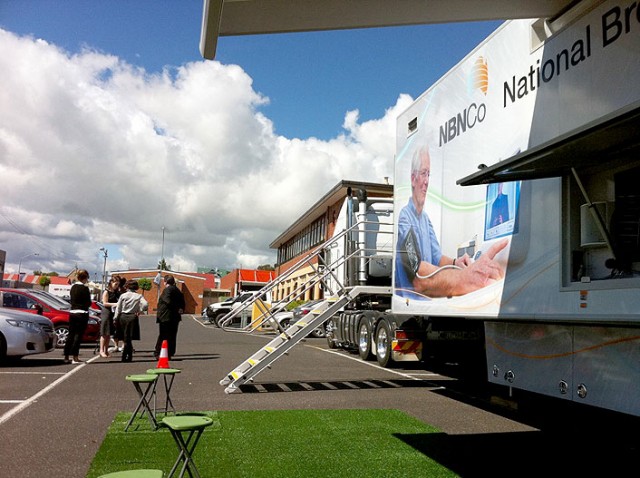
    Further to yesterday’s post about NBNCo’s inability to tell a story, I received a polite message from the long suffering staff at the Minister’s office that pointed me to some of the resources that NBNCo and the Department of  Broadband, Communications and Digital economy have posted.

    Here’s the list of case studies and videos;

    http://www.nbn.gov.au/nbn-advertising/nbn-case-studies/

    http://www.nbnco.com.au/nbn-for-business/case-studies.html

    http://www.nbn.gov.au/case-study/noella-babui-business/

    http://www.nbn.gov.au/case-study/seren-trump-small-home-based-business-owner/

    All of these case studies are nice, but they illustrate the problem – they’re nice, standard government issue media releases. The original CNet story that triggered yesterday’s story tells real stories that are more than just sanitised government PR.

    It also begs the question of where the hell are all these people successfully using the NBN when I ask around about them?

    What’s even more frustrating is the Sydney Morning Herald seems to get spoon fed these type of stories.

    The really irritating thing with stories like yesterday’s SMH piece is that it’s intended to promote the Digital Rural Futures Conference on the future of farming being held by the University of New England.

    Now this is something I’d would have gone to had I known about it and I’d have paid my own fares and accommodation. Yet the first I know about this conference is an article on a Saturday four days out from the event. That’s not what you’d call good PR.

    The poor public relations strategies of the Digital Rural Futures Conference is a symptom of the National Broadband’s Network’s proponents’ inability to get their message out the wider public.

    When we look back at the debacle that was the debate about Australia’s role in the 21st Century, it’s hard not to think the failure to articulate the importance of modernising the nation’s communications systems will be one of the key studies in how we blew it.

    Despite the best efforts of a few switched on people in Senator Conroy’s office, a lot more effort is needed to make the case for a national broadband and national investment in today’s technologies which are going to define the future.

    Similar posts: