Tag: investment

  • Social media’s irrational exuberance comes to an end

    Social media’s irrational exuberance comes to an end

    Last week saw the annual Y Combinator demo day where the startups funded by the incubator get to strut their stuff and it appears the age of social media hype is over.

    In the Wall Street Journal’s Digits blog, Amir Efrati reports Social is Out, Revenue is In as the companies showed off their income streams rather than the number of users which has been the measure for free social media apps.

    That social media is out shouldn’t be surprising as the services have been tracking a standard Gartner Hype Cycle with a boom in services, coverage and investments that’s now turning into the inevitable bust and a fall into the trough of disillusionment.

    Coupled with that fall for social media services are the disappointing stockmarket floats of Facebook and Groupon which have cruelled the enthusiasm for investing in tech startups with lots of user but not much revenue.

    Last week’s headlines featuring Yahoo!’s purchase of Summly for $30 million and Amazon’s acquisition of Goodreads for an estimated $150 million show how the days of greater fools writing billion dollar cheques is over as more sensible valuations take hold.

    Amazon’s purchase of Goodreads is more interesting than Yahoo! buying a teenage wunderkind’s venture in that Amazon is cementing its position at the centre of the global book publishing industry.

    Goodreads has been one of the quiet social media success of recent years having built its subscriber base to over 16 million members sharing book reviews and reading lists.

    The book review site is a natural fit for Amazon although the head of the US Authors’ Guild rightly worries the company is becoming a monopoly.

    Of course the obvious retort to this is that someone else could have bought the site and Forrester’s James McQuivey speculates on why an established publisher didn’t do so much earlier.

    This year’s Y Combinator Demo Day and the acquisitions of Goodreads and Summly show the era of irrational tech exuberance is over.

    For good businesses operators and investors this is not a bad thing as everyone can now focus on building good businesses rather than worrying about hype, spin and fools with more money than sense.

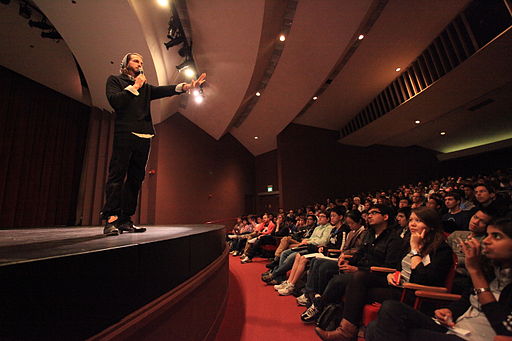
    Photo of Ashton Kutcher speaking at Y Combinator by Robert Scoble through Wikimedia commons
    Similar posts:

  • Privileges and princelings

    Privileges and princelings

    A strange thing about Australian business reporting is that its often full of gossip and name dropping as any third rate scandal magazine.

    In a perverse way, treating business executives like the Kardashians gives the average mug punter – and shareholders – a glimpse into how these companies do business. Like this story in the Australian Financial Review;

    Hamish Tyrwhitt was unaware of the latest drama unfolding within the Leighton board as he relaxed in the Qantas First Class Lounge in Sydney on Friday morning.

    Indeed, the contractor’s chief executive officer was busy chatting to former Wallabies captain John Eales while waiting to board a flight to Hong Kong where he was due to close a recent deal to build the Wynn Cotai hotel resort in Macau and enjoy the Sevens rugby tournament.

    The timing was not good. Tyrwhitt had only just boarded the flight when the news broke that chairman Stephen Johns and two directors had resigned. Tyrwhitt was forced to change his plans and is expected back in Sydney for a board meeting convened this weekend.

    Nice work if you can get it.

    A few pages further in the day’s AFR is another gem;

    One July evening about four years ago, off the south coast of France between Cannes and St Tropez, two men sat in the jacuzzi on the top deck of a 116-foot Azimut motor yacht. It was about 3am and the sea was rough. The spa water was sloshing about and had given the latest round of caprioskas a distinctly bitter taste.

    Dodo boss Larry Kestelman was telling his good friend, M2 Telecommunications founder Vaughan Bowen, about the challenges of growing his internet service provider business.

    It’s tough doing business when the spa waters are choppy. One expects better from a seven million dollar boat.

    That second article raises another point that’s often overlooked, or unmentioned, when reporting Australian business matters.

    on Thursday the 14th, something unexpected happened. At 12.30pm, after no activity all morning, shares in the thinly traded Eftel started to rise sharply. By the time the market closed at 4pm, Eftel had soared 44 per cent to 39.5¢. Someone with knowledge of the deal was insider trading.

    Insider trading? On the Australian Security Exchange? Somebody had better call those super-efficient regulators who were responsible for Australia cruising through the global economic crisis of 2008.

    Somebody obviously wanted their own 116ft luxury yacht or corporate box at the Hong Kong Sevens.

    Both of these stories illustrate the hubris and privileges of corporate Australia and its regulators.

    One wonders how well equipped these organisations are for an economic reversal when their leaders are more worried about caprioskas and their spots in the first class lounge.

    We may yet find out.

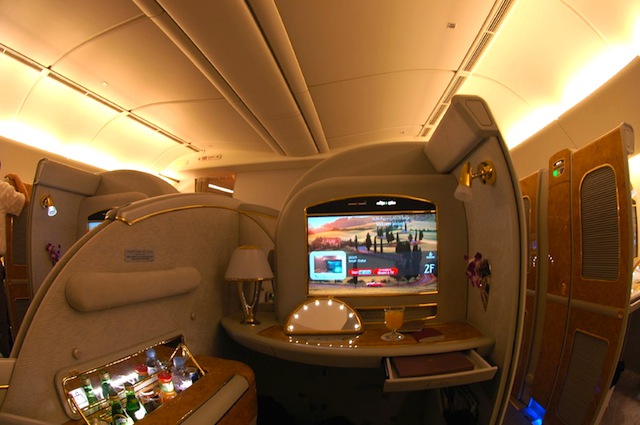
    First class airline seat images courtesy of Pyonko on Flickr and Wikimedia.

    Similar posts:

  • You call that a graph?

    You call that a graph?

    One way to illustrate a story is with charts. All too often though misleading graphs are used to make an incorrect point.

    A Verge story on Groupon shows how to get graphs right – clear, simple and tells the story of how the group buying service’s valuation soared and then plunged while it has never really been profitable.

    The vertical axis is the key to getting a graph right, cutting off most of the y-axis’ range is an easy way to mislead people with graphs. In this case you can see just the extent of Groupon’s valuation, profit and loss over the company’s short but troubled history.

    Since its inception, The Verge has been showing other sites how to tell stories online, their Scamworld story exposing the world of affiliate internet marketing sets the bar.

    Using graphs well is another area where The Verge is showing the rest of the media – including newspapers – how to do things well.

    For Groupon, things don’t look so good. As The Verge story points out, the company’s income largely tracked its workforce which grew from 126 at the start of 2010 to over 5,000 by April of 2011. Which illustrates how the business was tied into sales teams generating turnover.

    The spectacular growth of Groupon and other copycat businesses couldn’t last and hasn’t. The challenge for Groupon’s managers is to now build a sustainable business.

    For investors, those graphs of Groupon’s growth were a compelling story. Which is another reason why we all need to take care with what we think the charts tell us.

    Graph image courtesy of Striker_72 on SXC.HU

    Similar posts:

  • Australia welcomes the multi generational mortgage

    Australia welcomes the multi generational mortgage

    At the height of the Japanese property boom in the 1980s, the hundred year mortgage came into being.

    Pushing payments onto children and grand-children was the only way home prices could continue to rise once they hit levels which the average Japanese worker could ever afford with a more traditional twenty or thirty year mortgage.

    Twenty five years later Australia finds itself in a similar position as parents guarantee their childrens’ mortgages.

    Repeating the Japanese mistake

    While the Japanese looked to sticking their mortgages onto their kids and grandkids, Down Under the kids are fighting back and getting mum and dad to underwrite their unaffordable loans.

    This weekend’s Sydney Morning Herald features in its property section the story of how Sharon and Graeme Bruce guaranteed their son’s and his fiance’s mortgage in Sydney’s inner suburbs.

    While the story isn’t clear on the size of the deposit (which isn’t surprising given the SMH’s shoddy editing), it appears the Bruces’ have guaranteed around $300,000 so his son and future daughter-in-law can grab a five bedroom, 1.45 million dollar mansion.

    One wonders what great businesses Matt and Hannah could build if mum and dad were prepared to stump up a similar amount to invest in a start up?

    Australia’s property obsession

    Sadly we’ll never know – in Australia, the smart money gets a job, pays off a mortgage and accumulates wealth through investment properties. What cows are to African tribesmen, negatively geared units are to the Australian middle class.

    The hundred year strategy hasn’t worked too well for Japan, with a declining population those mortgages entered into a boom level 1980s values now don’t look so attractive and are one large reason for the nation’s lost decades.

    In Australia, things aren’t likely to work so well either. The Baby Boomers and Lucky Generationals – those born from 1930 to 1945 – guaranteeing their kids’ and grandkids’ mortgages are relying on ever increasing property prices.

    This is understandable given that few of them have any experience of long term stagnation, let alone decline, of property values but it leaves them incredibly exposed should the Aussie housing market slump.

    Can an Aussie property decline happen?

    Many Australians, particularly those with vested interests, maintain such a decline can’t happen but the prospects aren’t good as the SMH story shows;

    The couple had attempted to buy a small terrace in Newtown but kept getting pipped at the post by other young professional couples. At a higher price point they had no competition.

    Despite his parents’ generosity he said he would still need to rent out a few of the rooms to help pay for the mortgage.

    So Matt can’t afford the mortgage. That’s not good starting point and one that could cost his parents dearly, which they don’t seem to care about much.

    ”Obviously my dad guaranteeing the loan was the only way we were going to purchase this,” Mr Bruce said. ”You need to have a 20 per cent deposit otherwise the banks want you to pay insurance … it’s a bit of a rort really.”

    It’s fair to call mortgage insurance a rort – as it certainly is – but its purpose is to protect the banks should a mortgagee default and the financiers find themselves out of pocket.

    With Matt’s parents getting him out of paying that insurance his bank has much better default protection, equity in his parents’ property.

    Guaranteeing risk and misery

    I’m not privy to the finances of Sharon and Bruce, but most of their contemporaries can ill afford to lose several hundred thousand dollars in home equity in their later years.

    That is where Australia’s multi-generational mortgages could turn very nasty, very quickly as older Australians find themselves having to deliver on the guarantees they gave on behalf of their over committed offspring.

    In Japan, it’s taken a long time for the population to realise their national wealth has been squandered on twenty years of propping up unsustainable property prices and economic policies.

    One wonders how long it will takes Australians to realise the same has happened to them and what the political reaction will be.

    Similar posts:

  • Will going private save Dell?

    Will going private save Dell?

    Now Michael Dell and a team of private equity investors are going ahead with taking the company he founded private, the question is will this make any difference to the technology company.

    Turning around Dell is going to be a massive task as the company has lost the advantages that made it the world’s biggest PC manufacturer. At the same time, the industry itself is shrinking as corporate and consumer customers move from personal computers and servers to tablets and cloud services.

    The triumph of logistics

    Dell’s real success lay in logistics. In the early 1990s the company – along with its competitor Gateway – developed a global just-in-time assembly network which took advantage of cheap Asian suppliers, efficient air courier networks and call centres.

    Bringing these together meant Dell and Gateway could deliver a custom made computer to a customer in just over a week without the hassle of holding warehouses of stock, employing sales staff or renting stores.

    Price was the ultimate advantage and these companies could undercut competitors with their efficient networks, lack of inventory and no retail overheads.

    Losing an advantage

    Unfortunately for Dell, competitors caught up and by the early 2000s most PC manufacturers were using similar manufacturing methods and were able to match their price points.

    By 2006, HP overtook Dell as the world’s biggest PC manufacturer.

    Worse yet, Apple adapted Dell’s logistic systems to corner the high end of the PC market and then expand into consumer devices.

    Dell’s reaction was to compete solely on price and to do so they cut component costs and outsourced support to lowest cost providers.

    This backfired horribly and the poor quality products coupled with execrable after sales support deeply damaged Dell’s brand with the Dell Hell debacle being the public face of widespread customer unhappiness.

    Dell in the post PC world

    Making matters worse for Dell is that the market has shifted away from personal computers.

    Dell has a tragic track record of diversifying out of the PC markets, all of its attempts to move into consumer electronics with PDAs, smartphones, tablet computers and entertainment devices have been, at best, embarrassing.

    Enterprise computing has been more successful but even here Dell has shown little innovation and most of their entries into the corporate markets has been through acquiring specialist companies rather than doing anything different.

    Part of this to failure to diversify has been because of Dell’s relationship with Microsoft. The various versions of Windows intended to be used on PDAs and tablet computers turned out to be wholly unsatisfactory and left the market open to Apple with the iPhone and iPad.

    Going private

    That Microsoft is going to have a financial interest in the privatised Dell is not encouraging for the company’s prospects.

    Neither is the continued presence of Michael Dell. His return as the company’s CEO in 2007 has not solved the company’s problems.

    It’s difficult to see where the problem was being a public company, Dell’s woes were not because of troublesome board members or activist shareholders.

    Going private might allow Michael Dell and his team to experiment without the accountability of quarterly reporting, but that barely seems worth 26 billion dollars.

    Dell could surprise us all by reinventing its business and claiming a role in the post-PC world, but right now its hard to see how.

    Similar posts: