Tag: Japan

  • Japan’s demographic ruins

    Japan’s demographic ruins

    As Japan’s society ages and urbanises, the effects are being seen in buildings and communities being abandoned.

    The Japan Times reports on how the nation is now becoming a magnet for urban explorers discovering what lies insides abandoned homes, hospitals, hotels and theme parks.

    Many of the abandoned tourist attractions are legacies of the 1980s economic boom that saw a massive over-investment in property plays. With a shrinking population, those facilities were always doomed but in a growing society, there would have been economic reasons for redeveloping them.

    In Japan though, those economic drivers don’t exist in much of the country as the Japan Times explains.

    “Japan is in some sense uniquely blessed as a land of ruins. Its rapidly aging population, low birth rate, urbanization and lack of immigration have left a legacy of ghost towns and more than 8 million abandoned homes, or akiya. That tally could hit 21.5 million, one-third of all residences nationwide, by 2033, according to the Nomura Research Institute.”

    Japan is the first of many nations that will face the consequences of an aging population, what they do will be a lesson to all of those who follow. Of those, China will probably the biggest experiment.

    One big lesson is property demand changes and once valuable assets don’t necessarily hold their value in the face of a societal shift.

    Similar posts:

  • Japan looks to startups

    Japan looks to startups

    Can Japan reinvigorate its startup community? A story in the Wall Street Journal describes some of the attempts to encourage entrepreneurs in an economy that has been stagnant for a quarter century.

    In many ways Japan is a prototype for the modern global economy, just as the Japanese tried to stimulate their economy following their 1989 bust by pumping money into their deeply corrupt construction industry , so too has the rest of the world tried a similar strategy with the banking system after the 2008 crisis.

    The results in both cases been the same stagnation as the money is wasted on non productive schemes and speculation rather than investment in job and wealth creating businesses and innovations.

    Now the Japanese are looking to a bottom up stimulus to their economy which challenges the country’s social norms where getting a ‘safe job’ with a large corporation is seen as the best prospect for young people.

    While this is a change from the accepted wisdom, the entrepreneurial model really isn’t that strange for the Japanese with a range of successful technology companies started by post World War II entrepreneurs ranging from Sony to Softbank.

    The Japanese model though may not be suited to the Silicon Valley venture capital model and this is where it’s dangerous to make comparisons with what works in San Jose, Tel Aviv or Shoreditch.

    Japan’s strengths in industrial engineering may well make its businesses well suited for the Internet of Things the Wall Street Journal article quotes serial entrepreneur Taizo Son as suggesting. Interestingly, the 43 year old serial entrepreneur is the youngest brother of SoftBank founder Masayoshi Son.

    Another area where Japan is a glimpse of the future is in the aging population and it may well be that harnessing the abilities of older entrepreneurs is another area where the country can either show the way to success or what not to do with an older, stagnant economy.

    In many ways Japan is a pointer to where the world is heading. How they manage the early twenty-first century will be a lesson for the rest of us.

    Similar posts:

    • No Related Posts
  • Seppuku for the health care sector?

    Seppuku for the health care sector?

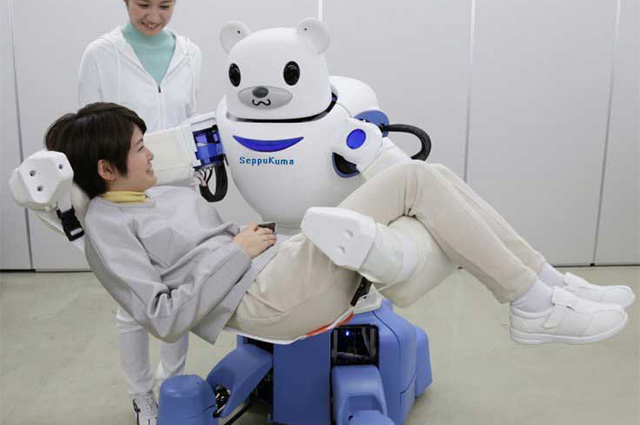
    It turns out Seppukuma is a parody and I fell for it. My apologies.

    Continuing the theme of Japanese robotics meet SeppuKuma, the friendly robot bear that might be the last thing you ever see.

    When we look at the future of work, health care comes up as one of the fields that is least vulnerable to automation. Seppukuma shows we shouldn’t take that for granted.

    Seppukuma is also an interesting example of how technology can subvert laws. Banning assisted suicide means little when a robot can be programmed to it.

    As cheap and accessible robotics become commonplace so too do devices like suicide assisting androids which raise a whole range of legal and ethical issues.

    Even though Seppukuma is a joke, the technology is feasible. We need to consider the issues and risk these devices will raise.

    Similar posts:

    • No Related Posts
  • Replacing Japan’s workers with robots

    Replacing Japan’s workers with robots

    Nearly half of Japan’s jobs could be done by computers, robots or artificial intelligence in the near future, says the Nomura Research Institute.

    In working with Oxford University’s Martin Program on Technology and Employment, the Nomura Research Institute examined 601 job classifications that currently employ 42.8 million Japanese.

    Using the Oxford University methodology, the Japanese researchers estimated more than two thirds of the roles could be automated with nearly half of all Japanese workers being potentially replaced by computers.

    Previously the Martin program has estimated  47 per cent of the United States’ workforce and just over a third of Britain’s are vulnerable to similar changes. Anyone who’s visited or lived in Japan wouldn’t be surprised at the relatively high level of vulnerability given the degree of manual jobs still being done in Japanese society that were long ago lost in the rest of the western world.

    For Japan, replacing workers with robots isn’t a bad option given the population is aging force and the nation is at best reluctant to import immigrants to address skills shortages. It’s not surprising the country is probably the most advanced at deploying robots in workplaces.

    How this will work for an aging Japan that has to support an increasingly older population will be fascinating to see. For other western countries – or even China – facing similar pressures, the Japanese will be providing important lessons.

    Similar posts:

    • No Related Posts
  • Japan’s adjustment to a low growth society

    Japan’s adjustment to a low growth society

    As the world worries about whether China is the next Japan, the Japanese themselves are getting on with life in a low growth economy.

    One of the latest ideas is to convert disused golf courses into solar energy farms as manufacturing giant Kyocera proposes a solution to deal with the nation’s power shortage after the closure of the Fukushima power plants.

    Japan’s golf course boom of the 1980s, which they exported around the world, was a classic case of overinvestment driven by easy money and lax lending standards. Something that China has certainly had in spades.

    The aging nation isn’t doing a perfect job however with the Washington Post reporting that the country’s over 65s are convicted of more crimes than juveniles and the sad reason is seniors are shoplifting to survive.

    One of the major mistakes made by Japanese governments through the 1990s was to pour money into corrupt civil projects to stimulate the economy. That money was largely wasted on bridges to nowhere and bullet trains to tiny towns which did little to add to the nation’s productivity or build a safety net for the aging population.

    Japan may well be leading the way for other aging nations, we need to heed their mistakes before our societies follow them.

    Similar posts:

    • No Related Posts