Tag: laptops

  • Lenovo Yoga

    Lenovo Yoga

    Can a laptop be a tablet computer? The Lenovo Yoga Pro 2 tries to balance the needs of both in a package designed for home and small business users.

    The laptop computer market is in a difficult place at the moment as both consumers and businesses move to tablets and smartphones so it’s interesting to get hold of the Lenovo Yoga Pro 2 to see how one of the leading portable manufacturers is responding to the changing industry.

    One of the best ways of testing a portable device is to take it on a long trip, so a couple of 14 hour transpacific flights and trips around San Francisco, the Napa Valley and Silicon Valley proved a good workout for the Yoga Pro.

    As a laptop

    From a hardware perspective the Yoga is an impressive device with 8Gb of RAM, 256Gb solid state hard drive and a 1.8GHz i7 chip. The screen is a very nice 13.3″ 3200 x 1800 high-resolution display.

    Rounding out the hardware specs are two USB ports — one 3.0 and the other 2.0 — along with a Micro HDMI output, webcam, inbuilt mic, headphone jack and an SD Card reader. All the basics expected in a mid range ultrabook that weighs in at a respectable 1.4kg.

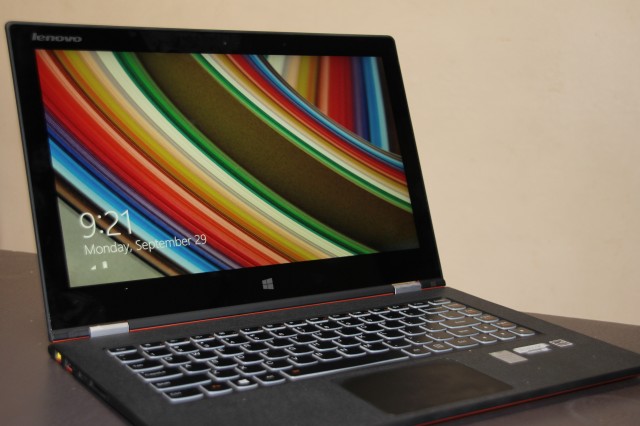
    lenovo-yoga-2-pro-in-laptop-mode-on-desktop

    In using the Yoga as a laptop, the device works well with the keys being crisp and responsive although the position of the glidepad and the backspace key being alongside the home key caused problems for this clumsy touch typist.

    One of the problems with the larger form of ultrabooks is their usability when travelling economy on a plane; if the passenger in front of you reclines then it becomes difficult to use the device. This isn’t a problem specific to the Lenovo Yoga, but it is a drawback that the industry seems not to have considered in its move to the larger screens.

    In the office

    If you’re not travelling on planes, the weight and form factor works well and makes the Yoga 2 Pro a nice device to use while on the move. In an office environment it’s a standard mid to upper range laptop with good fast specifications.

    For battery life, Lenovo claim “up to nine hours” for the Yoga Pro but in practice standard office use sees about five hours worth of juice with a full recharge taking under an hour. It’s lucky most transpacific flights now have power sockets.

    Flipping to a tablet

    While 1.4kg is good for a laptop it’s lousy for a tablet computer with the Yoga Pro 2 weighing in a kilo heavier than the iPad and 500g (one pound) heavier than the Microsoft Surface Pro. This makes it awkward to use over extended periods and the keyboard doesn’t feel right as the backing to a tablet.

    lenovo-yoga-2-pro-in-tablet-mode

    The Yoga’s weight problem illustrates the core conflict for a device that wants to be a laptop and a tablet as the different demands for each type of device make if difficult for designers to meet both markets.

    In the Yoga 2 Pro’s design, it’s clear the engineers had to make a choice between compromising either on the tablet or laptop functionality. As it turns out the designers decided to go with releasing a good Ultrabook laptop with compromised tablet functions — this was the correct choice for the Yoga.

    Windows 8 limitations

    Probably the greatest problem though for the Yoga Pro 2 in tablet mode lies in software with Windows 8 being far from adequate as a tablet operating system with a confused interface, an inconsistent user experience and unpredictable responses to touch screen commands.

    For companies like Lenovo who are persisting with Windows as their operating system, it’s becoming critical that they start demanding better design from Microsoft before they find their market being overwhelmed by Android and iOS devices offering a superior user interface.

    lenovo-yoga-2-pro-closed-mode-on-desktop

    While the Windows 8 irritations aren’t a deal breaker for the Yoga, it does limit the device as a tablet computer and its something anyone considering it instead of an iPad or Android tablet should keep in mind.

    A good general duty small business laptop

    Overall, the Lenovo Yoga Pro 2 is good Windows Ultrabook for home and small business use offering the benefits of an ultrabook with the flexibility of being able to flip into a tablet for specific uses.

    The device isn’t cheap, but the range of features and good hardware specs make it a decent purchase for small businesses, sole proprietors or workers operating from home who need a versatile Windows computer.
    Similar posts:

    • No Related Posts
  • How form factors evolve as tech affects design

    How form factors evolve as tech affects design

    Technology often dictates design. As tech evolves, we can rethink the design of many things we take for granted.

    While out helping a friend shop for computers this morning, it occurred to me how the keyboards of laptop PCs have changed.

    For many years, notepad keyboards were restricted to roughly 80 characters as the 4 x 3 ratio of screens have dictated the dimensions of of the keys. Here’s an example.

     80-character-keybaord

    In recent times though the wider screen dimensions of laptops has seen the resurrection of an older layout — the 102 key layout with an added numerical pad.

     102-character-keyboard

    What’s interesting about this is how technology form factors evolve.

    Not so long ago mobile phone manufacturers were competing to create the smallest handset. Cellphones like the  Motorola Razr pushed the limit on how small phones could be.

    With the arrival of the smartphone, the size and shape of mobile phones changed. Now the limiting factor was a screen big enough to read the internet on and display a thirty key keyboard.

    Now reliable handwriting recognition software means that some phones can eliminate the use of keyboards at all, which means we may start to see the race to create smaller cellphones restarting.

    The layout of all of the items we use, from cars to computers, is largely determined by technology limitations. As the tech evolves, we can start to rethink how a device is designed, just as the laptop and iPhone designers did.

    With whole new display, input and sensing technologies being developed, there are many household items that may well look different in the near future.

    Similar posts:

  • Was the netbook the Trabant or Model T of the computer world?

    Was the netbook the Trabant or Model T of the computer world?

    Taiwanese technology website Digitimes reports Asustek have shipped their last eeePC netbooks, bringing to an end a product that promised to change the computing world when they were first released in 2007.

    At the time the eeePC netbook picked up on a number of trends – cheap hardware, the maturity of the open source Linux operating system, affordable wireless access and, most importantly, the accessibility of cloud computing services.

    There’d been a pent up demand for usable portable computers for years but Microsoft and their hardware partners consistently released clunky, overpriced tablet computers that simply didn’t deliver on their promises.

    For users wanting a cheap, fairly robust portable computer then netbooks were a good choice, at the price you could even risk having one eaten by lions.

    into the lions den with an Asus eeePC netbook

    Unfortunately for netbook a few things went against the idea.

    Customers don’t like Linux

    An early blow to the eeePC was that retail users don’t like Linux. Most computer users are happy with Windows and MacOS and weaning them off what they know is a very hard sell.

    Sadly on this topic I have first hand knowledge having suffered the pain of co-founding a business in the mid 2000s that tried to sell Linux to small businesses.

    Asustek discovered this when they found customers preferred the more expensive Windows XP version over the original Linux equipped devices.

    Unfortunately Microsoft’s licenses damaged the economics of the netbook and held the manufacturers hostage to Microsoft who, at the time, wasn’t particularly inclined to encourage customers to use cloud services.

    Manufacturer resistance

    Microsoft weren’t the only supplier unhappy with netbooks. Harry McCracken at Time Tech describes how chip supplier Intel worked against the products.

    For manufacturers, the netbooks were bad news as they crushed margins in an industry already struggling with tiny profits. However all of them couldn’t ignore the sales volumes and released their own netbooks which cannabilised their own low end laptop and desktop ranges.

    In turn this irritated the army of PC resellers who found their commissions and margins were falling due to the lower ticket prices of netbooks.

    The rise of the tablet

    The one computer manufacturer who stayed aloof from the rush into low margin netbooks was Apple who had no reason to rush down the commodity computing rabbit hole. It was Steve Jobs who launched the product that made netbooks irrelevant.

    “Netbooks aren’t better at anything… they are just cheaper, they are just cheap laptops” Jobs said at the iPad launch in January 2010.

    Immediately the iPad redefined the computer market; those who’d been waiting a decade for a decent tablet computer scooped the devices up.

    Executives who wouldn’t have dreamt of replacing their Blackberries with an iPhone, let alone using an Apple computer proudly showed off their shiny iPads.

    The arrival of the iPad in boardrooms and executive suites also had the side effect of kick starting the Bring Your Own Device movement as CIOs and IT managers found that their policy of Just Say No was a career limiting move when the Managing Director wanted to connect her iPad to the corporate network.

    Rebuilding PC margins

    Around the time of the iPad’s released the major PC manufacturers declared a detente over netbooks and joined Intel in developing the Ultrabook specification.

    Intel designed the Ultrabook portable computer specification

    The aim of the Ultrabook was to de-commodify the PC laptop market by offering higher quality machines with better margins.

    While the Ultrabook has worked to a point, competition from tablet computers and the demands of consumers who’ve been trained to look for sub $500 portables means the more expensive systems are gradually coming down to the netbook’s price points.

    Today’s Ultrabook will be next month’s netbook.

    For the PC manufacturers, the lesson is that computers have been a commodity item for nearly a decade and only savvy marketing and product development – both of which have been Apple’s strengths – is the only way for long term success in the marketplace.

    Those US based manufacturers who haven’t figured this out are only go to find that Chinese manufacturers – led by companies like Taiwan’s Asustek – will increasingly take the bottom end of the market from them.

    The car industry is a good comparison to personal computers in commoditisation – with the passing of the netbook, the question is whether we’ll remember the eeePC  as a Trabant, Model T Ford or a Volkswagen Beatle.

    Similar posts: