Tag: machine learning

  • Rethinking artificial intelligence and the smarthome

    Rethinking artificial intelligence and the smarthome

    What happens when the founder and CEO of one of the world’s biggest tech companies decides to create a genuinely smart home? Facebook’s Mark Zuckerberg spend 2016 finding out.

    “My goal was to learn about the state of artificial intelligence — where we’re further along than people realize and where we’re still a long ways off,” Zuckerberg writes in a blog post.

    The immediate problem Zuckerberg faced in creating his home made Jarvis automation system was many household appliances are not network ready and for those that are,  the proliferation of standards makes tying them together difficult.

    For assistants like Jarvis to be able to control everything in homes for more people, we need more devices to be connected and the industry needs to develop common APIs and standards for the devices to talk to each other.

    Having jerry rigged a number of workarounds, including a cannon to fire his favourite t-shirts from the wardrobe and retrofitting a 1950s toaster to make his breakfast, Zuckerberg then faced another problem – the user interface.

    While voice is presumed to be the main way people will control the smart homes of the future, it turns out that text is a much less obtrusive way to communicate with the system.

    One thing that surprised me about my communication with Jarvis is that when I have the choice of either speaking or texting, I text much more than I would have expected. This is for a number of reasons, but mostly it feels less disturbing to people around me. If I’m doing something that relates to them, like playing music for all of us, then speaking feels fine, but most of the time text feels more appropriate. Similarly, when Jarvis communicates with me, I’d much rather receive that over text message than voice. That’s because voice can be disruptive and text gives you more control of when you want to look at it.

    Given the lead companies like Amazon, Microsoft, Google and Apple have over Facebook in voice recognition, it’s easy to dismiss Zuckerberg’s emphasis on text, but his view does feel correct. Having a HAL type voice booming through house isn’t optimal when you have a sleeping partner, children or house guests.

    Zuckerberg’s view also overlooks other control methods, Microsoft and Apple have been doing much in the realm of touch interfaces while wearables offer a range of possibilities for people to communicate with systems.

    The bigger problem Zuckerberg identifies is with Artificial Intelligence itself. At this stage of its development AI struggles to understand context and machine learning is far from mature.

    Another interesting limitation of speech recognition systems — and machine learning systems more generally — is that they are more optimized for specific problems than most people realize. For example, understanding a person talking to a computer is subtly different problem from understanding a person talking to another person.

    Ultimately Zuckerberg concludes that we have a long way to go with Artificial Intelligence and while there’s many things we’re going to be able to do in the near term, the real challenge lies in understanding the learning process itself, not to mention the concept of intelligence.

    In a way, AI is both closer and farther off than we imagine. AI is closer to being able to do more powerful things than most people expect — driving cars, curing diseases, discovering planets, understanding media. Those will each have a great impact on the world, but we’re still figuring out what real intelligence is.

    Perhaps we’re looking at the what intelligence and learning from a human perspective. Maybe we to approach artificial intelligence and machine learning from the computer’s perspective – what does intelligence look like to a machine?
    Similar posts:

    • No Related Posts
  • What happens when machines start to learn

    What happens when machines start to learn

    Computer programming is one of the jobs of the future. Right?

    Maybe not, as Japanese industrial robot maker Fanuc demonstrates with their latest robot that learns on the job.

    The MIT Technology Review describes how the robot analyses a task and fine tunes its own operations to do the task properly.

    Fanuc’s robot uses a technique known as deep reinforcement learning to train itself, over time, how to learn a new task. It tries picking up objects while capturing video footage of the process. Each time it succeeds or fails, it remembers how the object looked, knowledge that is used to refine a deep learning model, or a large neural network, that controls its action.

    While machines running on deep reinforcement learning won’t completely make programmers totally redundant, it shows basic operations even in those fields are going to be increasingly automated. Just knowing a programming language is not necessarily a passport to future prosperity.

    Another aspect flagged in the MIT article is how robots can learn in parallel, so groups can work together to understand and optimise tasks.

    While Fanuc and the MIT article are discussing small groups of similar computers working together it’s not hard to see this working on a global scale. What happens when your home vacuum cleaner starts talking to a US Air Force autonomous drone remains to be seen.

    Similar posts:

    • No Related Posts
  • Engineering for change – the ethics of the new economy

    Engineering for change – the ethics of the new economy

    Technologies like the internet of things, cloud computing, 3D printing and big data are changing our industries and society. At the ACI Connect event today, I gave a presentation on some of the opportunities, risks and ethical issues facing technologists and engineers in the connected economy.

    While many of the engineering principles underlying these technologies aren’t new, their scale and the power they give businesses and governments means there are serious ethical, security and societal issues we have to consider.

    This presentation explores some of those issues and the technologies and trends driving them.

    Entering the Data era

    A conceit among technologists is that we’re in an unprecedented era of change. This is not true.

    The Twentieth Century saw massive restructuring of our society as the telephone, mains electricity, the motor car and television changed our society. Many of today’s settled industries came out of the huge technological steps forward over the last hundred years.

    Just as cheap energy – delivered to us through the motor car and mains electricity – defined the Twentieth Century, this century will be defined by easily accessible and abundant information.

    Those changes over the last hundred years give us some hint as to where we are going; the shifts that saw coal carters, newspaper sellers and night soil men eventually become extinct, along with a shift from a largely agricultural workforce to industrialised employment, is going to be repeated this century as information becomes abundant.

    Harnessing the Internet of bees

    Cheap and small sensors mean it’s easier to put a chip on something. In this case we have a CSIRO project tracking bee activity where Tasmanian scientists have put tracking devices on bees.

    Those tracking devices would have weighed several hundred grams and cost hundreds of dollars ten years ago but today they are small and cheap enough to fit onto the backs of bees.

    Being able to deploy these sensors means we can fit them to things we couldn’t have imagined a few years ago and the data they generate is going to give us insights into patterns and behaviours we couldn’t have contemplated.

    However not all of this data is useful or necessary and some may even be damaging to individuals and groups. One ethical question we have to ask ourselves is whether it is in the community’s interests to collect this information.

    Another aspect of connecting devices, or even animals and people, to the Internet or a network is it opens the possibility of hacking, as we’ve seen in the recent Jeep case where engineers showed they could control a vehicle remotely. The security and privacy aspects of the IoT are critical and something designers and product engineers can’t overlook.

    Decoding the data

    It’s often said that Data is the New Oil. In truth it isn’t, data is increasingly cheap and easy to access. Being able to analyse that information is where the power lies.

    Data analytics is probably going to be one of the most important fields in an information rich economy and already we’re seeing companies springing up to help farmers estimate crop yields, truck drivers plan their routes and even organisations like the Royal Flying Doctor Service using cloud services to better plan their operations.

    Again these services plan a lot but there’s also downsides as inappropriate data matching risks breaching consumers’ privacy and even drawing false conclusions from confusing correlation with causation. A good example of this is Facebook being used to judge credit worthiness.

    Removing the human element

    Automation – whether it’s through robotics, machine learning or algorithms – will change many industries and the workforces employed by them.

    One understated field is management where many white collar supervisor jobs are at risk from business automation. It may be that the executive suites are the next sector to be decimated by computers and robots.

    Similarly, many services industry jobs such as taxi drivers and baristas are at risk from robotics while large scale 3D printing of buildings threatens to put many building trades under pressure.

    No more truck drivers

    Driverless vehicles have a whole range of applications, in logistics were seeing them put forklift drivers out of work while mining companies are rolling out massive dump trucks in their new mines that don’t require $200,000 a year drivers.

    One study estimates that half the police workforce in the United States would become redundant as law abiding driverless cars become common.

    Similarly electric cars will have a massive impact on government revenues. Currently Australian governments raise $17bn a year from fuel excise and has ramifications for businesses involved in the supply chain for service stations.

    Once driverless vehicles become commonplace we may well see them changing industries like daycare, public transport and couriers as it becomes possible to summon an autonomous vehicle, put the kids or the luggage into it and then send it off to its destination. If you’re worried, you can track the progress on an app.

    The effects of the driverless car show how we have to think laterally about the effects of new technologies on our businesses, sometimes the effects of a new way of doing things could indirectly hurt our business or create new opportunities.

    Squeezing out inefficiencies

    One of the great promises for the IoT, Big Data and business automation is to remove inefficiencies from industry. Cisco believe that up to 14% of the Oil and Gas industry’s costs could be stripped away with today’s technologies. That in itself is worth over a 100 billion dollars a year in cost savings.

    GE are deploying their technologies into a diverse range of industrial equipment ranging from jet engines to railway locomotives and wind turbines with spectacular results in reducing costs and improving productivity.

    The effect of these improvements means less downtime and maintenance costs which are good news for customers and shareholder of these companies, but bad news if you’re a maintenance business. It also means the speed of change in business is accelerating.

    Skilling the future workforce

    In summary the skills needed today are very different to those of 1915 and 1965 and those of the next fifty years will be even different.

    As a society we have to decide what skills we are going to give not our children but those currently still in the workforce who are going to be working longer and later into their lives as the workforce ages.

    We also have to consider what sort of ethical compass we have. While the technology we have today is powerful and capable of great things, it’s also capable of great harm. We need to have an understanding of what the effects and limits are of our actions with the Internet of Things, Big Data and analytics.

    Ultimately we need to ask what value we as individuals can add to our communities and society.

    Similar posts:

  • Putting machine learning into wine

    Putting machine learning into wine

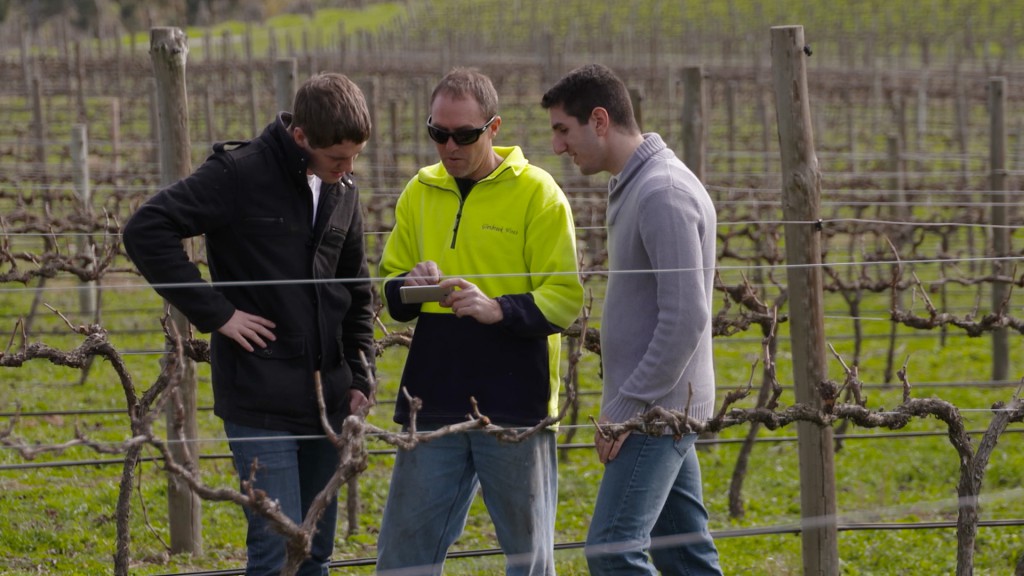
    As we gather more data, the opportunities to apply it become wider. A good example of this is Seer Insights, a South Australian company started by pair of university students that calculates the likely grape yields for vineyards.

    Seer Insights’ product Grapebrain is made up of two components, a mobile app that the farmer uses to count the grape clusters on the vines and then a cloud service that analyses the data and produces web based reports for the farmers.

    The current methods are notoriously unreliable with Seer Insights estimating mistakes cost the Australian viticulture industry $200 million a year as harvests are miscalculated resulting in either rotting fruit or wasted contractor fees.

    Born in an elevator

    Seer’s founders, Harry Lucas and Liam Ellul, started the business after a chance meeting on their university campus. “We started off doing this after being stuck in a lift together,” remembers Liam. “Originally we were looking at the hyper-spectrum imaging for broadacre farming but when we started looking at the problems we ended up talking to wine organisations about this.”

    “The technology predicts how many grapes will be coming off the vineyards at the end of the season to enable people to sort out their finances,” Harry says. “The growth process grapes go through is difficult to model so we use machine learning to do that.”

    For both the founders having an off the shelf product, in this case Microsoft’s machine learning tools, to run the data analysis made it relatively easy to launch the product.

    As a winner of Microsoft’s Tech eChallenge, the startup has won a trip to the United States as well as being profiled by the company as a machine learning case study.

    Over time as these tools become more accessible to small companies we’ll see more businesses accessing machine learning services to enhance their operations.

    As companies face the waves of data flowing into their businesses over the next decade, it will be those who manage it well and gather valuable insights from their information that will be the winners.

    Similar posts:

    • No Related Posts