Tag: management

  • Employment’s changing face

    Employment’s changing face

    Last Thursday recruitment company Talent2 launched its 2013 Market Pulse Survey looking at the employment trends across the Asia Pacific.

    According to the survey, things are looking good with 61% of businesses across the Asia Pacific forecasting growth and 45% expecting to hire more staff.

    However there’s an interesting underlying theme to the good news, employment is changing in large organisations.

    One of the give-aways is the fact that while nearly two-thirds of businesses expect to grow in 2013, less than half intend to increase staff. Businesses are doing more with less.

    Part of this is because of increased automation. Despite the headlines, productivity is increasing in workplaces – particularly offices – as technology automates many business functions in fields like logistics and workforce management.

    Another aspect driving the lack of employment is outsourcing, Talent2 say the proportion of Australians working as full time employees dipped below 75% in 2012 with a four percentage point drop over the year.

    With more businesses contracting work out, one could expect the number of sole proprietors to be increasing. However this seems not to be the case.

    The number of non-employing Australian businesses

    According to the Australian Bureau of Statistics, the number of sole traders is barely moving – between 2006 and 2011 the number of “non-employing Australian businesses” only increased 5% while the population grew over 8%.

    This implies the proportion of contractors in the workforce is actually shrinking.

    Much of this is probably due to the work going offshore, particularly to Business Process Outsourcers (BPOs) in countries like the Philippines, Malaysia and Sri Lanka.

    Saturday’s Australian Financial Review looked at what the BPOs are doing in the Philippines and they aren’t carrying out the call centre and basic clerical work that’s made up most of the outsourcing over the last twenty years. Now it’s management roles that are going offshore.

    The bigger issue confronting Australians, however, is not call centre workers being relocated to the Philippines. It’s low- to mid-level professional jobs, being moved out of companies, accounting firms and law offices.

    Legal outsourcing has been growing for a decade as large law firms have moved many of their para-legal and routine tasks offshore to countries where legal graduates are plentiful but work at lower rates than their western colleagues.

    An interesting aspect in legal offshoring is that much of the work that was done by young lawyers has now gone to overseas contractors, which probably means there’s going to be a shortage of experienced legal practioners in the medium term. This is going to have profound consequences for law firms and their partners.

    It’s also going to mean law and associated degrees are going to be less popular with school leavers as career prospects dwindle.

    The biggest impact though is for managers – we’ve grown used to the assumption that management jobs stay at head office while the lower level jobs go to the lowest cost provider.

    Now is those lowest cost providers are offering good quality management staff along with support desk and call centre staff.

    During the restructurings of the 1980s and 90s, it was blue collar workers who were the most affected by change. Now it’s the turn of the office workers and managers.

    It will be interesting to see how many of the people who thought they were secure in their roles deal with the uncertainty they now have. For some it’s going to be a tough decade.


    Similar posts:

  • Smelling digital garbage

    Smelling digital garbage

    Excel spreadsheets lie at the core of business computing, but what happens when they go wrong?

    James Kwak writing in the Baseline Scenario blog describes how Excel spreadsheets have an important role in the banking industry and their key role in one of the industry’s most embarrassing recent scandals.

    In the early days of the personal computer spreadsheets; it was company accountants and bookkeeping clerks who bought the early PCs into offices to help them do their jobs in the late 1980s .

    From the accounts department, desktop computers spread through the businesses world and the PC industry took off.

    Over time, Microsoft Excel displaced competitors like Excel 1-2-3 and the earliest spreadsheet of all, VisiCalc, and became the industry standard.

    With the widespread adoption of Excel and millions of people creating spreadsheets to help do their jobs came a new set of unique business risks.

    The weakness with Excel isn’t with the program itself, it’s that the formulas in many spreadsheets aren’t properly tested and often incorrect data is put into the wrong fields.

    In his story Kwak cites the JP Morgan spreadsheets that miscalculated the firms Value-At-Risk (VAR) calculations for synthetic derivatives. The result was the London Whale debacle where traders were allowed to take positions – some would call them bets – exposing the bank to huge potential losses.

    It turns out that faulty spreadsheets had a key role as traders cut and paste data between various spreadsheets and the formulas that made the calculations had basic errors.

    That a bank would have such slapdash procedures is surprising but not shocking, almost every organisation has a similar setup and it gets worse as a project becomes more complex and bigger numbers become involved. The construction industry is particularly bad for this.

    Often, a spreadsheet will show out a bunch of numbers which simply aren’t correct. Someone made a mistake entering some data or one of the formulas has an error.

    The business risk lies in not picking up those errors, JP Morgan fell for this and probably every business has, thankfully to less disastrous results.

    My own personal experience was with a major construction project in Thailand. One sheet of calculations had been missed and the entire budget for lights – not a trivial amount in a 35 storey five star hotel – hadn’t been included in the contractor’s price.

    This confirmed in my mind that most competitive construction tenders are won by the contractor who made the most costly errors in calculating their price. Little has convinced me otherwise since.

    In the computer industry there’s a saying that “garbage in equals garbage out” which is true. However if the computer program itself is flawed, then good data becomes garbage.

    Excel’s real flaw is that it can make impressive looking garbage that appears credible if it isn’t checked and treated with suspicion. The responsibility lies with us to notice the smell when the computer spits out bad figures.

    Spreadsheet image courtesy of mmagallan through sxc.hu

    Similar posts:

  • Necessity, innovation and the birth of the web

    Necessity, innovation and the birth of the web

    The man who invented the world wide web, Tim Berners-Lee spoke at the launch of the CSIRO’s Digital Productivity and Services Flagship in Sydney yesterday.

    In telling about how the idea the idea of web, or Hyper Text Markup Language (HTML), came about Berners-Lee touched on some fundamental truths about innovation in big organisations.

    In the 1990s the European Laboratory for Particle Physics (CERN) in Geneva had thousands of researchers bringing their own computers, it was an early version of what we now call the Bring Your Own Device (BYOD) policy.

    “When they used their computers, they used their favourite computer running their favourite operating system. If they didn’t like what was available they wrote the software themselves,” said Tim. “Of course, none of these talked to each other.”

    As a result sharing data was a nightmare as each scientist created documents using their own programs which often didn’t work on their colleagues’ computers.

    Tim had the idea of standard language that would allow researchers to share information easily, although getting projects like this running in large bureaucratic organisations like CERN isn’t easy.

    For getting HTML and the web running in CERN Tim gives credit to his boss, Mike Sendall, who supported him and his idea.

    “If you’re wondering why innovation happens, one of the things is great bosses who let you do things on the side, Mike found an excuse to get a NeXT computer,” remembers Tim. “‘Why don’t you test it with your hypertext program?’ Mike said with a wink.”

    There’s much talk about innovation in organisations, but without management support those ideas go nowhere, the story of the web is possibly the best example of what can happen when executives don’t just expect their workers to clock in, shut up and watch the clock.

    One key point Tim made in his presentation was that it was twenty years after the Internet was invented before the web came along and another five years until the online world really took off.

    We’re at that stage of development with the web now and with the development of the new HTML5 standard we’re going to see far more communication between machines.

    Berners-Lee says “instead of having 1011 web pages communicating, we start to have 1011 computers talking to each other.”

    These connections mean online innovation is only just beginning, we haven’t seen anything yet.

    If you want your staff to stay quiet and watch the clock, that’s fine. But your clock might be figuring out how to do your job better than you can.

    Tim Berners-Lee image courtesy of Tanaka on Flickr

    Similar posts:

  • Throwing your problems over the fence

    Throwing your problems over the fence

    I first heard the term “throwing the problem over the fence” from a telco project manager a few years ago, it describes how modern organisations shift risk to others.

    Throwing the problem over the fence usually involves contracting out a task, the philosophy is once the contract is signed delivery is no longer management’s problem, it’s now the responsibility of the contractor. Once the job is over the fence it’s out of sight and out of mind.

    Governments, financial institutions and most corporations have become very good at throwing their problems over the fence.

    Contracting away your worries

    A core tenet of 1980s management thinking is contracting out; freeing executives from the tedious task of actually doing their jobs lets them focus on the important things in life, like securing performance bonuses.

    Of course you can’t contract out risk – risk is like toothpaste, squeeze it in one place and it oozes out somewhere else.

    Unlike toothpaste, risks have a habit of growing if they are ignored. Which becomes a problem for whoever is unwittingly on the other side of the fence.

    Railways and risk

    In “The Crash That Stopped Britain” author Ian Jack looked at the causes of the October 2000 Hatfield train accident which threw the nation’s railway network into chaos.

    Jack correctly predicted that no-one would be found responsible as the tangle of rail operators, maintenance companies, financiers, labour hire firms and regulators made it almost impossible to determine exactly where responsibility for a fatal failure lay.

    Diffusing responsibility is partly by design although originally the idea was to save costs, the theory being that tendering work previously done in house to the lowest cost provider would save money.

    Instead its caused an escalation in costs as contracting out meant an increase in middlemen as financiers, lawyers, project managers, contract administrators – of which I was once one – and many others are drafted in to manage the outsourced contracts.

    Throughout the Anglosphere – the US, UK, Canada, Australia and New Zealand – the results of embracing this mentality has meant skyrocketing costs and delays in public work projects, a good example being the Southern Sydney Freight Line which was three years late and 250% over budget.

    Naturally no-one is held responsible for the delays, cost over-runs or lousy initial planning and estimating on that project, which is a happy result for everyone except the taxpayer who foots the bill.

    The Global Financial Crisis

    While the cost of building railways, schools and motorways is a chronic problem, a far more bigger issue is the role of “throwing problems over the fence” in the financial industry.

    Securitisation was seen as a magic bullet for the banking industry in the 1990s, the Basel Accords allowed banks to bundle up their entire home loan portfolios and throw them over the fence to fund managers and their unwitting investors.

    When the inevitable happened with the Global Financial Crisis in 2008, it was difficult to attribute exactly who held the mortgages, let alone who was responsible for the losses among the mass of brokers, ratings agencies, fund managers and bankers who’d profited so well from the boom.

    The only thing we could be sure of was that it was the taxpayer – you, your children and grand-children – who ended up holding the problem when the GFC’s bills were hurled over the last fence.

    On the other side of the fence

    Risk isn’t something that can be thrown over a fence, eventually it comes back in a bigger and nastier way. The question is who ends up dealing with it.

    The genius of political and business leaders in the last 30 years has been in how they’ve thrown their responsibilities over the fence while retaining the perks and privilege of holding responsible positions.

    Generally it’s taxpayers and shareholders sitting on the other side of the fence who have to deal with the costs and they aren’t getting cheaper.

    Similar posts:

  • Towards the post car society

    Towards the post car society

    We don’t often think about it, but the design or our cities reflect the technologies of the day. Right now the way we live is built around the motor vehicle, but are we moving into a new era?

    After a visit to Ford Australia’s Centre of Excellence For Design and Engineering, Neerav Bhatt has some thoughts on the role of the motor car in an era where people don’t have to travel to their workplaces.

    One of Neerav’s points is that car use is falling among younger workers, a trend that’s happening across the western world.

    Much of this is put down to the generations of Millennials and Gen-Ys being more interested in technology purchases rather than cars along with changing work patterns.

    A more fundamental reason could be that we’re reaching the end of the motor car era.

    If there is one technology that represents the Twentieth Century it is the motor car; the automobile has shaped our cities, our lifestyles and our culture.

    However we are now in the Twenty-First Century.

    The three eras of motoring

    Roughly speaking, we could break the Twentieth Century’s love affair with the motor car into three phases; development, consolidation and dependency.

    In the first period, the automotive industry was developing with thousands of manufacturers experimenting with the technology and production methods. At the same time governments were beginning to build road networks and communities were demanding improved links.

    By the beginning of World War II, the motor car was an important part of life but ownership was largely restricted to affluent households and business.

    Following World War II governments made huge investments in road networks and automobiles became cheaper to own.

    This gave a generation a new taste of freedom as you could go anywhere with a tank of gas. It also changed the layout of our suburbs as people could now travel further to work, allowing them to move into bigger houses on the fringe of town.

    As government investment was focused on road building, passenger train and tram networks were starved of capital with many cities abandoning their transit systems altogether.

    Suburbs built in the early to mid Twentieth Century had evolved around trams and the legacy of that can still be seen today. However customers no longer wanted to fight for parking spots on crowded streets designed for horse drawn carriages and trams.

    Responding to this developers started building supermarkets and shopping malls which became popular largely because they offered easier parking. Cheaper goods made available by improved logistics systems – another effect of the motor car – was the other main reason.

    The beginning of dependency

    With the advent of the 1970s oil shock, the role of the motor car turned from being a tool of liberation into one of dependency. The suburbs of the 1960s and 70s had been built around the assumption of universal car ownership and cheap fuel. When fuel ceased being cheap, then households budgets were affected.

    Not coincidentally after the oil shock the reversal of ‘white flight’ – the movement of the middle classes to outer suburbs – started with the gentrification of inner suburbs that had been abandoned by the working class.

    Through the 1970s and 80s the cost of owning a motor car became more expensive as governments stopped externalising the costs of maintaining roads and saw car use and petrol taxes as a revenue source.

    At the same time the obvious effects of saturating society motor cars became obvious as roads increasingly became choked and planners began to realise that building more roads only attracted more traffic.

    Times of decline

    By the turn of the Twenty-first Century technology had also started to move away from centralised offices and factories. Today technologies like the internet and increasingly 3D printing mean that workers don’t have to commute vast distances. Automation also means many levels of management are no longer necessary.

    Changing work patterns is also affecting incomes, with car ownership being expensive many employees – particularly young workers – don’t want to buy automobiles.

    This all means that the era of the motor car is coming to an end, it’s not going to vanish quickly but the decline has started.

    For business, this means the post World War II assumptions that saw the rise of the supermarket, shopping mall and big box discount store are no longer valid.

    Some managers, most notably those of doomed department stores, won’t learn these lessons and will pass into history like the stagecoach companies.

    Just as the end of the horse and carriage era saw the demise of buggy whip makers and blacksmiths, the rise of the motor car saw an unprecedented rise in wealth, employment and productivity. Not only were the lost jobs created elsewhere, but many more were created.

    While the motor car isn’t going to disappear overnight, the decline has started and our society is adapting. For business and government leaders, the task is to understand those changes and adapt.

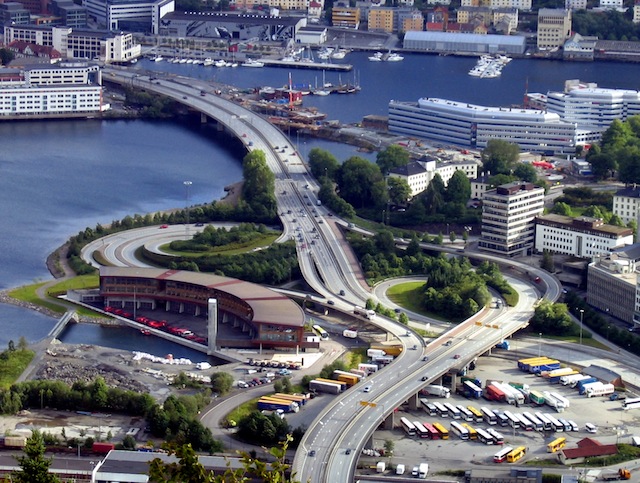
    Image courtesy of a Norwegian motorway by Ayla87 through SXC

    Similar posts: