
Tag: management

  • Disruption and leadership

    Disruption and leadership

    As new communications tools appear, the challenge for managers is to deal with the disruptions these technologies bring to their businesses.

    Launching Deloitte Digital’s release of Taking Leadership in the Digital Economy last week the Executive Director of Telstra Digital Consumers, Gerd Schenkel, described how business is changing as consumers are being empowered by smartphones.

    A good example of this is the taxi industry where applications like GoCatch, InGoGo and Uber give passengers the opportunity to fight back against poor service from protected operators.

    Sydney is an attractive market for taxi industry disruptors as the current protected market fails both passengers and drivers. Travis Kalanick, the CEO of Uber, said at the Sydney launch of his service earlier last week that the city is one of the more ‘problematic” markets they’ve entered alongside San Francisco and Paris.

    That letting down drivers along with passengers is an also an important point – drivers get 80% of Uber’s charges while InGoGo and GoCatch free operators from poor booking systems that frustrate everybody involved in the industry while making the system as unaccountable as possible.

    Similar changes are happening in other industries as technology changes the way suppliers, customers and staff work.

    A good example of changing work practices is the adoption of Bring Your Own Device (BYOD) policies in the workplace. A few years ago in most businesses it was unthought of that staff could be allowed to bring their own computers to work. Today it’s common and soon the companies that don’t have a BYOD policy will be exception.

    BYOD has happened because of the arrival of cheap consumer devices like smartphones and tablets along with IT departments rolling out web based services.

    We’ve seen this before – probably the greatest influences on the shape of modern society had been electricity and the motor car. These, and many other technological changes have shaped today’s workplace.

    Many businesses though suffer for those changes as we’re seeing with the drying up of the newspapers’ “rivers of gold”.

    For Telstra this is seen in the demise of their phone directory business; Sensis was a true river of gold in the days of printed phone directories, but a number of management mis-steps over the last 15 years meant they totally missed the transition to digital.

    The tragedy for Telstra that Sensis’ strength in the local advertising market should have been a positive given Google’s failure to execute on their local search strategy.

    On reflecting about the struggle to deal with transitions to new technology, just how many business are like Sensis and Fairfax in having leaders that aren’t equipped to deal with these changes.

    The leaders of the 1980s whose business models were based on the assumption of economic growth underpinned by easy credit, cheap energy and demographic growth and now finding those factors are moving against them at the same time technology change is disrupting their industries.

    For the upcoming generation of leaders, both in business and government, having the ability to adapt to the changed power relationships between customers, suppliers and workers is going to be essential. For those steeped in last century’s certainties, it’s going to be a tough time.
    Similar posts:

  • Comparing Management costs

    Comparing Management costs

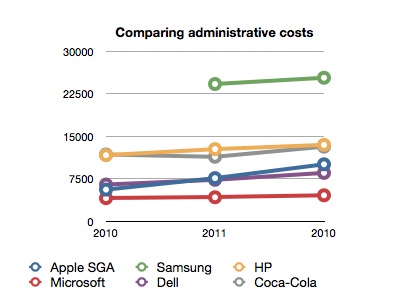
    Telecoms analyst site Asymco has a look at how much Samsung spends on marketing compared to other tech companies, particularly Apple, with Coca-Cola added as a sanity check from outside the bubble.

    While the results are stunning with Samsung dwarfing the others, the Asymco story also touches on the total cost of sales and general administration expenses with the observation that, as a proportion of revenue, Sumsung’s are soaring while Apple’s are declining.

    Teasing those figures out a bit more is interesting, when we track the sales and general administration costs of all the business we see that with the exception of Apple they’ve been remarkable flat in straight dollar terms over the last three years.

    Of course this comparison is a little unfair as this is an absolute number, not as a proportion of revenue and as Horace Dediu points out in the Asymco posts Apple’s expenses as a ratio to sales has fallen.

    For companies like HP, Dell and Microsoft where sales have been stagnant or falling it might be that the ratio is rising while spending is flat.

    We’ll tease these figures out over the next few days.

    In the meantime, the fact that Samsung is spending such an awesome amount on marketing should cause us to treat Android sales figures with caution as that spend in undoubtedly inflating their sales figures. More on that in the future as well.

    Similar posts:

  • Whitman’s managerial mountain

    Whitman’s managerial mountain

    This week’s announcement by HP that it will take a nearly nine billion dollar write down on the $10 billion investment it made in British business intelligence software business Autonomy shows how a once proud company can be laid low by a managerial culture.

    HP’s purchase of Autonomy was a classic example of the Silicon Valley greater fool exit where the founders and investors of a business find a foolish buyer – in this case HP – to overpay for the operation.

    In HP’s case it appears they overpaid by $8.8 billion dollars, this follows a $8 billion dollar write down earlier this year on the 2008 acquisition of Electronic Data Systems.

    HP’s management are now claiming Autonomy’s managers defrauded them and the deal has been referred to the US Securities and Exchange Commission and the UK Serious Fraud Office – a point which Autonomy’s former CEO, Mike Lynch, describes as nonsense given 300 HP managers and two major accounting companies carried out due diligence on the firm.

    For HP this is another humiliation on a decade of embarrassment largely caused by poor leadership with poorly chosen CEOs including the hubristic Carly Fiorina, followed by the poster boy of entitled managerialism, Mark Hurd, who in turn was succeeded by the haplessly incompetent Leon Apotheker.

    Apotheker was the wrong person to undo the mistakes of his predecessors however at least with the Autonomy purchase he was trying to clamber onto a technology trend before it left the station, unlike both Hurd and Fiorina who had missed opportunities and entered markets way too late. Although like Apotheker, they overpaid for acquisitions like Palm, EDS and 3Com.

    In Fiorina’s case she had missed the dot com boom and subsequent bust while trashing the company’s brand by competing with Dell in the low end, lousy margin consumer PC industry.

    Hurd’s solution was services, as shown by the $14 billion dollar acquisition of EDS. At the same time he took an axe to HPs costs and continued Fiorina’s gutting of HP’s core competences in R&D and high end industrial technology.

    Like all managerialists, Mark didn’t apply the cost cutting mantra to himself, staying at the best hotels and flying the world on corporate jets like a latter Bourbon. A list of his expenses, along with the salaries for himself and his senior executive buddies, would embarrass a third-world kleptocrat.

    When he left HP under the cloud of a sexual harrassment scandal, the board gave him a settlement of over $40 million dollars rather than the $27 million he was entitled to.

    Most infamously, in the scandal that bought him down, a company ‘hostess’ claimed he stopped by an ATM in Madrid to show her the million he kept on call in his checking account.

    It’s instructive that Roman emperors would have a slave reminding them that they were only mortal. Today’s managerial heroes have ‘hostesses’ to remind them of their entitled position of being hairy chested, virile heroes of 20th Century capitalism; even as their 1980s thinking destroyed shareholder wealth on an industrial scale.

    One could ask why a company like HP would need ‘hostesses’ – particularly at a time when cost cutting was mandating office lights were turned off at 6pm. Just the fact pretty ladies could be on the company payroll to solely to stroke the egos of senior male executives is enough in itself to illustrate the mess HP had become.

    With over $16 billion in write downs this year, sacking the eye-candy for over-privileged middle aged executives is the easier task for current HP CEO Meg Whitman. Whether she can manage to save HP from over a decade of poor management remains to be seen, but the shareholders will be hoping.

    Similar posts:

  • Incurious George and the cult of managerialism

    Incurious George and the cult of managerialism

    “Do you not read papers?” Thundered the BBC’s John Humphrys to the corporation’s Director General during an interview over the broadcaster’s latest scandal.

    That exchange was one of the final straws for the hapless George Entwhistle’s 54 day leadership of the British Broadcasting Corporation where the Jimmy Savile scandal had seen him labelled as ‘Incurious George’ for his failure to ask basic questions of his subordinates.

    Humphry’s emphasised this when discussing the Newsnight program’s advance notice of the allegations they were going make;

    You have a staff, but you have an enormous staff of people who are reporting into you on all sorts of things – they didn’t see this tweet that was going to set the world on fire?

    A lack of staff certainly isn’t the BBC’s problem, the organisation’s chairman Chris Patten quipped after Entwhistle’s resignation that the broadcaster has more managers than the Chinese Communist Party.

    George Entwhistle’s failure to ask his legion of managers and their failure to keep the boss informed is symptomatic of modern management where layers of bureaucracy are used to diffuse responsibility.

    In every corporate scandal over the last two decades we find the people who were paid well to hold ‘responsible’ positions claimed they weren’t told about the nefarious deeds or negligence of their underlings.

    Shareholders suffer massive losses, taxpayers bail out floundering businesses and yet senior executives and board members happily waddle along blissfully content as long as the money keeps rolling in.

    If it were just private enterprise affected by this managerialism then it could be argued that the free market will fix the problem. Unfortunately the public sector is equally affected.

    Managerialism infects the public service as we see with the BBC and it’s political masters  and the results are hospital patients die, wards of the state abused, known swindlers rob old ladies and agencies continually fail to deliver the services they are charged to deliver.

    Again the layers of management diffuse responsibility; the Minister, the Director-General and the ranks of Directors with claims to the executive toilet suite’s keys are insulated from the inconvenience of actually being responsible for doing the job they are paid to do.

    Managerialism and incuriousity are fine bedfellows, in many ways Incurious George Entwhistle is the management icon of our times.

    Similar posts:

  • Beware the business trolls

    Beware the business trolls

    “A psychopath will enter everyone’s lives at one time. When yours arrives, your job is to get them out of your life as quickly as possible.”

    That little gem was handed down to me before the internet gave everyone a global megaphone to entertain themselves with. Today it’s likely a dozen psychopaths a week could enter your life through the web or social media.

    One of the manifestations of this ability for anyone to post to the web regardless of merit or sanity has given rise to the phenomenon of “trolling”, of which there has been much recent media attention.

    At its most basic, trolling is about getting attention. The troll hopes to get a reaction from something outrageous they’ve said or done. In that respect they aren’t too different to radio talk back hosts or SmartCompany editors.

    Business has its own types of trolls: the ‘squeaky wheel’ who hopes that by making a complete pain of themselves you’ll succumb to their unreasonable demands; the perennial tyre kicker who wastes your sales staff’s time; or the late payer who enjoys toying with you and your accounts people but has no intention of ever paying the bill.

    The effects of these business trolls can be just as debilitating as an online troll, with the added bonus that they distract you and your employees from getting work done.

    Sometimes the business owner makes the mistake of taking things personally. This often happens when a bad debtor upsets us so much we make it our life mission to get what we deserve to be paid.

    Hundreds of hours and thousands of dollars later we surrender and accept we were never really going to get that relatively trivial sum.

    The worst of all the business trolls is the recreational debtor. These business psychopaths take delight in ringing up debts they have no intention of paying and then treating your attempts to get the money back as a type of game where they will thoroughly mess with your mind.

    These are the people to get out of your life as quickly as possible. It could be writing off the debt, giving them the refund or just kicking them out of the store.

    So beware of the business trolls, they are as likely to appear in your outstandings file as on your Facebook page.

    Similar posts: