Microsoft Research ran an experiment last week on their artificial intelligence engine where they set a naive robot to learn from it was told on Twitter.
Within two days Tay, as they named the bot, had become an obnoxious racist as Twitter user directed obnoxious comments at the account.
Realising the monster they had created, Microsoft shut the experiment down. The result is less than encouraging for the artificial intelligence community.
Self learning robots may have a lot of power and potential, but if they’re learning from humans they may pick up bad habits. We need to tread carefully with this.
The market was applauding the continued shift to cloud services with income rising five percent in the company’s Intelligent Cloud division, however the decline in the company’s more traditional strengths of software licenses and devices saw earnings fall by eleven percent over the corresponding period last year.
More concerning for the company’s shareholders would be the profits that have fallen 23% which once again proves that cloud services are much less profitable than Microsoft’s traditional software business.
To make matters worse margins on cloud services are falling with returns from the division declining despite sales being up five percent. It’s not hard to see the effects of Amazon Web Services’ ruthless driving down of cloud service prices.
While Microsoft’s results are encouraging in that they show the company is continuing its evolution to a cloud services business, it’s clear the legacy products are still the key cash generators.
As of December 31, Microsoft has a 102 billion dollars in the bank so there’s little risk the company will be going broke soon however the company has to find a way to make better profits from its new business models.
Microsoft today opens the doors to its first flagship store outside of North America in Sydney, Australia. A look inside the project gives some insight into the company’s retail strategy.
Situated in Westfield’s Pitt Street Mall, the store promises “cutting-edge retail and experiential spaces that allow consumers to get hands on with products in an immersive way.” What’s immediately notable is the lack of obvious security with all the devices on display being available for customers to pick up and walk around the shop with.
Most of those devices showcase Microsoft’s various projects and alliances. Everything from XBoxes running Minecraft to Lumia phones are on display along with a range of laptops from partners such as Dell, Toshiba and Lenovo.
Looking across the shop floor
Notable among the devices is are the Surface Book and Surface Pro 4 along with the Microsoft Band 2 taking place of pride in the displays. As with everything else, customers can slip the wriststaps on and walk around with them. Microsoft’s representatives were coy on how they will prevent the less honest walking out the store with them.
Microsoft Band 2 wearables on display
Acting as a store greeter, the Answer Desk is the hub of store where representatives direct traffic whether it’s technical support – which like the Apple Genius Bar is provided free – sales, or directions to events in the upstairs community theatre.
Welcome to the Microsoft Store Answers Desk
Community is a big theme in the store and the company announced $4.8 million in software and technology grants to 11 not-for-profit Australian organisations to coincide with the shop’s opening.
That emphasis on ‘community’ is reflected in this quote from the company’s press release;
“Our new flagship store is here to showcase the very best of Microsoft to the local community and we are delighted Sydney has been chosen as its home,” said Pip Marlow, managing director, Microsoft Australia. “This is a key part of our commitment to delivering a truly interactive retail experience that gives customers, partners and community organisations the opportunity to see, experience and do great things, all made possible by Microsoft technology.”
Pip Marlow sees the upstairs community room as being an opportunity to engage with various school, business and technology groups. The space itself is a little cramped, however it can be isolated from the store’s general hubbub, unlike the Apple Store’s equivalent space.
The community theatre
Overall the store is modernistic but somewhat cramped and should the store be successful congestion is going to be a real problem, particularly around the Answer Desk and the narrow stairwell which, like its Apple competitor two blocks away, features a translucent stairwell.
A narrow translucent staircase
In comparison to both the nearby Apple and Telstra stores, the Microsoft Showcase is surprisingly low tech with its retail experience. While the assistants will have mobile Point Of Sale terminals there’s little in the way of location technologies and contactless payments.
Overall the Microsoft Store comes across as a touch crowded and, dare one say, a little old school retail. As a showcase for the company’s products, it’s probably no more impressive than those of the better retailers.
However if Pip Marlow’s aim of building a community around Microsoft’s products is successful, that could prove to be the long term winning strategy for the company.
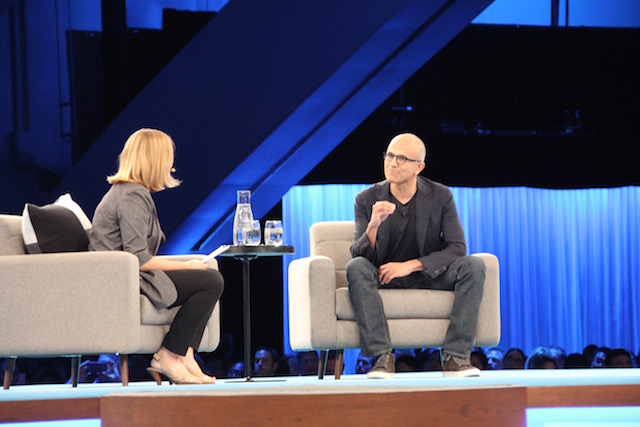
Nadella has asked this question before and his answer at the San Francisco event was that Microsoft exists to empower people through technology, something that Bill Gates and Paul Allen envisaged in the mid 1970s when they founded new startup.
To show how he sees Microsoft’s position in the modern workplace, Nadella gave a not completely flawless demonstration of Microsoft’s integration with Salesforce.
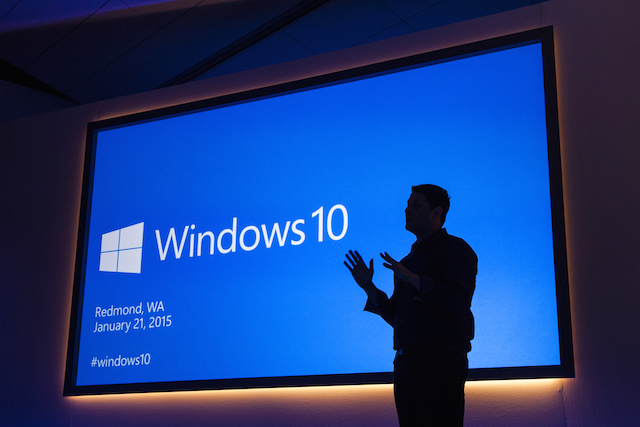
The products Nadella pushed were Windows Phone and Windows 10, which he claims to be part of a major change in businesses with data transforming the way we work.
Interestingly, he framed the Windows 10 IoT strategy around endpoint security. While there are millions of vulnerable devices, it’s not clear shipping them with Microsoft’s firmware will resolve the problem.
“What’s the big technology shift? It’s how we use the data.” Nadella proclaimed in laying out how he sees a data culture transforming the places we work.
A Grand Pivot
Microsoft itself is dealing with a cultural transformation with the company shifting across to cloud based subscription services. “The thing that it’s done for us is it’s not a one-for-one move. It’s not like we’re just moving Exchange on premise to Exchange as a Service, it changes the value proposition for the customers.”
Nadella sees those cloud services as an opportunity to sell more products – and add more value – to customers, particularly small businesses.
The CEO’s role
A business’ success relies upon its culture and Nadella sees the role of the CEO as being about curating that culture, “I always ask what it is that defines us.”
Part of that culture is about becoming customer focused which involves thinking outside of one company’s products or silos, “how is our industry going to succeed? It’s going to succeed if we can add value our customers. Our customers are going to make choices that aren’t homogenous.”
Those varied choices are what’s driving Microsoft’s current push into alliances. “If we are going to realise the power of technology, then these partnerships will amplify that,” says Nadella.
While there were nuggets of truth in Nadella’s presentation, there was also a lot of truisms and somewhat meaningless slogans. While Microsoft’s push onto the cloud and into alliances that were once considered unholy might be genuine, it’s hard not to think there’s still a lot of marketing speak wrapped around it.
Email remains the biggest business app in the world says Peter Bauer, the CEO and co-founder of mail management service Mimecast.
Boston based, South African born Bauer founded his company to “make email safer for business” and after launching in his home country and attracting 14,000 customers and spoke in Sydney about his company and how email is changing in the world of the cloud.
In many respects email is one of those applications – like SMS – that happened by accident. In it’s early days no-one intended or expected those messaging systems to become key communications services.
“I started my IT career in the mid-1990s as an e-mail systems engineer and if you think back to the mid 90s no business cared much about email at all,” says Bauer who believes the experience gave him a unique perspective to how the service evolved into a key business application.
Over the next ten years Bauer saw how email became the personal filing systems for most workers and put systems under pressure as companies had to manage large file stores with the associated compliance and discovery risks.
The security risks too were huge as email became the preferred malware delivery system as virus and spyware writers used infected messages to get onto users’ systems, a problem that has become worse as ransomware and phishing attacks have become common.
“Because business operations and process became dependent upon email, it became necessary to make the service highly available,” says Bauer in emphasising how important it has become to most large and small enterprises.
Even with the shift to the cloud, most companies have remained with email with companies moving to Microsoft’s Office365 – Bauer claims the take up has doubled in the last twelve months. Google’s Apps are gaining traction in the small end of the industry but the enterprises are really wedded to the Microsoft platform.
Bauer sees that shift to cloud based services as changing the risk profile for businesses and this is another opportunity for his business.
Email faces a number of challenges as social media and instant messaging apps become preferred communications tools for younger groups while some businesses are banning email.
For the moment though, it looks like the service is safe as companies remain wedded to email as the preferred form of business communication.